

408
21 Theory: Multifield Oscillation Dynamics
V 0 denotes the volume of any size at zero temperature and the ambient pressure
of reference. The x(P) is a form of the equation of states. Matching the measured x-P
curve with the x(P) function and the Birch-Mürnaghan (BM) equation [51], one can
obtain the nonlinear compressibility coefficients, β, β
and the bulk modulus B 0 and
its first-order derivative B
0 of the specimen. The relation of β B 0 ∼ = 1 holds general
for reference [18].
Figure 21.4b illustrates the P-V profile and its integration. In the P-V profile, only
the gridded part −
V
V 0
pdV ∼ = −
p
p 0
p
dV
dp
dp contributes to the energy density of the
entire body [52]. For the single bond, the atomic volume, V (z, t, p), is replaced by the
bond length, d(z, t, p), and the p is replaced by the force, f, acting along the bond. The
β(p) remains constant at fixed temperature within the regime of elastic deformation
and then the integration
P
0 β( p)dp = β P can be simplified, unless phase transition
occurs [53, 54].
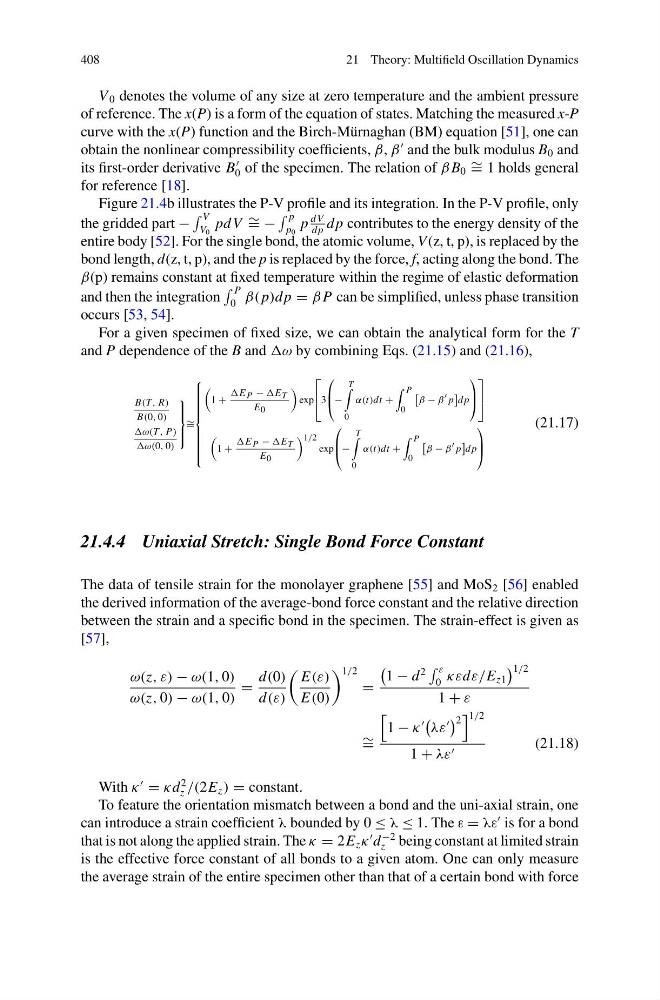
For a given specimen of fixed size, we can obtain the analytical form for the T
and P dependence of the B and ω by combining Eqs. (21.15) and (21.16),
B(T, R)
B(0, 0)
ω(T, P)
ω(0, 0)
⎫
⎪ ⎪ ⎬
⎪ ⎪ ⎭
∼ =
⎧
⎪ ⎪ ⎪ ⎪ ⎪ ⎪ ⎪ ⎪ ⎨
⎪ ⎪ ⎪ ⎪ ⎪ ⎪ ⎪ ⎪ ⎩
1 +
E P − E T
E 0
exp
⎡
⎢
⎣3
⎛
⎜
⎝−
T
0
α(t)dt +
P
0
β − β p
dp
⎞
⎟
⎠
⎤
⎥
⎦
1 +
E P − E T
E 0
1/2
exp
⎛
⎜
⎝−
T
0
α(t)dt +
P
0
β − β p
dp
⎞
⎟
⎠
(21.17)
21.4.4 Uniaxial Stretch: Single Bond Force Constant
The data of tensile strain for the monolayer graphene [55] and MoS 2 [56] enabled
the derived information of the average-bond force constant and the relative direction
between the strain and a specific bond in the specimen. The strain-effect is given as
[57],
ω(z, ε) − ω(1, 0)
ω(z, 0) − ω(1, 0)
=
d(0)
d(ε)
E(ε)
E(0)
1/2
=
1 − d
2
ε
0 κεdε/E z1
1/2
1 + ε
∼ =
1 − κ
λε
2
1/2
1 + λε
(21.18)
With κ
= κd
2
z /(2E z ) = constant.
To feature the orientation mismatch between a bond and the uni-axial strain, one
can introduce a strain coefficient λ bounded by 0 ≤ λ ≤ 1. The ε = λε
is for a bond
that is not along the applied strain. The κ = 2E z κ
d
−2
z being constant at limited strain
is the effective force constant of all bonds to a given atom. One can only measure
the average strain of the entire specimen other than that of a certain bond with force
21 Theory: Multifield Oscillation Dynamics
V 0 denotes the volume of any size at zero temperature and the ambient pressure
of reference. The x(P) is a form of the equation of states. Matching the measured x-P
curve with the x(P) function and the Birch-Mürnaghan (BM) equation [51], one can
obtain the nonlinear compressibility coefficients, β, β
and the bulk modulus B 0 and
its first-order derivative B
0 of the specimen. The relation of β B 0 ∼ = 1 holds general
for reference [18].
Figure 21.4b illustrates the P-V profile and its integration. In the P-V profile, only
the gridded part −
V
V 0
pdV ∼ = −
p
p 0
p
dV
dp
dp contributes to the energy density of the
entire body [52]. For the single bond, the atomic volume, V (z, t, p), is replaced by the
bond length, d(z, t, p), and the p is replaced by the force, f, acting along the bond. The
β(p) remains constant at fixed temperature within the regime of elastic deformation
and then the integration
P
0 β( p)dp = β P can be simplified, unless phase transition
occurs [53, 54].
For a given specimen of fixed size, we can obtain the analytical form for the T
and P dependence of the B and ω by combining Eqs. (21.15) and (21.16),
B(T, R)
B(0, 0)
ω(T, P)
ω(0, 0)
⎫
⎪ ⎪ ⎬
⎪ ⎪ ⎭
∼ =
⎧
⎪ ⎪ ⎪ ⎪ ⎪ ⎪ ⎪ ⎪ ⎨
⎪ ⎪ ⎪ ⎪ ⎪ ⎪ ⎪ ⎪ ⎩
1 +
E P − E T
E 0
exp
⎡
⎢
⎣3
⎛
⎜
⎝−
T
0
α(t)dt +
P
0
β − β p
dp
⎞
⎟
⎠
⎤
⎥
⎦
1 +
E P − E T
E 0
1/2
exp
⎛
⎜
⎝−
T
0
α(t)dt +
P
0
β − β p
dp
⎞
⎟
⎠
(21.17)
21.4.4 Uniaxial Stretch: Single Bond Force Constant
The data of tensile strain for the monolayer graphene [55] and MoS 2 [56] enabled
the derived information of the average-bond force constant and the relative direction
between the strain and a specific bond in the specimen. The strain-effect is given as
[57],
ω(z, ε) − ω(1, 0)
ω(z, 0) − ω(1, 0)
=
d(0)
d(ε)
E(ε)
E(0)
1/2
=
1 − d
2
ε
0 κεdε/E z1
1/2
1 + ε
∼ =
1 − κ
λε
2
1/2
1 + λε
(21.18)
With κ
= κd
2
z /(2E z ) = constant.
To feature the orientation mismatch between a bond and the uni-axial strain, one
can introduce a strain coefficient λ bounded by 0 ≤ λ ≤ 1. The ε = λε
is for a bond
that is not along the applied strain. The κ = 2E z κ
d
−2
z being constant at limited strain
is the effective force constant of all bonds to a given atom. One can only measure
the average strain of the entire specimen other than that of a certain bond with force