

406
21 Theory: Multifield Oscillation Dynamics
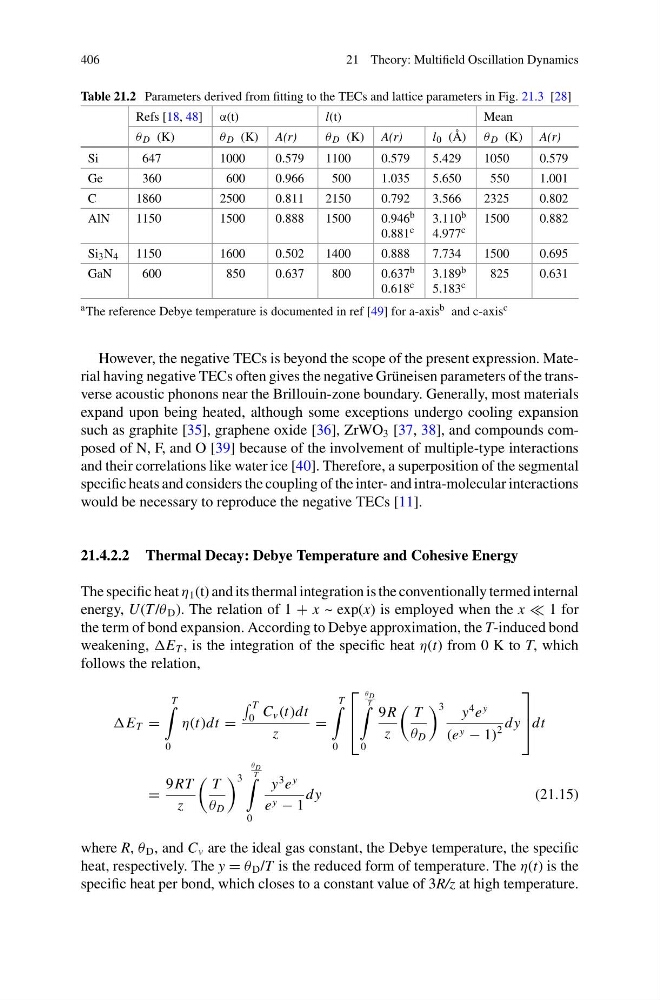
Table 21.2 Parameters derived from fitting to the TECs and lattice parameters in Fig. 21.3 [28]
Refs [18, 48] α(t)
l(t)
Mean
θ D (K)
θ D (K) A(r)
θ D (K) A(r)
l 0 (Å) θ D (K) A(r)
Si
647
1000
0.579
1100
0.579
5.429
1050
0.579
Ge
360
600
0.966
500
1.035
5.650
550
1.001
C
1860
2500
0.811
2150
0.792
3.566
2325
0.802
AlN
1150
1500
0.888
1500
0.946 b
0.881 c
3.110 b
4.977 c
1500
0.882
Si 3 N 4 1150
1600
0.502
1400
0.888
7.734
1500
0.695
GaN
600
850
0.637
800
0.637 b
0.618 c
3.189 b
5.183 c
825
0.631
a The reference Debye temperature is documented in ref [49] for a-axis b and c-axis c
However, the negative TECs is beyond the scope of the present expression. Material having negative TECs often gives the negative Grüneisen parameters of the transverse acoustic phonons near the Brillouin-zone boundary. Generally, most materials
expand upon being heated, although some exceptions undergo cooling expansion
such as graphite [35], graphene oxide [36], ZrWO 3 [37, 38], and compounds composed of N, F, and O [39] because of the involvement of multiple-type interactions
and their correlations like water ice [40]. Therefore, a superposition of the segmental
specific heats and considers the coupling of the inter- and intra-molecular interactions
would be necessary to reproduce the negative TECs [11].
21.4.2.2 Thermal Decay: Debye Temperature and Cohesive Energy
The specific heat η 1 (t) and its thermal integration is the conventionally termed internal
energy, U(T /θ D ). The relation of 1 + x ~ exp(x) is employed when the x 1 for
the term of bond expansion. According to Debye approximation, the T-induced bond
weakening, E T , is the integration of the specific heat η(t) from 0 K to T, which
follows the relation,
E T =
T
0
η(t)dt =
T
0 C v (t)dt
z
=
T
0
⎡
⎢
⎣
θ D
T
0
9R
z
T
θ D
3 y
4 e
y
(e y − 1)
2
dy
⎤
⎥
⎦dt
=
9RT
z
T
θ D
3
θ D
T
0
y
3 e
y
e y − 1
dy
(21.15)
where R, θ D , and C v are the ideal gas constant, the Debye temperature, the specific
heat, respectively. The y = θ D /T is the reduced form of temperature. The η(t) is the
specific heat per bond, which closes to a constant value of 3R/z at high temperature.
21 Theory: Multifield Oscillation Dynamics
Table 21.2 Parameters derived from fitting to the TECs and lattice parameters in Fig. 21.3 [28]
Refs [18, 48] α(t)
l(t)
Mean
θ D (K)
θ D (K) A(r)
θ D (K) A(r)
l 0 (Å) θ D (K) A(r)
Si
647
1000
0.579
1100
0.579
5.429
1050
0.579
Ge
360
600
0.966
500
1.035
5.650
550
1.001
C
1860
2500
0.811
2150
0.792
3.566
2325
0.802
AlN
1150
1500
0.888
1500
0.946 b
0.881 c
3.110 b
4.977 c
1500
0.882
Si 3 N 4 1150
1600
0.502
1400
0.888
7.734
1500
0.695
GaN
600
850
0.637
800
0.637 b
0.618 c
3.189 b
5.183 c
825
0.631
a The reference Debye temperature is documented in ref [49] for a-axis b and c-axis c
However, the negative TECs is beyond the scope of the present expression. Material having negative TECs often gives the negative Grüneisen parameters of the transverse acoustic phonons near the Brillouin-zone boundary. Generally, most materials
expand upon being heated, although some exceptions undergo cooling expansion
such as graphite [35], graphene oxide [36], ZrWO 3 [37, 38], and compounds composed of N, F, and O [39] because of the involvement of multiple-type interactions
and their correlations like water ice [40]. Therefore, a superposition of the segmental
specific heats and considers the coupling of the inter- and intra-molecular interactions
would be necessary to reproduce the negative TECs [11].
21.4.2.2 Thermal Decay: Debye Temperature and Cohesive Energy
The specific heat η 1 (t) and its thermal integration is the conventionally termed internal
energy, U(T /θ D ). The relation of 1 + x ~ exp(x) is employed when the x 1 for
the term of bond expansion. According to Debye approximation, the T-induced bond
weakening, E T , is the integration of the specific heat η(t) from 0 K to T, which
follows the relation,
E T =
T
0
η(t)dt =
T
0 C v (t)dt
z
=
T
0
⎡
⎢
⎣
θ D
T
0
9R
z
T
θ D
3 y
4 e
y
(e y − 1)
2
dy
⎤
⎥
⎦dt
=
9RT
z
T
θ D
3
θ D
T
0
y
3 e
y
e y − 1
dy
(21.15)
where R, θ D , and C v are the ideal gas constant, the Debye temperature, the specific
heat, respectively. The y = θ D /T is the reduced form of temperature. The η(t) is the
specific heat per bond, which closes to a constant value of 3R/z at high temperature.