

21.3 Single Bond Multifield Oscillations
401
Perturbation acts on the potential and dislocates the (d, E b ) to a new equilibrium
[d b (1 + ε J ), E b (1 + J )]. For instance, a compression or a tension perturbs the
U(R) in a manner given in Fig. 21.2a. Compression stores energy into a bond by
shortening and stiffening it while tension does it contrastingly, along the f (P) path.
Thus, the bond is relaxed in length and energy and all the detectable properties of
the substance vary. Thermal activation not only fluctuates the vibrating oscillator
but also elongates and softens the bond. The perturbation may modify the shape of
the potential function, but it is not that important or out of immediate concern when
consider property at quasi-equilibrate state.
21.3.2 Phonon Frequency Shift
Instead of the extrinsic Raman scattering process, one shall emphasize that the solution to the Hamiltonian of a vibration system is a Fourier series with multiple terms
whose frequencies are folds of that of the primary mode [1]. Therefore, the frequency of the 2D mode should be twofold that of the primary D mode of diamond.
This fact may clarify the origin of the 2D mode that is often referred to the double
resonant Raman scattering process. Any perturbation to the Hamiltonian such as the
interlayer van der Waals force, the dipole-dipole interaction, or the nonlinear effect
only relaxes the folded frequencies to deviate from the ideal values. The fact that the
number-of-layer reduction induced D peak shifting from 1367 to 1344 cm
−1 and the
2D peak shifting from 2720 to 2680 cm
−1 , is right within this scheme.
The opposite trends of the Raman frequency shifts due to the change of the numberof-layer of graphene indicate that the origin of the G mode is different from that of
the D/2D modes; therefore, one cannot expect to unify them simultaneously using
single model. On the other hand, the applied strain, pressure, temperature or the
atomic-CN variation can modulate the length and energy of the involved bonds, or
their representative, and hence the phonon frequencies change with bond relaxation.
Band splitting is expected to happen if the uniaxial strain is applied in a direction
along or perpendicular to a C–C bond in the graphene of C 6v group symmetry. The
extent of band splitting depends on the extent of the mismatch between a certain
bond and the direction of the strain.
One can measure the Raman frequency of a particular x mode as, ω x = ω x0 +
ω x , where ω x0 is the referential dimer vibration frequency, from which the Raman
shift ω x proceeds. The ω x0 may vary with the frequency of the incident photon.
Incorporating the variables of atomic coordination, strain, temperature, and pressure
(x i = z, , T, P) into the expressions for bond length and bond energy, see Eq. (21.2),
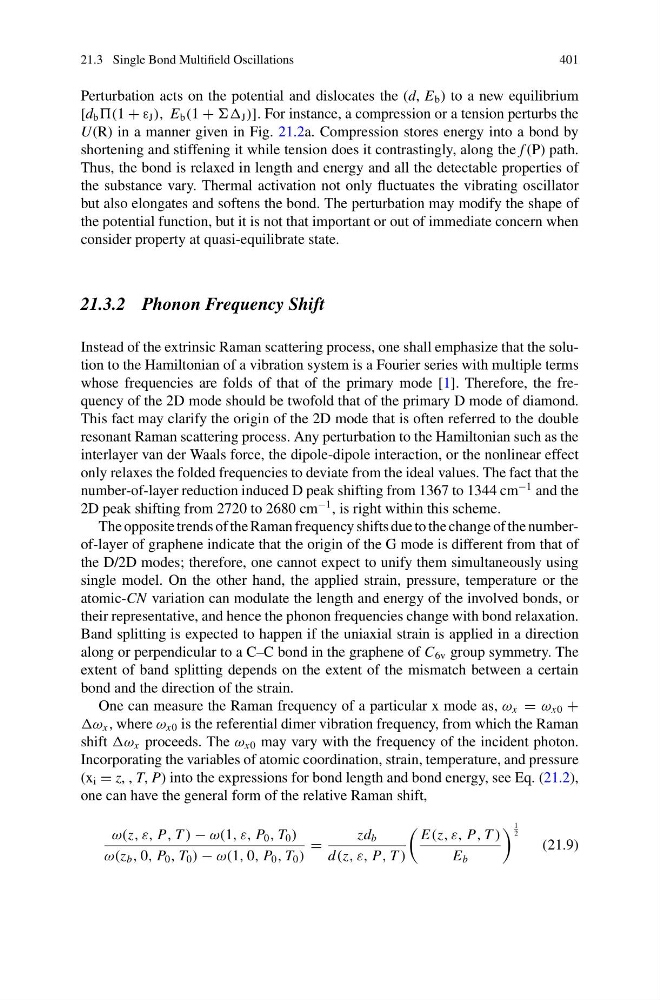
one can have the general form of the relative Raman shift,
ω(z, ε, P, T ) − ω(1, ε, P 0 , T 0 )
ω(z b , 0, P 0 , T 0 ) − ω(1, 0, P 0 , T 0 )
=
zd b
d(z, ε, P, T )
E(z, ε, P, T )
E b
1
2
(21.9)
401
Perturbation acts on the potential and dislocates the (d, E b ) to a new equilibrium
[d b (1 + ε J ), E b (1 + J )]. For instance, a compression or a tension perturbs the
U(R) in a manner given in Fig. 21.2a. Compression stores energy into a bond by
shortening and stiffening it while tension does it contrastingly, along the f (P) path.
Thus, the bond is relaxed in length and energy and all the detectable properties of
the substance vary. Thermal activation not only fluctuates the vibrating oscillator
but also elongates and softens the bond. The perturbation may modify the shape of
the potential function, but it is not that important or out of immediate concern when
consider property at quasi-equilibrate state.
21.3.2 Phonon Frequency Shift
Instead of the extrinsic Raman scattering process, one shall emphasize that the solution to the Hamiltonian of a vibration system is a Fourier series with multiple terms
whose frequencies are folds of that of the primary mode [1]. Therefore, the frequency of the 2D mode should be twofold that of the primary D mode of diamond.
This fact may clarify the origin of the 2D mode that is often referred to the double
resonant Raman scattering process. Any perturbation to the Hamiltonian such as the
interlayer van der Waals force, the dipole-dipole interaction, or the nonlinear effect
only relaxes the folded frequencies to deviate from the ideal values. The fact that the
number-of-layer reduction induced D peak shifting from 1367 to 1344 cm
−1 and the
2D peak shifting from 2720 to 2680 cm
−1 , is right within this scheme.
The opposite trends of the Raman frequency shifts due to the change of the numberof-layer of graphene indicate that the origin of the G mode is different from that of
the D/2D modes; therefore, one cannot expect to unify them simultaneously using
single model. On the other hand, the applied strain, pressure, temperature or the
atomic-CN variation can modulate the length and energy of the involved bonds, or
their representative, and hence the phonon frequencies change with bond relaxation.
Band splitting is expected to happen if the uniaxial strain is applied in a direction
along or perpendicular to a C–C bond in the graphene of C 6v group symmetry. The
extent of band splitting depends on the extent of the mismatch between a certain
bond and the direction of the strain.
One can measure the Raman frequency of a particular x mode as, ω x = ω x0 +
ω x , where ω x0 is the referential dimer vibration frequency, from which the Raman
shift ω x proceeds. The ω x0 may vary with the frequency of the incident photon.
Incorporating the variables of atomic coordination, strain, temperature, and pressure
(x i = z, , T, P) into the expressions for bond length and bond energy, see Eq. (21.2),
one can have the general form of the relative Raman shift,
ω(z, ε, P, T ) − ω(1, ε, P 0 , T 0 )
ω(z b , 0, P 0 , T 0 ) − ω(1, 0, P 0 , T 0 )
=
zd b
d(z, ε, P, T )
E(z, ε, P, T )
E b
1
2
(21.9)