

402
21 Theory: Multifield Oscillation Dynamics
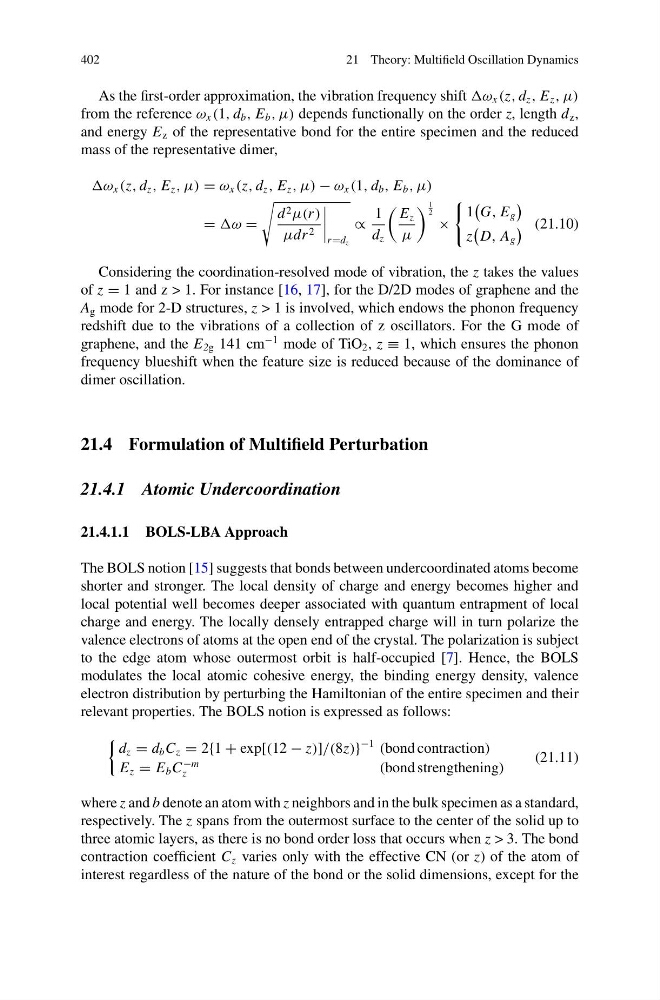
As the first-order approximation, the vibration frequency shift ω x (z, d z , E z , μ)
from the reference ω x (1, d b , E b , μ) depends functionally on the order z, length d z ,
and energy E z of the representative bond for the entire specimen and the reduced
mass of the representative dimer,
ω x (z, d z , E z , μ) = ω x (z, d z , E z , μ) − ω x (1, d b , E b , μ)
= ω =
d 2 μ(r )
μdr 2
r =d z
∝
1
d z
E z
μ
1
2 ×
1
G, E g
z
D, A g
(21.10)
Considering the coordination-resolved mode of vibration, the z takes the values
of z = 1 and z > 1. For instance [16, 17], for the D/2D modes of graphene and the
A g mode for 2-D structures, z > 1 is involved, which endows the phonon frequency
redshift due to the vibrations of a collection of z oscillators. For the G mode of
graphene, and the E 2g 141 cm
−1 mode of TiO 2 , z ≡ 1, which ensures the phonon
frequency blueshift when the feature size is reduced because of the dominance of
dimer oscillation.
21.4 Formulation of Multifield Perturbation
21.4.1 Atomic Undercoordination
21.4.1.1 BOLS-LBA Approach
The BOLS notion [15] suggests that bonds between undercoordinated atoms become
shorter and stronger. The local density of charge and energy becomes higher and
local potential well becomes deeper associated with quantum entrapment of local
charge and energy. The locally densely entrapped charge will in turn polarize the
valence electrons of atoms at the open end of the crystal. The polarization is subject
to the edge atom whose outermost orbit is half-occupied [7]. Hence, the BOLS
modulates the local atomic cohesive energy, the binding energy density, valence
electron distribution by perturbing the Hamiltonian of the entire specimen and their
relevant properties. The BOLS notion is expressed as follows:
d z = d b C z = 2{1 + exp[(12 − z)]/(8z)}
−1
(bond contraction)
E z = E b C
−m
z
(bond strengthening)
(21.11)
where z and b denote an atom with z neighbors and in the bulk specimen as a standard,
respectively. The z spans from the outermost surface to the center of the solid up to
three atomic layers, as there is no bond order loss that occurs when z > 3. The bond
contraction coefficient C z varies only with the effective CN (or z) of the atom of
interest regardless of the nature of the bond or the solid dimensions, except for the
21 Theory: Multifield Oscillation Dynamics
As the first-order approximation, the vibration frequency shift ω x (z, d z , E z , μ)
from the reference ω x (1, d b , E b , μ) depends functionally on the order z, length d z ,
and energy E z of the representative bond for the entire specimen and the reduced
mass of the representative dimer,
ω x (z, d z , E z , μ) = ω x (z, d z , E z , μ) − ω x (1, d b , E b , μ)
= ω =
d 2 μ(r )
μdr 2
r =d z
∝
1
d z
E z
μ
1
2 ×
1
G, E g
z
D, A g
(21.10)
Considering the coordination-resolved mode of vibration, the z takes the values
of z = 1 and z > 1. For instance [16, 17], for the D/2D modes of graphene and the
A g mode for 2-D structures, z > 1 is involved, which endows the phonon frequency
redshift due to the vibrations of a collection of z oscillators. For the G mode of
graphene, and the E 2g 141 cm
−1 mode of TiO 2 , z ≡ 1, which ensures the phonon
frequency blueshift when the feature size is reduced because of the dominance of
dimer oscillation.
21.4 Formulation of Multifield Perturbation
21.4.1 Atomic Undercoordination
21.4.1.1 BOLS-LBA Approach
The BOLS notion [15] suggests that bonds between undercoordinated atoms become
shorter and stronger. The local density of charge and energy becomes higher and
local potential well becomes deeper associated with quantum entrapment of local
charge and energy. The locally densely entrapped charge will in turn polarize the
valence electrons of atoms at the open end of the crystal. The polarization is subject
to the edge atom whose outermost orbit is half-occupied [7]. Hence, the BOLS
modulates the local atomic cohesive energy, the binding energy density, valence
electron distribution by perturbing the Hamiltonian of the entire specimen and their
relevant properties. The BOLS notion is expressed as follows:
d z = d b C z = 2{1 + exp[(12 − z)]/(8z)}
−1
(bond contraction)
E z = E b C
−m
z
(bond strengthening)
(21.11)
where z and b denote an atom with z neighbors and in the bulk specimen as a standard,
respectively. The z spans from the outermost surface to the center of the solid up to
three atomic layers, as there is no bond order loss that occurs when z > 3. The bond
contraction coefficient C z varies only with the effective CN (or z) of the atom of
interest regardless of the nature of the bond or the solid dimensions, except for the