

400
21 Theory: Multifield Oscillation Dynamics
One can extend the Grüneisen parameter to inspect the bonding dynamics under
compression and heating. Eq. (21.8) gives the relative change of bond length and
energy,
⎧
⎨
⎩
d b
=
1
d b
T
T 0
α(t)dt
P
P 0
β( p)dp
E b
=
−
1
E b
T
T 0
η(t)dt +
V
V 0
p(v)dv
Employing the single bond specific-heat η(t) = C v (t)/z b , and d(V P) = Vd P +
PdV , and PdV = PVdP × dV/(VdP) = −βPVdP, and
ω
=
2E
−
d
;
Yields the extended Grüneisen parameters,
γ T =
dω
ω 0 dt
γ P =
dω
ω 0 dp
= −
C v (t//D )
2z b E b
+
α(t)
d b
β( p)
−
p
2E b /V b
+
1
d b
The compressibility ( p < 0), β = −∂v/(V ∂ p), is an inversion of its elastic modulus
in dimension. The Grüneisen parameter integrates information on how the bond
length and bond energy change under P and T perturbation and counts the intrinsic
specific heat, Debye temperature, compressibility, thermal expansion coefficient. The
z b E b = E coh and E b /V b = E den . Likewise, one can amplify the Grüneisen parameter
to cover more stimuli.
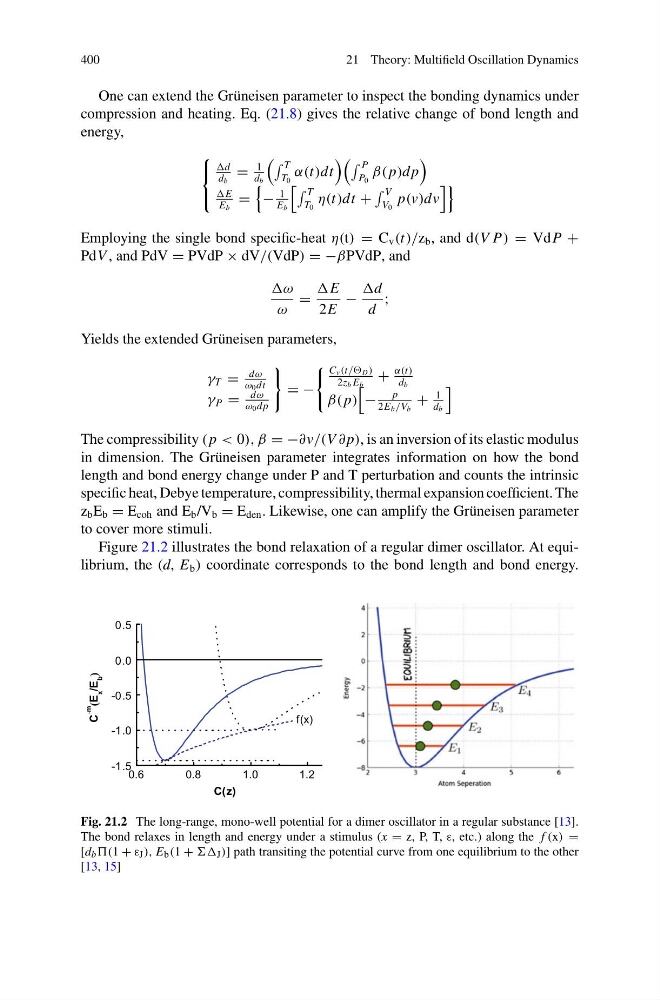
Figure 21.2 illustrates the bond relaxation of a regular dimer oscillator. At equilibrium, the (d, E b ) coordinate corresponds to the bond length and bond energy.
0.6
0.8
1.0
1.2
-1.5
-1.0
-0.5
0.0
0.5
C
-m
(E
x
/E
b
)
f(x)
C(z)
Fig. 21.2 The long-range, mono-well potential for a dimer oscillator in a regular substance [13].
The bond relaxes in length and energy under a stimulus (x = z, P, T, ε, etc.) along the f (x) =
[d b (1 + ε J ), E b (1 + J )] path transiting the potential curve from one equilibrium to the other
[13, 15]
21 Theory: Multifield Oscillation Dynamics
One can extend the Grüneisen parameter to inspect the bonding dynamics under
compression and heating. Eq. (21.8) gives the relative change of bond length and
energy,
⎧
⎨
⎩
d b
=
1
d b
T
T 0
α(t)dt
P
P 0
β( p)dp
E b
=
−
1
E b
T
T 0
η(t)dt +
V
V 0
p(v)dv
Employing the single bond specific-heat η(t) = C v (t)/z b , and d(V P) = Vd P +
PdV , and PdV = PVdP × dV/(VdP) = −βPVdP, and
ω
=
2E
−
d
;
Yields the extended Grüneisen parameters,
γ T =
dω
ω 0 dt
γ P =
dω
ω 0 dp
= −
C v (t//D )
2z b E b
+
α(t)
d b
β( p)
−
p
2E b /V b
+
1
d b
The compressibility ( p < 0), β = −∂v/(V ∂ p), is an inversion of its elastic modulus
in dimension. The Grüneisen parameter integrates information on how the bond
length and bond energy change under P and T perturbation and counts the intrinsic
specific heat, Debye temperature, compressibility, thermal expansion coefficient. The
z b E b = E coh and E b /V b = E den . Likewise, one can amplify the Grüneisen parameter
to cover more stimuli.
Figure 21.2 illustrates the bond relaxation of a regular dimer oscillator. At equilibrium, the (d, E b ) coordinate corresponds to the bond length and bond energy.
0.6
0.8
1.0
1.2
-1.5
-1.0
-0.5
0.0
0.5
C
-m
(E
x
/E
b
)
f(x)
C(z)
Fig. 21.2 The long-range, mono-well potential for a dimer oscillator in a regular substance [13].
The bond relaxes in length and energy under a stimulus (x = z, P, T, ε, etc.) along the f (x) =
[d b (1 + ε J ), E b (1 + J )] path transiting the potential curve from one equilibrium to the other
[13, 15]