

21.2 Taylor Coefficients Versus Observables
399
Considering the proportional relations of the dimensionality would be adequate as
one is focusing on the relative change of a known bulk property as the standard
reference upon perturbation.
From the dimensionality analysis of Table 21.1 (line 5 and 6), one can correlate the
atomic site resolved elastic modulus B i (z i ) and the vibration frequency shift ω(z i )
with [ω(z i )]
2
/[B i d i ] ≡ 1 if the z i and remain unchanged. These relationships apply
to any interatomic potential U(r) as the B i and at the ith atomic site are related only
to the bond order, length, and energy at the equilibrium.
21.3 Single Bond Multifield Oscillations
21.3.1 Bond Length and Energy Relaxation
The interatomic bond is the basic unit of structure and energy-storage. The bond
relaxes upon perturbation, which in turn mediates the electronic energetics and the
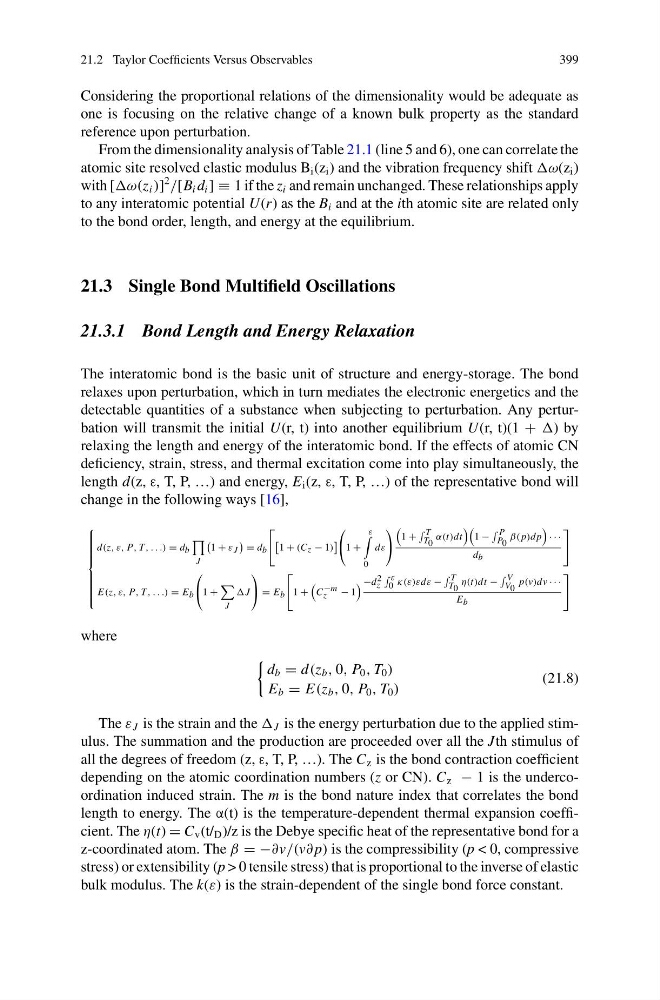
detectable quantities of a substance when subjecting to perturbation. Any perturbation will transmit the initial U(r, t) into another equilibrium U(r, t)(1 + ) by
relaxing the length and energy of the interatomic bond. If the effects of atomic CN
deficiency, strain, stress, and thermal excitation come into play simultaneously, the
length d(z, ε, T, P, …) and energy, E i (z, ε, T, P, …) of the representative bond will
change in the following ways [16],
⎧
⎪ ⎪ ⎪ ⎪ ⎪ ⎪ ⎪ ⎨
⎪ ⎪ ⎪ ⎪ ⎪ ⎪ ⎪ ⎩
d(z, ε, P, T, . . .) = d b
J
1 + ε J
= d b
⎡
⎣
1 + (Cz − 1)
⎛
⎝ 1 +
ε
0
dε
⎞
⎠
1 +
T
T 0
α(t)dt
1 −
P
P 0
β( p)dp
· · ·
d b
⎤
⎦
E(z, ε, P, T, . . .) = E b
⎛
⎝ 1 +
J
J
⎞
⎠ = E b
⎡
⎣ 1 +
C −m
z
− 1
−d 2
z
ε
0 κ(ε)εdε −
T
T 0
η(t)dt −
V
V 0
p(v)dv · · ·
E b
⎤
⎦
where
d b = d(z b , 0, P 0 , T 0 )
E b = E(z b , 0, P 0 , T 0 )
(21.8)
The ε J is the strain and the J is the energy perturbation due to the applied stimulus. The summation and the production are proceeded over all the Jth stimulus of
all the degrees of freedom (z, ε, T, P, …). The C z is the bond contraction coefficient
depending on the atomic coordination numbers (z or CN). C z − 1 is the undercoordination induced strain. The m is the bond nature index that correlates the bond
length to energy. The α(t) is the temperature-dependent thermal expansion coefficient. The η(t) = C v (t/ D )/z is the Debye specific heat of the representative bond for a
z-coordinated atom. The β = −∂v/(v∂ p) is the compressibility (p < 0, compressive
stress) or extensibility (p > 0 tensile stress) that is proportional to the inverse of elastic
bulk modulus. The k(ε) is the strain-dependent of the single bond force constant.
399
Considering the proportional relations of the dimensionality would be adequate as
one is focusing on the relative change of a known bulk property as the standard
reference upon perturbation.
From the dimensionality analysis of Table 21.1 (line 5 and 6), one can correlate the
atomic site resolved elastic modulus B i (z i ) and the vibration frequency shift ω(z i )
with [ω(z i )]
2
/[B i d i ] ≡ 1 if the z i and remain unchanged. These relationships apply
to any interatomic potential U(r) as the B i and at the ith atomic site are related only
to the bond order, length, and energy at the equilibrium.
21.3 Single Bond Multifield Oscillations
21.3.1 Bond Length and Energy Relaxation
The interatomic bond is the basic unit of structure and energy-storage. The bond
relaxes upon perturbation, which in turn mediates the electronic energetics and the
detectable quantities of a substance when subjecting to perturbation. Any perturbation will transmit the initial U(r, t) into another equilibrium U(r, t)(1 + ) by
relaxing the length and energy of the interatomic bond. If the effects of atomic CN
deficiency, strain, stress, and thermal excitation come into play simultaneously, the
length d(z, ε, T, P, …) and energy, E i (z, ε, T, P, …) of the representative bond will
change in the following ways [16],
⎧
⎪ ⎪ ⎪ ⎪ ⎪ ⎪ ⎪ ⎨
⎪ ⎪ ⎪ ⎪ ⎪ ⎪ ⎪ ⎩
d(z, ε, P, T, . . .) = d b
J
1 + ε J
= d b
⎡
⎣
1 + (Cz − 1)
⎛
⎝ 1 +
ε
0
dε
⎞
⎠
1 +
T
T 0
α(t)dt
1 −
P
P 0
β( p)dp
· · ·
d b
⎤
⎦
E(z, ε, P, T, . . .) = E b
⎛
⎝ 1 +
J
J
⎞
⎠ = E b
⎡
⎣ 1 +
C −m
z
− 1
−d 2
z
ε
0 κ(ε)εdε −
T
T 0
η(t)dt −
V
V 0
p(v)dv · · ·
E b
⎤
⎦
where
d b = d(z b , 0, P 0 , T 0 )
E b = E(z b , 0, P 0 , T 0 )
(21.8)
The ε J is the strain and the J is the energy perturbation due to the applied stimulus. The summation and the production are proceeded over all the Jth stimulus of
all the degrees of freedom (z, ε, T, P, …). The C z is the bond contraction coefficient
depending on the atomic coordination numbers (z or CN). C z − 1 is the undercoordination induced strain. The m is the bond nature index that correlates the bond
length to energy. The α(t) is the temperature-dependent thermal expansion coefficient. The η(t) = C v (t/ D )/z is the Debye specific heat of the representative bond for a
z-coordinated atom. The β = −∂v/(v∂ p) is the compressibility (p < 0, compressive
stress) or extensibility (p > 0 tensile stress) that is proportional to the inverse of elastic
bulk modulus. The k(ε) is the strain-dependent of the single bond force constant.