

398
21 Theory: Multifield Oscillation Dynamics
21.1.4 Collective Oscillation
The collective oscillation means a certain atom vibrates in concert with its zcoordinated neighbors. The vibration amplitude is the dislocation of an atom with its
equilibrium position x = r − d 0 . The high-order terms of the potentials contribute
to the nonlinear behavior. For a dimer oscillator, the atomic coordination number
is z = 1; otherwise, the short-range interaction on each atom results from its z > 1
neighboring coordinating atoms, the atomic vibrating dislocation is the contribution
from all the surrounding coordinates, z. Since the vibration amplitude x d 0 , the
mean contribution from each coordinate to the force constant and to the magnitude
of the atomic dislocation as the first-order approximation [12],
k 1 = k 2 = · · · = k z = μ i (cω)
2
and,
x 1 = x 2 = · · · = x z = (r − d 0 )
2
/z
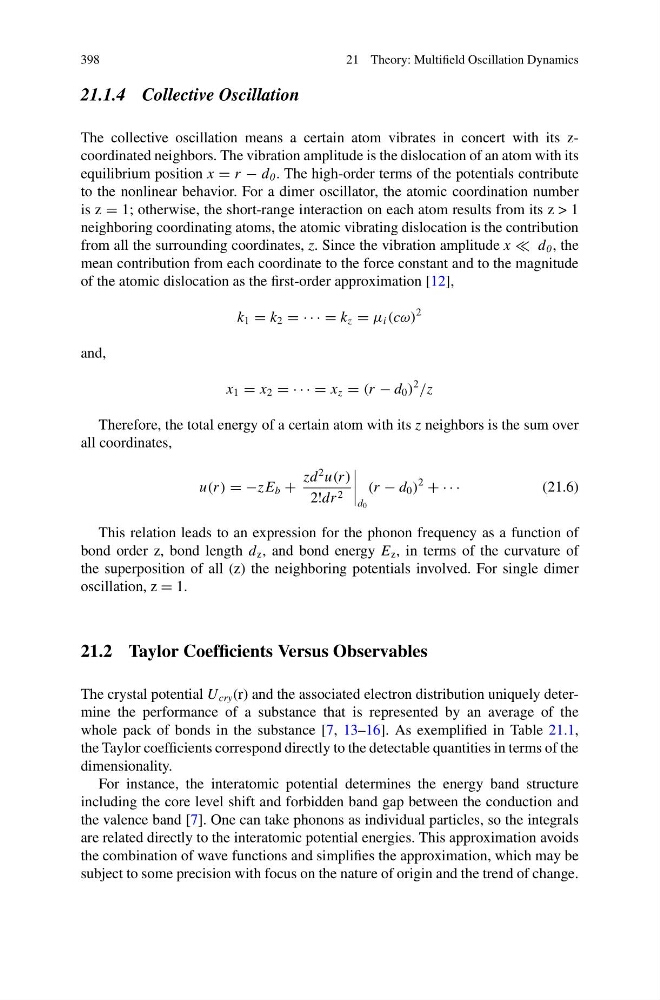
Therefore, the total energy of a certain atom with its z neighbors is the sum over
all coordinates,
u(r ) = −z E b +
zd
2 u(r )
2!dr 2
d 0
(r − d 0 )
2
+ · · ·
(21.6)
This relation leads to an expression for the phonon frequency as a function of
bond order z, bond length d z , and bond energy E z , in terms of the curvature of
the superposition of all (z) the neighboring potentials involved. For single dimer
oscillation, z = 1.
21.2 Taylor Coefficients Versus Observables
The crystal potential U cry (r) and the associated electron distribution uniquely determine the performance of a substance that is represented by an average of the
whole pack of bonds in the substance [7, 13–16]. As exemplified in Table 21.1,
the Taylor coefficients correspond directly to the detectable quantities in terms of the
dimensionality.
For instance, the interatomic potential determines the energy band structure
including the core level shift and forbidden band gap between the conduction and
the valence band [7]. One can take phonons as individual particles, so the integrals
are related directly to the interatomic potential energies. This approximation avoids
the combination of wave functions and simplifies the approximation, which may be
subject to some precision with focus on the nature of origin and the trend of change.
21 Theory: Multifield Oscillation Dynamics
21.1.4 Collective Oscillation
The collective oscillation means a certain atom vibrates in concert with its zcoordinated neighbors. The vibration amplitude is the dislocation of an atom with its
equilibrium position x = r − d 0 . The high-order terms of the potentials contribute
to the nonlinear behavior. For a dimer oscillator, the atomic coordination number
is z = 1; otherwise, the short-range interaction on each atom results from its z > 1
neighboring coordinating atoms, the atomic vibrating dislocation is the contribution
from all the surrounding coordinates, z. Since the vibration amplitude x d 0 , the
mean contribution from each coordinate to the force constant and to the magnitude
of the atomic dislocation as the first-order approximation [12],
k 1 = k 2 = · · · = k z = μ i (cω)
2
and,
x 1 = x 2 = · · · = x z = (r − d 0 )
2
/z
Therefore, the total energy of a certain atom with its z neighbors is the sum over
all coordinates,
u(r ) = −z E b +
zd
2 u(r )
2!dr 2
d 0
(r − d 0 )
2
+ · · ·
(21.6)
This relation leads to an expression for the phonon frequency as a function of
bond order z, bond length d z , and bond energy E z , in terms of the curvature of
the superposition of all (z) the neighboring potentials involved. For single dimer
oscillation, z = 1.
21.2 Taylor Coefficients Versus Observables
The crystal potential U cry (r) and the associated electron distribution uniquely determine the performance of a substance that is represented by an average of the
whole pack of bonds in the substance [7, 13–16]. As exemplified in Table 21.1,
the Taylor coefficients correspond directly to the detectable quantities in terms of the
dimensionality.
For instance, the interatomic potential determines the energy band structure
including the core level shift and forbidden band gap between the conduction and
the valence band [7]. One can take phonons as individual particles, so the integrals
are related directly to the interatomic potential energies. This approximation avoids
the combination of wave functions and simplifies the approximation, which may be
subject to some precision with focus on the nature of origin and the trend of change.