

21.1 Lattice Oscillation Dynamics
397
21.1.3 Lagrangian Mechanics of Coupled Oscillators
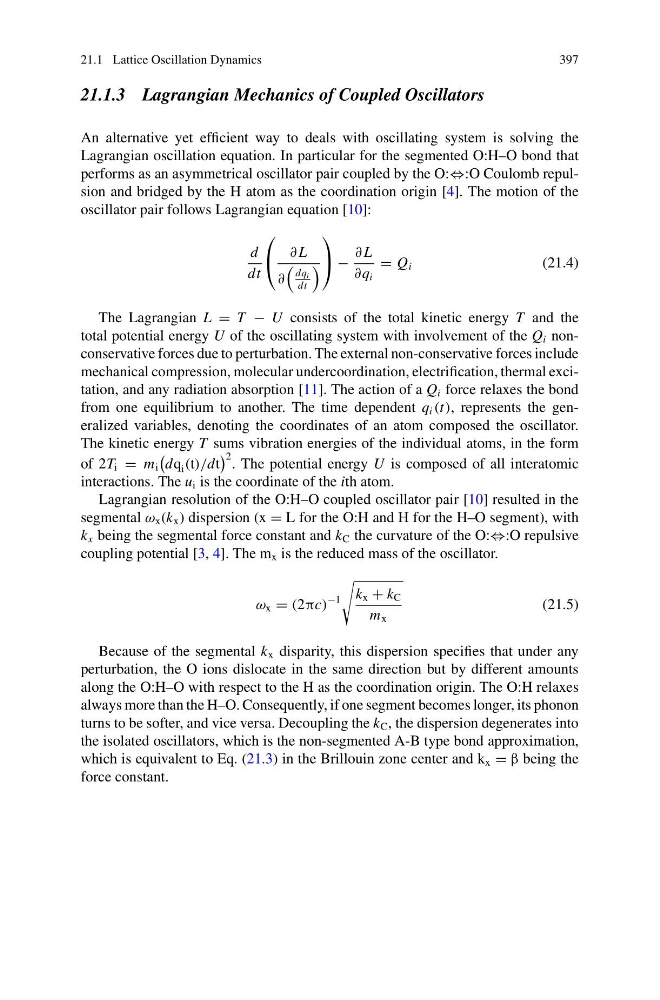
An alternative yet efficient way to deals with oscillating system is solving the
Lagrangian oscillation equation. In particular for the segmented O:H–O bond that
performs as an asymmetrical oscillator pair coupled by the O:⇔:O Coulomb repulsion and bridged by the H atom as the coordination origin [4]. The motion of the
oscillator pair follows Lagrangian equation [10]:
d
dt
⎛
⎝ ∂ L
∂
dq i
dt
⎞
⎠ −
∂ L
∂q i
= Q i
(21.4)
The Lagrangian L = T − U consists of the total kinetic energy T and the
total potential energy U of the oscillating system with involvement of the Q i nonconservative forces due to perturbation. The external non-conservative forces include
mechanical compression, molecular undercoordination, electrification, thermal excitation, and any radiation absorption [11]. The action of a Q i force relaxes the bond
from one equilibrium to another. The time dependent q i (t), represents the generalized variables, denoting the coordinates of an atom composed the oscillator.
The kinetic energy T sums vibration energies of the individual atoms, in the form
of 2T i = m i
dq i (t)/dt
2 . The potential energy U is composed of all interatomic
interactions. The u i is the coordinate of the ith atom.
Lagrangian resolution of the O:H–O coupled oscillator pair [10] resulted in the
segmental ω x (k x ) dispersion (x = L for the O:H and H for the H–O segment), with
k x being the segmental force constant and k C the curvature of the O:⇔:O repulsive
coupling potential [3, 4]. The m x is the reduced mass of the oscillator.
ω x = (2πc)
−1
k x + k C
m x
(21.5)
Because of the segmental k x disparity, this dispersion specifies that under any
perturbation, the O ions dislocate in the same direction but by different amounts
along the O:H–O with respect to the H as the coordination origin. The O:H relaxes
always more than the H–O. Consequently, if one segment becomes longer, its phonon
turns to be softer, and vice versa. Decoupling the k C , the dispersion degenerates into
the isolated oscillators, which is the non-segmented A-B type bond approximation,
which is equivalent to Eq. (21.3) in the Brillouin zone center and k x = β being the
force constant.
397
21.1.3 Lagrangian Mechanics of Coupled Oscillators
An alternative yet efficient way to deals with oscillating system is solving the
Lagrangian oscillation equation. In particular for the segmented O:H–O bond that
performs as an asymmetrical oscillator pair coupled by the O:⇔:O Coulomb repulsion and bridged by the H atom as the coordination origin [4]. The motion of the
oscillator pair follows Lagrangian equation [10]:
d
dt
⎛
⎝ ∂ L
∂
dq i
dt
⎞
⎠ −
∂ L
∂q i
= Q i
(21.4)
The Lagrangian L = T − U consists of the total kinetic energy T and the
total potential energy U of the oscillating system with involvement of the Q i nonconservative forces due to perturbation. The external non-conservative forces include
mechanical compression, molecular undercoordination, electrification, thermal excitation, and any radiation absorption [11]. The action of a Q i force relaxes the bond
from one equilibrium to another. The time dependent q i (t), represents the generalized variables, denoting the coordinates of an atom composed the oscillator.
The kinetic energy T sums vibration energies of the individual atoms, in the form
of 2T i = m i
dq i (t)/dt
2 . The potential energy U is composed of all interatomic
interactions. The u i is the coordinate of the ith atom.
Lagrangian resolution of the O:H–O coupled oscillator pair [10] resulted in the
segmental ω x (k x ) dispersion (x = L for the O:H and H for the H–O segment), with
k x being the segmental force constant and k C the curvature of the O:⇔:O repulsive
coupling potential [3, 4]. The m x is the reduced mass of the oscillator.
ω x = (2πc)
−1
k x + k C
m x
(21.5)
Because of the segmental k x disparity, this dispersion specifies that under any
perturbation, the O ions dislocate in the same direction but by different amounts
along the O:H–O with respect to the H as the coordination origin. The O:H relaxes
always more than the H–O. Consequently, if one segment becomes longer, its phonon
turns to be softer, and vice versa. Decoupling the k C , the dispersion degenerates into
the isolated oscillators, which is the non-segmented A-B type bond approximation,
which is equivalent to Eq. (21.3) in the Brillouin zone center and k x = β being the
force constant.