

21.1 Lattice Oscillation Dynamics
395
correlated through their coefficients. A Taylor series can be considered a special case
of the generalized Fourier series, with an orthonormal base of power functions and
a properly defined inner product [8].
For the oscillating system, the E ν (0) is replaced with the èω 0 that is the reference
dimer vibration energy and ω = ω 0 (1 + ) is the shift under perturbation. The ω
varies with the curvature of the resultant potential in the form of μω
2
= [U (d)(1 +
)]
at the relaxed equilibrium in which the nonlinear contribution is within the limit
of instrumental detection. An examination [9] of the contribution of the anharmonic
correction to the H–O vibration frequency (3200 cm
−1 ) revealed that the addition of
the anharmonic vibrational potential only shifts the H–O phonon by about 100 cm
−1
or less without deriving new vibrating signatures.
One can replace the integration of the coupled wave functions and interatomic
potentials with the interatomic potential energy directly to simplify the discussion. At
equilibrium, the coordinate (d, E) for the potential curve gives directly the bond length
(d) and bond energy (E). Despite the possible rendering of precision of the solution,
this approximation allows one to focus on the nature origin behind and the varying
trends of phononic measurements. Consideration of the relative frequency shift due
to perturbation further improves the precision due to simplification. Furthermore,
the spectroscopic measurements fingerprint the perturbation to the collection of all
possible potentials without needing to discriminate them one from another.
21.1.2 Atomic Chains
Raman scattering arises from the radiating dipole moment induced by the electric
field of the incident electromagnetic radiation. The laws of momentum and energy
conservation govern the interaction between the incident photons and the phonons
being activated. When one considers a solid containing numerous Bravais unit cells
and each cell contains n atoms, there will be 3n modes of vibrations. Among the 3n
modes, there will be three acoustic modes, LA, TA 1 and TA 2 and 3(n − 1) optical
modes. The acoustic mode stands for the in-phase motion of the mass center of the
unit cell or the entire solid.
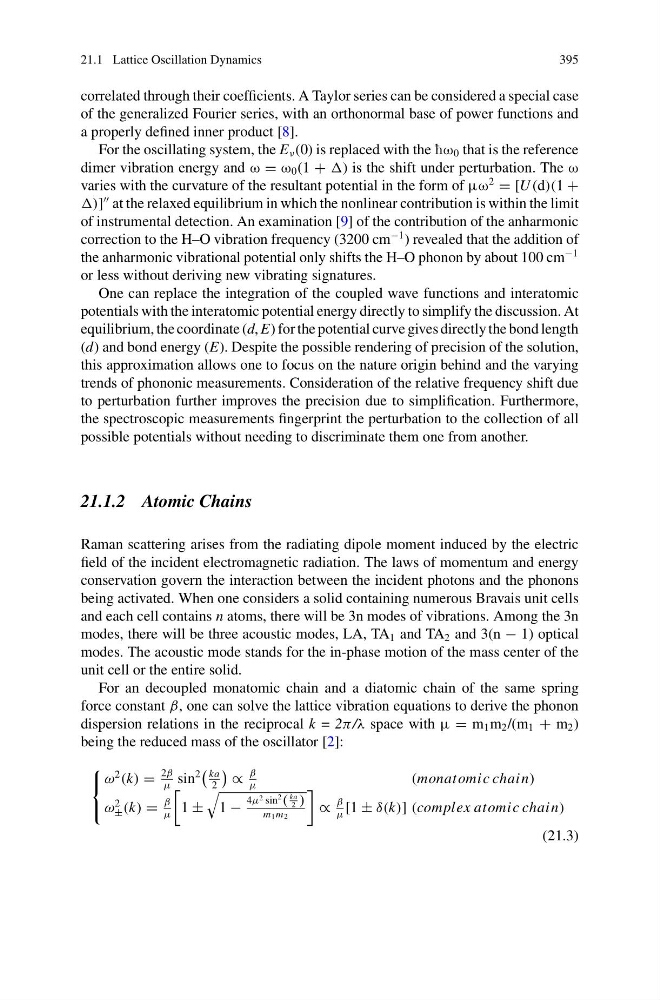
For an decoupled monatomic chain and a diatomic chain of the same spring
force constant β, one can solve the lattice vibration equations to derive the phonon
dispersion relations in the reciprocal k = 2π /λ space with μ = m 1 m 2 /(m 1 + m 2 )
being the reduced mass of the oscillator [2]:
⎧
⎨
⎩
ω
2
(k) =
2β
μ
sin
2
ka
2
∝
β
μ
(monatomic chain)
ω
2
± (k) =
β
μ
1 ±
1 −
4μ 2 sin
2
(
ka
2 )
m 1 m 2
∝
β
μ
[1 ± δ(k)] (complex atomic chain)
(21.3)
395
correlated through their coefficients. A Taylor series can be considered a special case
of the generalized Fourier series, with an orthonormal base of power functions and
a properly defined inner product [8].
For the oscillating system, the E ν (0) is replaced with the èω 0 that is the reference
dimer vibration energy and ω = ω 0 (1 + ) is the shift under perturbation. The ω
varies with the curvature of the resultant potential in the form of μω
2
= [U (d)(1 +
)]
at the relaxed equilibrium in which the nonlinear contribution is within the limit
of instrumental detection. An examination [9] of the contribution of the anharmonic
correction to the H–O vibration frequency (3200 cm
−1 ) revealed that the addition of
the anharmonic vibrational potential only shifts the H–O phonon by about 100 cm
−1
or less without deriving new vibrating signatures.
One can replace the integration of the coupled wave functions and interatomic
potentials with the interatomic potential energy directly to simplify the discussion. At
equilibrium, the coordinate (d, E) for the potential curve gives directly the bond length
(d) and bond energy (E). Despite the possible rendering of precision of the solution,
this approximation allows one to focus on the nature origin behind and the varying
trends of phononic measurements. Consideration of the relative frequency shift due
to perturbation further improves the precision due to simplification. Furthermore,
the spectroscopic measurements fingerprint the perturbation to the collection of all
possible potentials without needing to discriminate them one from another.
21.1.2 Atomic Chains
Raman scattering arises from the radiating dipole moment induced by the electric
field of the incident electromagnetic radiation. The laws of momentum and energy
conservation govern the interaction between the incident photons and the phonons
being activated. When one considers a solid containing numerous Bravais unit cells
and each cell contains n atoms, there will be 3n modes of vibrations. Among the 3n
modes, there will be three acoustic modes, LA, TA 1 and TA 2 and 3(n − 1) optical
modes. The acoustic mode stands for the in-phase motion of the mass center of the
unit cell or the entire solid.
For an decoupled monatomic chain and a diatomic chain of the same spring
force constant β, one can solve the lattice vibration equations to derive the phonon
dispersion relations in the reciprocal k = 2π /λ space with μ = m 1 m 2 /(m 1 + m 2 )
being the reduced mass of the oscillator [2]:
⎧
⎨
⎩
ω
2
(k) =
2β
μ
sin
2
ka
2
∝
β
μ
(monatomic chain)
ω
2
± (k) =
β
μ
1 ±
1 −
4μ 2 sin
2
(
ka
2 )
m 1 m 2
∝
β
μ
[1 ± δ(k)] (complex atomic chain)
(21.3)