

394
21 Theory: Multifield Oscillation Dynamics
dispersion [2], and the Lagrangian oscillation mechanics for the coupled oscillators
[3, 4]. The oscillation can also be categorized as an isolated dimer oscillator, a coupled
oscillator pair, and collective vibrations in which multiple dimers are simultaneously
involved.
Bond relaxation and associated electronic redistribution in the real and energy
spaces mediate the structure and properties of a substance [5]. An electron in a solid
or in a liquid is subject to its intra-atomic potential of v atom (r) and the superposition
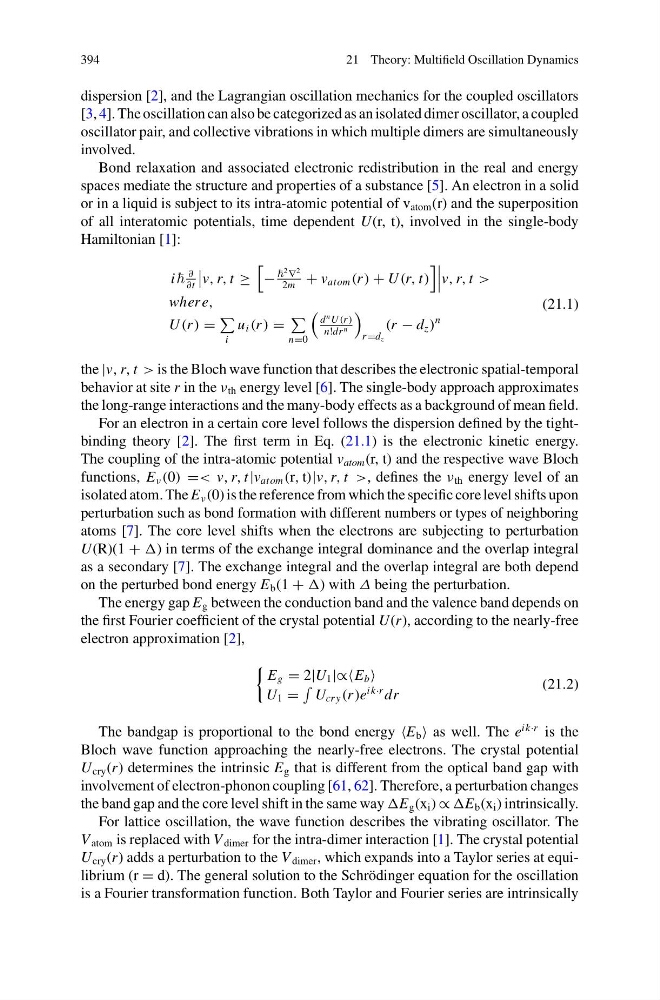
of all interatomic potentials, time dependent U(r, t), involved in the single-body
Hamiltonian [1]:
i
∂
∂t
v, r, t ≥
−
2 ∇
2
2m
+ v atom (r ) + U (r, t)
v, r, t >
where,
U (r ) =
i
u i (r ) =
n=0
d
n U (r )
n!dr n
r =d z
(r − d z )
n
(21.1)
the |v, r, t > is the Bloch wave function that describes the electronic spatial-temporal
behavior at site r in the ν th energy level [6]. The single-body approach approximates
the long-range interactions and the many-body effects as a background of mean field.
For an electron in a certain core level follows the dispersion defined by the tightbinding theory [2]. The first term in Eq. (21.1) is the electronic kinetic energy.
The coupling of the intra-atomic potential v atom (r, t) and the respective wave Bloch
functions, E ν (0) =< v, r, t|v atom (r, t)|v, r, t >, defines the ν th energy level of an
isolated atom. The E ν (0) is the reference from which the specific core level shifts upon
perturbation such as bond formation with different numbers or types of neighboring
atoms [7]. The core level shifts when the electrons are subjecting to perturbation
U(R)(1 + ) in terms of the exchange integral dominance and the overlap integral
as a secondary [7]. The exchange integral and the overlap integral are both depend
on the perturbed bond energy E b (1 + ) with Δ being the perturbation.
The energy gap E g between the conduction band and the valence band depends on
the first Fourier coefficient of the crystal potential U(r), according to the nearly-free
electron approximation [2],
E g = 2|U 1 |∝E b
U 1 =
U cr y (r )e
ik·r dr
(21.2)
The bandgap is proportional to the bond energy E b as well. The e
ik·r is the
Bloch wave function approaching the nearly-free electrons. The crystal potential
U cry (r) determines the intrinsic E g that is different from the optical band gap with
involvement of electron-phonon coupling [61, 62]. Therefore, a perturbation changes
the band gap and the core level shift in the same way E g (x i ) ∝ E b (x i ) intrinsically.
For lattice oscillation, the wave function describes the vibrating oscillator. The
V atom is replaced with V dimer for the intra-dimer interaction [1]. The crystal potential
U cry (r) adds a perturbation to the V dimer , which expands into a Taylor series at equilibrium (r = d). The general solution to the Schrödinger equation for the oscillation
is a Fourier transformation function. Both Taylor and Fourier series are intrinsically
21 Theory: Multifield Oscillation Dynamics
dispersion [2], and the Lagrangian oscillation mechanics for the coupled oscillators
[3, 4]. The oscillation can also be categorized as an isolated dimer oscillator, a coupled
oscillator pair, and collective vibrations in which multiple dimers are simultaneously
involved.
Bond relaxation and associated electronic redistribution in the real and energy
spaces mediate the structure and properties of a substance [5]. An electron in a solid
or in a liquid is subject to its intra-atomic potential of v atom (r) and the superposition
of all interatomic potentials, time dependent U(r, t), involved in the single-body
Hamiltonian [1]:
i
∂
∂t
v, r, t ≥
−
2 ∇
2
2m
+ v atom (r ) + U (r, t)
v, r, t >
where,
U (r ) =
i
u i (r ) =
n=0
d
n U (r )
n!dr n
r =d z
(r − d z )
n
(21.1)
the |v, r, t > is the Bloch wave function that describes the electronic spatial-temporal
behavior at site r in the ν th energy level [6]. The single-body approach approximates
the long-range interactions and the many-body effects as a background of mean field.
For an electron in a certain core level follows the dispersion defined by the tightbinding theory [2]. The first term in Eq. (21.1) is the electronic kinetic energy.
The coupling of the intra-atomic potential v atom (r, t) and the respective wave Bloch
functions, E ν (0) =< v, r, t|v atom (r, t)|v, r, t >, defines the ν th energy level of an
isolated atom. The E ν (0) is the reference from which the specific core level shifts upon
perturbation such as bond formation with different numbers or types of neighboring
atoms [7]. The core level shifts when the electrons are subjecting to perturbation
U(R)(1 + ) in terms of the exchange integral dominance and the overlap integral
as a secondary [7]. The exchange integral and the overlap integral are both depend
on the perturbed bond energy E b (1 + ) with Δ being the perturbation.
The energy gap E g between the conduction band and the valence band depends on
the first Fourier coefficient of the crystal potential U(r), according to the nearly-free
electron approximation [2],
E g = 2|U 1 |∝E b
U 1 =
U cr y (r )e
ik·r dr
(21.2)
The bandgap is proportional to the bond energy E b as well. The e
ik·r is the
Bloch wave function approaching the nearly-free electrons. The crystal potential
U cry (r) determines the intrinsic E g that is different from the optical band gap with
involvement of electron-phonon coupling [61, 62]. Therefore, a perturbation changes
the band gap and the core level shift in the same way E g (x i ) ∝ E b (x i ) intrinsically.
For lattice oscillation, the wave function describes the vibrating oscillator. The
V atom is replaced with V dimer for the intra-dimer interaction [1]. The crystal potential
U cry (r) adds a perturbation to the V dimer , which expands into a Taylor series at equilibrium (r = d). The general solution to the Schrödinger equation for the oscillation
is a Fourier transformation function. Both Taylor and Fourier series are intrinsically