

384
20 Wonders of Multifield Lattice Oscillation
gold nanoparticles is different from that of the bulk counterpart. Atomic undercoordination has an opposite effect to compensate for thermal expansion on the lattice
constant [9].
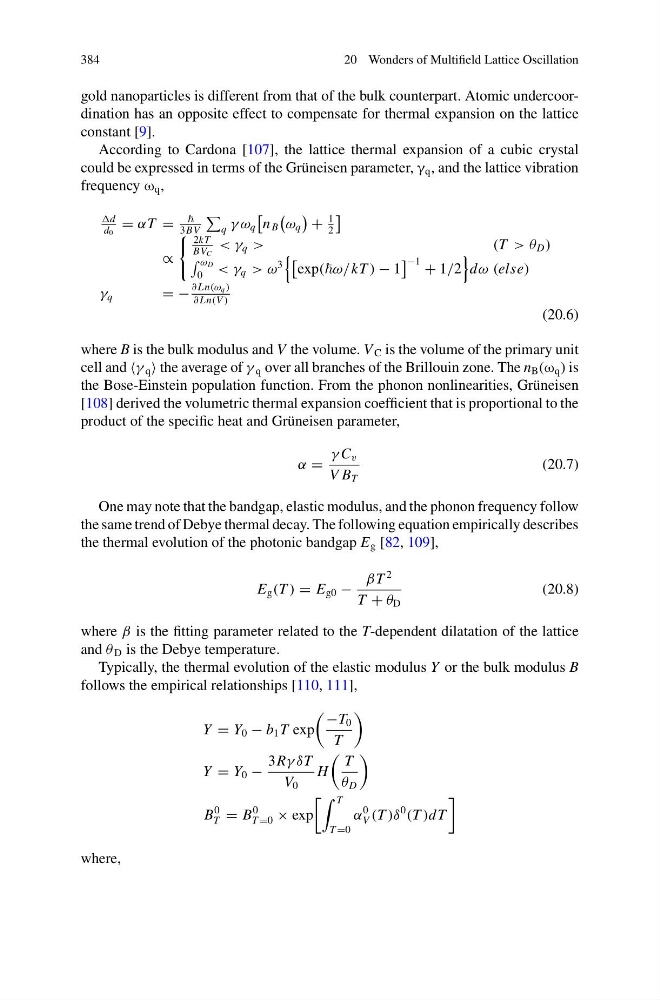
According to Cardona [107], the lattice thermal expansion of a cubic crystal
could be expressed in terms of the Grüneisen parameter, γ q , and the lattice vibration
frequency ω q ,
d
d 0
= αT =
3BV
q γ ω q
n B
ω q
+
1
2
∝
2kT
BV C
< γ q >
(T > θ D )
ω D
0 < γ q > ω
3
exp(ω/kT ) − 1
−1 + 1/2
dω (else)
γ q
= −
∂ Ln(ω q )
∂ Ln(V )
(20.6)
where B is the bulk modulus and V the volume. V C is the volume of the primary unit
cell and γ q the average of γ q over all branches of the Brillouin zone. The n B (ω q ) is
the Bose-Einstein population function. From the phonon nonlinearities, Grüneisen
[108] derived the volumetric thermal expansion coefficient that is proportional to the
product of the specific heat and Grüneisen parameter,
α =
γ C v
V B T
(20.7)
One may note that the bandgap, elastic modulus, and the phonon frequency follow
the same trend of Debye thermal decay. The following equation empirically describes
the thermal evolution of the photonic bandgap E g [82, 109],
E g (T ) = E g0 −
βT
2
T + θ D
(20.8)
where β is the fitting parameter related to the T-dependent dilatation of the lattice
and θ D is the Debye temperature.
Typically, the thermal evolution of the elastic modulus Y or the bulk modulus B
follows the empirical relationships [110, 111],
Y = Y 0 − b 1 T exp
−T 0
T
Y = Y 0 −
3Rγ δT
V 0
H
T
θ D
B
0
T = B
0
T =0 × exp
T
T =0
α
0
V (T )δ
0
(T )dT
where,
20 Wonders of Multifield Lattice Oscillation
gold nanoparticles is different from that of the bulk counterpart. Atomic undercoordination has an opposite effect to compensate for thermal expansion on the lattice
constant [9].
According to Cardona [107], the lattice thermal expansion of a cubic crystal
could be expressed in terms of the Grüneisen parameter, γ q , and the lattice vibration
frequency ω q ,
d
d 0
= αT =
3BV
q γ ω q
n B
ω q
+
1
2
∝
2kT
BV C
< γ q >
(T > θ D )
ω D
0 < γ q > ω
3
exp(ω/kT ) − 1
−1 + 1/2
dω (else)
γ q
= −
∂ Ln(ω q )
∂ Ln(V )
(20.6)
where B is the bulk modulus and V the volume. V C is the volume of the primary unit
cell and γ q the average of γ q over all branches of the Brillouin zone. The n B (ω q ) is
the Bose-Einstein population function. From the phonon nonlinearities, Grüneisen
[108] derived the volumetric thermal expansion coefficient that is proportional to the
product of the specific heat and Grüneisen parameter,
α =
γ C v
V B T
(20.7)
One may note that the bandgap, elastic modulus, and the phonon frequency follow
the same trend of Debye thermal decay. The following equation empirically describes
the thermal evolution of the photonic bandgap E g [82, 109],
E g (T ) = E g0 −
βT
2
T + θ D
(20.8)
where β is the fitting parameter related to the T-dependent dilatation of the lattice
and θ D is the Debye temperature.
Typically, the thermal evolution of the elastic modulus Y or the bulk modulus B
follows the empirical relationships [110, 111],
Y = Y 0 − b 1 T exp
−T 0
T
Y = Y 0 −
3Rγ δT
V 0
H
T
θ D
B
0
T = B
0
T =0 × exp
T
T =0
α
0
V (T )δ
0
(T )dT
where,