

20.4 Overview on Theoretical Progress
385
H
T
θ D
= 3
T
θ D
3 θ D
T
0
x
3 dx
e x − 1
(20.9)
where Y 0 is the Young’s modulus and B
0
T =0 the bulk modulus at T = 0 K. The bulk
modulus B correlates to Y by Y /B = 3 × (1 − 2ν), where ν denoting the Poisson ratio
that is negligibly small, and therefore, Y ≈ 3B. The parameters b 1 and T 0 are arbitrary
constants for data fitting. γ is Grüneisen parameter and δ is Anderson constant. The
superscript 0 denotes quantities gained at one bar pressure. The α
0
V is the coefficient
of volume thermal expansion, and δ
0
(T ) is the Anderson-Grüneisen parameter.
Numerically, the first expression could fit the linear part and the last two
could reproduce measurements over the entire temperature range despite the freely
adjustable parameters such as the γ and δ that are hardly experimentally available. The physical origin for the thermally driven elastic softening is still open for
exploration.
20.4.3 Phonon Optical-Acoustic Thermal Degeneration
The thermal evolution of the Γ and ω are often attributed to the anharmonic
phonon–phonon interactions, lattice-mismatch, volume thermal expansion, and the
optical phonon degeneration into multiple acoustic phonons [68, 112]. On the base
of the extended Klemens–Hart–Aggarwal–Lax premise [113, 114], Balkanski et al.
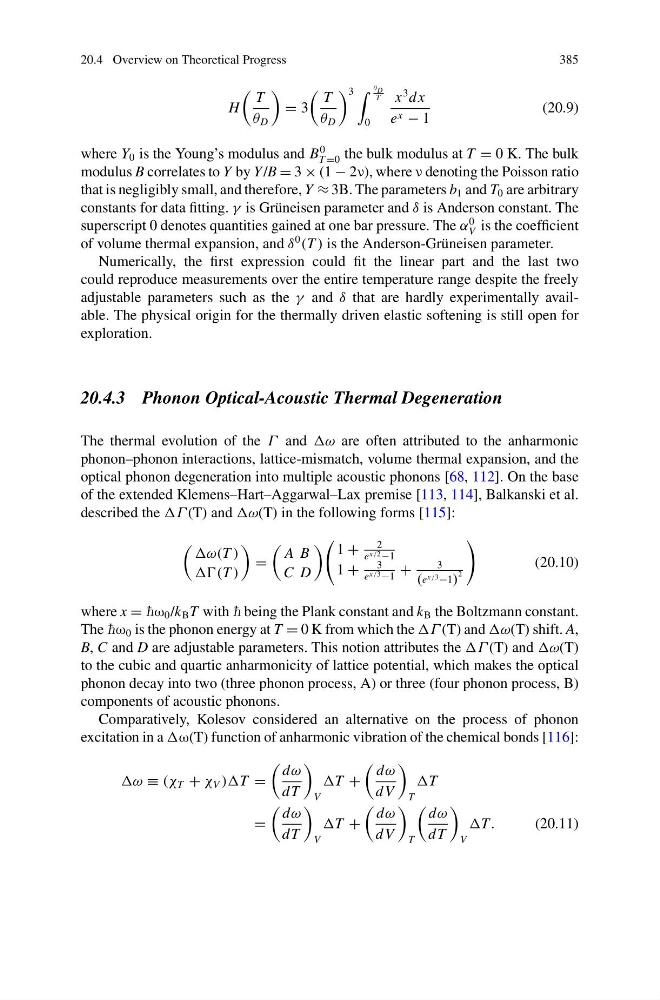
described the Γ (T) and ω(T) in the following forms [115]:
ω(T )
(T )
=
A B
C D
1 +
2
e x/2 −1
1 +
3
e x/3 −1
+
3
(e
x/3 −1)
2
(20.10)
where x = èω 0 /k B T with è being the Plank constant and k B the Boltzmann constant.
The èω 0 is the phonon energy at T = 0 K from which the Γ (T) and ω(T) shift. A,
B, C and D are adjustable parameters. This notion attributes the Γ (T) and ω(T)
to the cubic and quartic anharmonicity of lattice potential, which makes the optical
phonon decay into two (three phonon process, A) or three (four phonon process, B)
components of acoustic phonons.
Comparatively, Kolesov considered an alternative on the process of phonon
excitation in a ω(T) function of anharmonic vibration of the chemical bonds [116]:
ω ≡ (χ T + χ V )T =
dω
dT
V
T +
dω
dV
T
T
=
dω
dT
V
T +
dω
dV
T
dω
dT
V
T.
(20.11)
385
H
T
θ D
= 3
T
θ D
3 θ D
T
0
x
3 dx
e x − 1
(20.9)
where Y 0 is the Young’s modulus and B
0
T =0 the bulk modulus at T = 0 K. The bulk
modulus B correlates to Y by Y /B = 3 × (1 − 2ν), where ν denoting the Poisson ratio
that is negligibly small, and therefore, Y ≈ 3B. The parameters b 1 and T 0 are arbitrary
constants for data fitting. γ is Grüneisen parameter and δ is Anderson constant. The
superscript 0 denotes quantities gained at one bar pressure. The α
0
V is the coefficient
of volume thermal expansion, and δ
0
(T ) is the Anderson-Grüneisen parameter.
Numerically, the first expression could fit the linear part and the last two
could reproduce measurements over the entire temperature range despite the freely
adjustable parameters such as the γ and δ that are hardly experimentally available. The physical origin for the thermally driven elastic softening is still open for
exploration.
20.4.3 Phonon Optical-Acoustic Thermal Degeneration
The thermal evolution of the Γ and ω are often attributed to the anharmonic
phonon–phonon interactions, lattice-mismatch, volume thermal expansion, and the
optical phonon degeneration into multiple acoustic phonons [68, 112]. On the base
of the extended Klemens–Hart–Aggarwal–Lax premise [113, 114], Balkanski et al.
described the Γ (T) and ω(T) in the following forms [115]:
ω(T )
(T )
=
A B
C D
1 +
2
e x/2 −1
1 +
3
e x/3 −1
+
3
(e
x/3 −1)
2
(20.10)
where x = èω 0 /k B T with è being the Plank constant and k B the Boltzmann constant.
The èω 0 is the phonon energy at T = 0 K from which the Γ (T) and ω(T) shift. A,
B, C and D are adjustable parameters. This notion attributes the Γ (T) and ω(T)
to the cubic and quartic anharmonicity of lattice potential, which makes the optical
phonon decay into two (three phonon process, A) or three (four phonon process, B)
components of acoustic phonons.
Comparatively, Kolesov considered an alternative on the process of phonon
excitation in a ω(T) function of anharmonic vibration of the chemical bonds [116]:
ω ≡ (χ T + χ V )T =
dω
dT
V
T +
dω
dV
T
T
=
dω
dT
V
T +
dω
dV
T
dω
dT
V
T.
(20.11)