

356
18 Four-Stage Cu 3 O 2 Bonding Dynamics
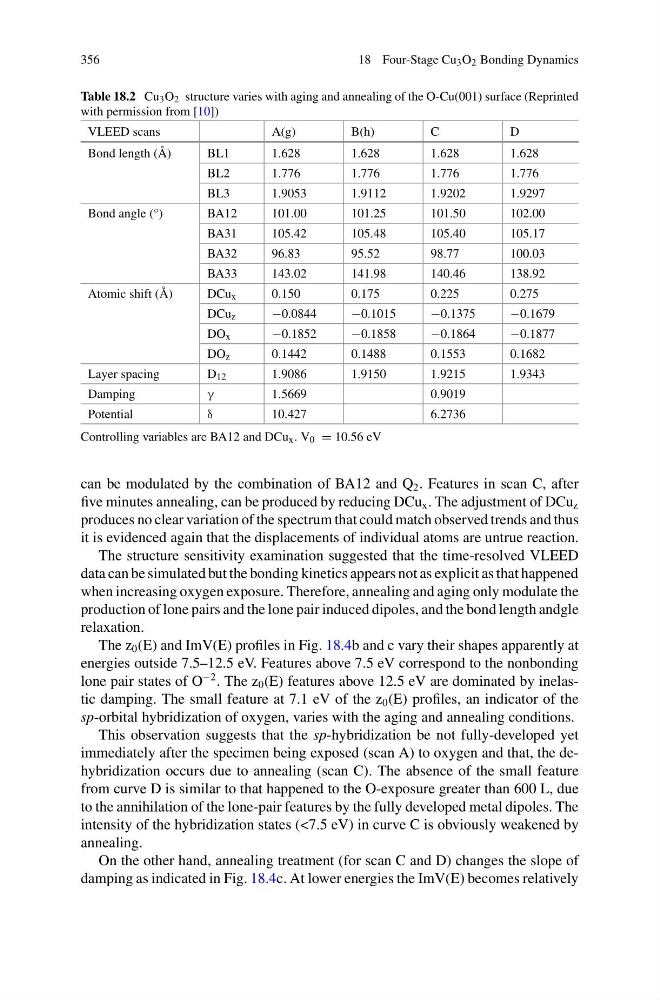
Table 18.2 Cu 3 O 2 structure varies with aging and annealing of the O-Cu(001) surface (Reprinted
with permission from [10])
VLEED scans
A(g)
B(h)
C
D
Bond length (Å)
BL1
1.628
1.628
1.628
1.628
BL2
1.776
1.776
1.776
1.776
BL3
1.9053
1.9112
1.9202
1.9297
Bond angle (°)
BA12
101.00
101.25
101.50
102.00
BA31
105.42
105.48
105.40
105.17
BA32
96.83
95.52
98.77
100.03
BA33
143.02
141.98
140.46
138.92
Atomic shift (Å)
DCu x
0.150
0.175
0.225
0.275
DCu z
−0.0844
−0.1015
−0.1375
−0.1679
DO x
−0.1852
−0.1858
−0.1864
−0.1877
DO z
0.1442
0.1488
0.1553
0.1682
Layer spacing
D 12
1.9086
1.9150
1.9215
1.9343
Damping
γ
1.5669
0.9019
Potential
δ
10.427
6.2736
Controlling variables are BA12 and DCu x . V 0 = 10.56 eV
can be modulated by the combination of BA12 and Q 2 . Features in scan C, after
five minutes annealing, can be produced by reducing DCu x . The adjustment of DCu z
produces no clear variation of the spectrum that could match observed trends and thus
it is evidenced again that the displacements of individual atoms are untrue reaction.
The structure sensitivity examination suggested that the time-resolved VLEED
data can be simulated but the bonding kinetics appears not as explicit as that happened
when increasing oxygen exposure. Therefore, annealing and aging only modulate the
production of lone pairs and the lone pair induced dipoles, and the bond length andgle
relaxation.
The z 0 (E) and ImV(E) profiles in Fig. 18.4b and c vary their shapes apparently at
energies outside 7.5–12.5 eV. Features above 7.5 eV correspond to the nonbonding
lone pair states of O
−2 . The z 0 (E) features above 12.5 eV are dominated by inelastic damping. The small feature at 7.1 eV of the z 0 (E) profiles, an indicator of the
sp-orbital hybridization of oxygen, varies with the aging and annealing conditions.
This observation suggests that the sp-hybridization be not fully-developed yet
immediately after the specimen being exposed (scan A) to oxygen and that, the dehybridization occurs due to annealing (scan C). The absence of the small feature
from curve D is similar to that happened to the O-exposure greater than 600 L, due
to the annihilation of the lone-pair features by the fully developed metal dipoles. The
intensity of the hybridization states (<7.5 eV) in curve C is obviously weakened by
annealing.
On the other hand, annealing treatment (for scan C and D) changes the slope of
damping as indicated in Fig. 18.4c. At lower energies the ImV(E) becomes relatively
18 Four-Stage Cu 3 O 2 Bonding Dynamics
Table 18.2 Cu 3 O 2 structure varies with aging and annealing of the O-Cu(001) surface (Reprinted
with permission from [10])
VLEED scans
A(g)
B(h)
C
D
Bond length (Å)
BL1
1.628
1.628
1.628
1.628
BL2
1.776
1.776
1.776
1.776
BL3
1.9053
1.9112
1.9202
1.9297
Bond angle (°)
BA12
101.00
101.25
101.50
102.00
BA31
105.42
105.48
105.40
105.17
BA32
96.83
95.52
98.77
100.03
BA33
143.02
141.98
140.46
138.92
Atomic shift (Å)
DCu x
0.150
0.175
0.225
0.275
DCu z
−0.0844
−0.1015
−0.1375
−0.1679
DO x
−0.1852
−0.1858
−0.1864
−0.1877
DO z
0.1442
0.1488
0.1553
0.1682
Layer spacing
D 12
1.9086
1.9150
1.9215
1.9343
Damping
γ
1.5669
0.9019
Potential
δ
10.427
6.2736
Controlling variables are BA12 and DCu x . V 0 = 10.56 eV
can be modulated by the combination of BA12 and Q 2 . Features in scan C, after
five minutes annealing, can be produced by reducing DCu x . The adjustment of DCu z
produces no clear variation of the spectrum that could match observed trends and thus
it is evidenced again that the displacements of individual atoms are untrue reaction.
The structure sensitivity examination suggested that the time-resolved VLEED
data can be simulated but the bonding kinetics appears not as explicit as that happened
when increasing oxygen exposure. Therefore, annealing and aging only modulate the
production of lone pairs and the lone pair induced dipoles, and the bond length andgle
relaxation.
The z 0 (E) and ImV(E) profiles in Fig. 18.4b and c vary their shapes apparently at
energies outside 7.5–12.5 eV. Features above 7.5 eV correspond to the nonbonding
lone pair states of O
−2 . The z 0 (E) features above 12.5 eV are dominated by inelastic damping. The small feature at 7.1 eV of the z 0 (E) profiles, an indicator of the
sp-orbital hybridization of oxygen, varies with the aging and annealing conditions.
This observation suggests that the sp-hybridization be not fully-developed yet
immediately after the specimen being exposed (scan A) to oxygen and that, the dehybridization occurs due to annealing (scan C). The absence of the small feature
from curve D is similar to that happened to the O-exposure greater than 600 L, due
to the annihilation of the lone-pair features by the fully developed metal dipoles. The
intensity of the hybridization states (<7.5 eV) in curve C is obviously weakened by
annealing.
On the other hand, annealing treatment (for scan C and D) changes the slope of
damping as indicated in Fig. 18.4c. At lower energies the ImV(E) becomes relatively