

18.5 De-Hybridisation of Oxygen
357
(a) Q (%)
2.0
4.0
6.0
2
(b) BA12 ( )
o
102
106
98
98
102
106
(c) DCu (A)
o
0.175
0.225
0.275
x
(d) DCu (A)
o
z
0.15
0.20
0.10
7.5 10.0 12.5 15.0
7.5 10.0 12.5 15.0
7.5 10.0 12.5 15.0
7.5 10.0 12.5 15.0
0
2
4
2
4
0
0
0
2
2
4
4
I
I
00
0
(%)
Energy (eV)
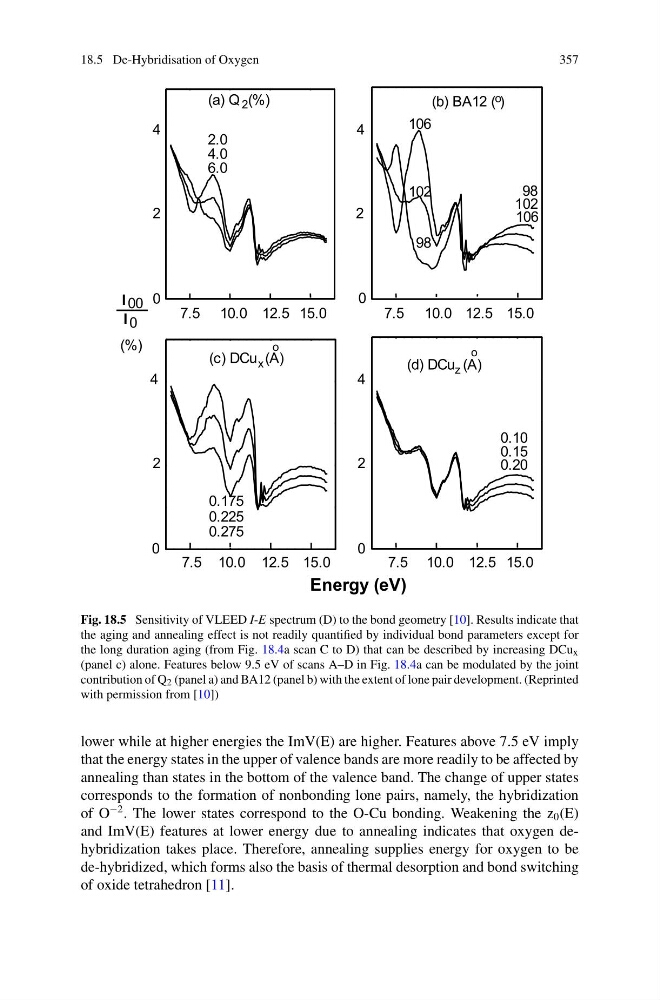
Fig. 18.5 Sensitivity of VLEED I-E spectrum (D) to the bond geometry [10]. Results indicate that
the aging and annealing effect is not readily quantified by individual bond parameters except for
the long duration aging (from Fig. 18.4a scan C to D) that can be described by increasing DCu x
(panel c) alone. Features below 9.5 eV of scans A–D in Fig. 18.4a can be modulated by the joint
contribution of Q 2 (panel a) and BA12 (panel b) with the extent of lone pair development. (Reprinted
with permission from [10])
lower while at higher energies the ImV(E) are higher. Features above 7.5 eV imply
that the energy states in the upper of valence bands are more readily to be affected by
annealing than states in the bottom of the valence band. The change of upper states
corresponds to the formation of nonbonding lone pairs, namely, the hybridization
of O
−2 . The lower states correspond to the O-Cu bonding. Weakening the z 0 (E)
and ImV(E) features at lower energy due to annealing indicates that oxygen dehybridization takes place. Therefore, annealing supplies energy for oxygen to be
de-hybridized, which forms also the basis of thermal desorption and bond switching
of oxide tetrahedron [11].
357
(a) Q (%)
2.0
4.0
6.0
2
(b) BA12 ( )
o
102
106
98
98
102
106
(c) DCu (A)
o
0.175
0.225
0.275
x
(d) DCu (A)
o
z
0.15
0.20
0.10
7.5 10.0 12.5 15.0
7.5 10.0 12.5 15.0
7.5 10.0 12.5 15.0
7.5 10.0 12.5 15.0
0
2
4
2
4
0
0
0
2
2
4
4
I
I
00
0
(%)
Energy (eV)
Fig. 18.5 Sensitivity of VLEED I-E spectrum (D) to the bond geometry [10]. Results indicate that
the aging and annealing effect is not readily quantified by individual bond parameters except for
the long duration aging (from Fig. 18.4a scan C to D) that can be described by increasing DCu x
(panel c) alone. Features below 9.5 eV of scans A–D in Fig. 18.4a can be modulated by the joint
contribution of Q 2 (panel a) and BA12 (panel b) with the extent of lone pair development. (Reprinted
with permission from [10])
lower while at higher energies the ImV(E) are higher. Features above 7.5 eV imply
that the energy states in the upper of valence bands are more readily to be affected by
annealing than states in the bottom of the valence band. The change of upper states
corresponds to the formation of nonbonding lone pairs, namely, the hybridization
of O
−2 . The lower states correspond to the O-Cu bonding. Weakening the z 0 (E)
and ImV(E) features at lower energy due to annealing indicates that oxygen dehybridization takes place. Therefore, annealing supplies energy for oxygen to be
de-hybridized, which forms also the basis of thermal desorption and bond switching
of oxide tetrahedron [11].