

336
17 Blouin Zones, Effective Mass, Muffin-tin Potential…
17.2.3 Valence Bands
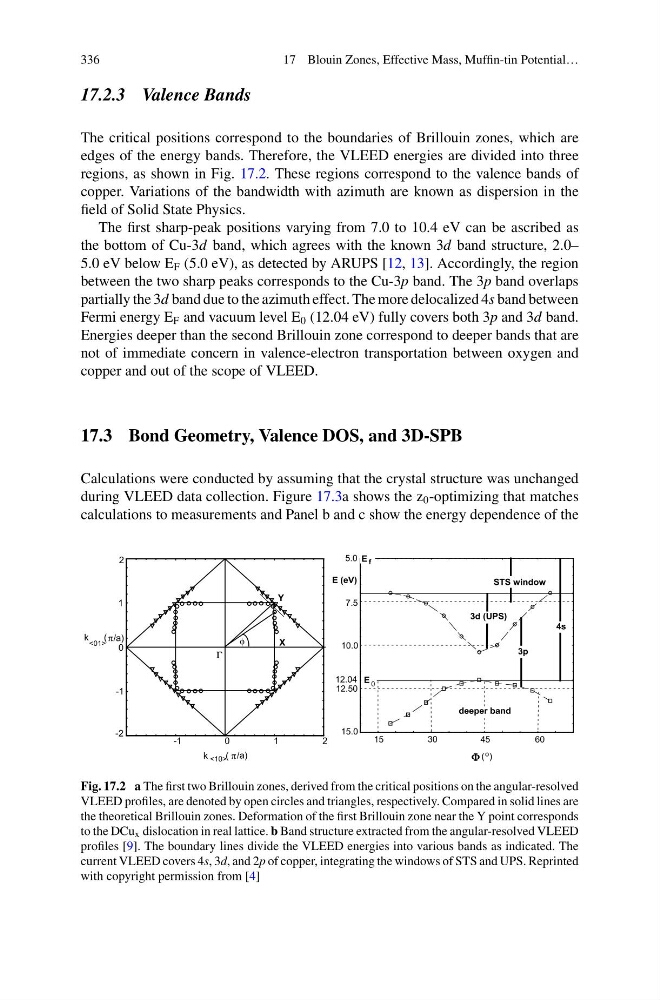
The critical positions correspond to the boundaries of Brillouin zones, which are
edges of the energy bands. Therefore, the VLEED energies are divided into three
regions, as shown in Fig. 17.2. These regions correspond to the valence bands of
copper. Variations of the bandwidth with azimuth are known as dispersion in the
field of Solid State Physics.
The first sharp-peak positions varying from 7.0 to 10.4 eV can be ascribed as
the bottom of Cu-3d band, which agrees with the known 3d band structure, 2.0–
5.0 eV below E F (5.0 eV), as detected by ARUPS [12, 13]. Accordingly, the region
between the two sharp peaks corresponds to the Cu-3p band. The 3p band overlaps
partially the 3d band due to the azimuth effect. The more delocalized 4s band between
Fermi energy E F and vacuum level E 0 (12.04 eV) fully covers both 3p and 3d band.
Energies deeper than the second Brillouin zone correspond to deeper bands that are
not of immediate concern in valence-electron transportation between oxygen and
copper and out of the scope of VLEED.
17.3 Bond Geometry, Valence DOS, and 3D-SPB
Calculations were conducted by assuming that the crystal structure was unchanged
during VLEED data collection. Figure 17.3a shows the z 0 -optimizing that matches
calculations to measurements and Panel b and c show the energy dependence of the
φ
Γ
Y
X
2
1
0
-1
-2
-1
0
1
2
π/a)
k
(
<01>
π/a)
k
(
<10>
E (eV)
5.0
10.0
12.04
12.50
15.0
45
60
30
15
( )
o
4s
3p
7.5
deeper band
STS window
3d (UPS)
E f
E 0
Φ
Fig. 17.2 a The first two Brillouin zones, derived from the critical positions on the angular-resolved
VLEED profiles, are denoted by open circles and triangles, respectively. Compared in solid lines are
the theoretical Brillouin zones. Deformation of the first Brillouin zone near the Y point corresponds
to the DCu x dislocation in real lattice. b Band structure extracted from the angular-resolved VLEED
profiles [9]. The boundary lines divide the VLEED energies into various bands as indicated. The
current VLEED covers 4s, 3d, and 2p of copper, integrating the windows of STS and UPS. Reprinted
with copyright permission from [4]
17 Blouin Zones, Effective Mass, Muffin-tin Potential…
17.2.3 Valence Bands
The critical positions correspond to the boundaries of Brillouin zones, which are
edges of the energy bands. Therefore, the VLEED energies are divided into three
regions, as shown in Fig. 17.2. These regions correspond to the valence bands of
copper. Variations of the bandwidth with azimuth are known as dispersion in the
field of Solid State Physics.
The first sharp-peak positions varying from 7.0 to 10.4 eV can be ascribed as
the bottom of Cu-3d band, which agrees with the known 3d band structure, 2.0–
5.0 eV below E F (5.0 eV), as detected by ARUPS [12, 13]. Accordingly, the region
between the two sharp peaks corresponds to the Cu-3p band. The 3p band overlaps
partially the 3d band due to the azimuth effect. The more delocalized 4s band between
Fermi energy E F and vacuum level E 0 (12.04 eV) fully covers both 3p and 3d band.
Energies deeper than the second Brillouin zone correspond to deeper bands that are
not of immediate concern in valence-electron transportation between oxygen and
copper and out of the scope of VLEED.
17.3 Bond Geometry, Valence DOS, and 3D-SPB
Calculations were conducted by assuming that the crystal structure was unchanged
during VLEED data collection. Figure 17.3a shows the z 0 -optimizing that matches
calculations to measurements and Panel b and c show the energy dependence of the
φ
Γ
Y
X
2
1
0
-1
-2
-1
0
1
2
π/a)
k
(
<01>
π/a)
k
(
<10>
E (eV)
5.0
10.0
12.04
12.50
15.0
45
60
30
15
( )
o
4s
3p
7.5
deeper band
STS window
3d (UPS)
E f
E 0
Φ
Fig. 17.2 a The first two Brillouin zones, derived from the critical positions on the angular-resolved
VLEED profiles, are denoted by open circles and triangles, respectively. Compared in solid lines are
the theoretical Brillouin zones. Deformation of the first Brillouin zone near the Y point corresponds
to the DCu x dislocation in real lattice. b Band structure extracted from the angular-resolved VLEED
profiles [9]. The boundary lines divide the VLEED energies into various bands as indicated. The
current VLEED covers 4s, 3d, and 2p of copper, integrating the windows of STS and UPS. Reprinted
with copyright permission from [4]