

17.2 Sharp Features: Brillion Zones and Energy Bands
335
17.2.2 Lattice Reconstruction
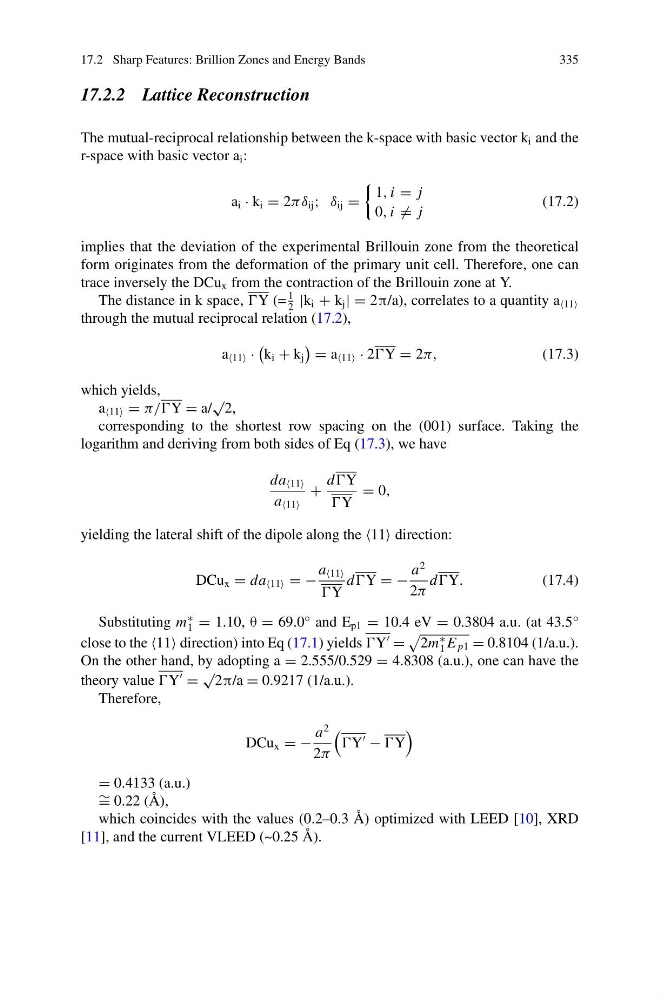
The mutual-reciprocal relationship between the k-space with basic vector k i and the
r-space with basic vector a i :
a i · k i = 2πδ ij ; δ ij =
1, i = j
0, i = j
(17.2)
implies that the deviation of the experimental Brillouin zone from the theoretical
form originates from the deformation of the primary unit cell. Therefore, one can
trace inversely the DCu x from the contraction of the Brillouin zone at Y.
The distance in k space, Y (=
1
2
|k i + k j | = 2π/a), correlates to a quantity a 11
through the mutual reciprocal relation (17.2),
a 11 ·
k i + k j
= a 11 · 2Y = 2π,
(17.3)
which yields,
a 11 = π/Y = a/
√
2,
corresponding to the shortest row spacing on the (001) surface. Taking the
logarithm and deriving from both sides of Eq (17.3), we have
da 11
a 11
+
dY
Y
= 0,
yielding the lateral shift of the dipole along the 11 direction:
DCu x = da 11 = −
a 11
Y
dY = −
a
2
2π
dY.
(17.4)
Substituting m
∗
1 = 1.10, θ = 69.0° and E p1 = 10.4 eV = 0.3804 a.u. (at 43.5°
close to the 11 direction) into Eq (17.1) yields Y
=
2m
∗
1 E p1 = 0.8104 (1/a.u.).
On the other hand, by adopting a = 2.555/0.529 = 4.8308 (a.u.), one can have the
theory value Y
=
√
2π/a = 0.9217 (1/a.u.).
Therefore,
DCu x = −
a
2
2π
Y
− Y
= 0.4133 (a.u.)
∼ = 0.22 (Å),
which coincides with the values (0.2–0.3 Å) optimized with LEED [10], XRD
[11], and the current VLEED (~0.25 Å).
335
17.2.2 Lattice Reconstruction
The mutual-reciprocal relationship between the k-space with basic vector k i and the
r-space with basic vector a i :
a i · k i = 2πδ ij ; δ ij =
1, i = j
0, i = j
(17.2)
implies that the deviation of the experimental Brillouin zone from the theoretical
form originates from the deformation of the primary unit cell. Therefore, one can
trace inversely the DCu x from the contraction of the Brillouin zone at Y.
The distance in k space, Y (=
1
2
|k i + k j | = 2π/a), correlates to a quantity a 11
through the mutual reciprocal relation (17.2),
a 11 ·
k i + k j
= a 11 · 2Y = 2π,
(17.3)
which yields,
a 11 = π/Y = a/
√
2,
corresponding to the shortest row spacing on the (001) surface. Taking the
logarithm and deriving from both sides of Eq (17.3), we have
da 11
a 11
+
dY
Y
= 0,
yielding the lateral shift of the dipole along the 11 direction:
DCu x = da 11 = −
a 11
Y
dY = −
a
2
2π
dY.
(17.4)
Substituting m
∗
1 = 1.10, θ = 69.0° and E p1 = 10.4 eV = 0.3804 a.u. (at 43.5°
close to the 11 direction) into Eq (17.1) yields Y
=
2m
∗
1 E p1 = 0.8104 (1/a.u.).
On the other hand, by adopting a = 2.555/0.529 = 4.8308 (a.u.), one can have the
theory value Y
=
√
2π/a = 0.9217 (1/a.u.).
Therefore,
DCu x = −
a
2
2π
Y
− Y
= 0.4133 (a.u.)
∼ = 0.22 (Å),
which coincides with the values (0.2–0.3 Å) optimized with LEED [10], XRD
[11], and the current VLEED (~0.25 Å).