

318
16 VLEED Capability and Sensitivity
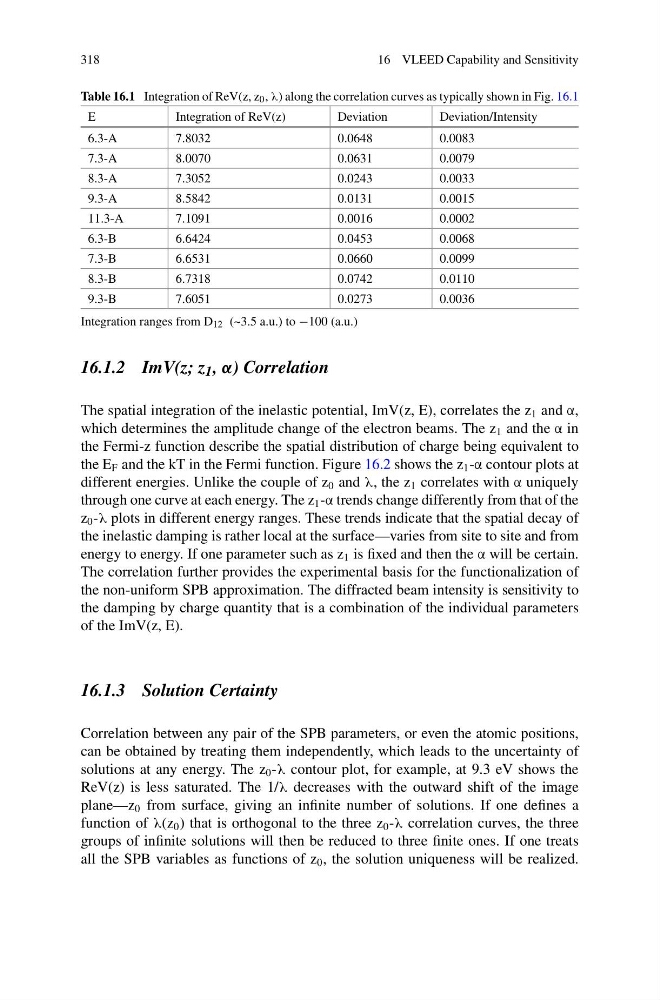
Table 16.1 Integration of ReV(z, z 0 , λ) along the correlation curves as typically shown in Fig. 16.1
E
Integration of ReV(z)
Deviation
Deviation/Intensity
6.3-A
7.8032
0.0648
0.0083
7.3-A
8.0070
0.0631
0.0079
8.3-A
7.3052
0.0243
0.0033
9.3-A
8.5842
0.0131
0.0015
11.3-A
7.1091
0.0016
0.0002
6.3-B
6.6424
0.0453
0.0068
7.3-B
6.6531
0.0660
0.0099
8.3-B
6.7318
0.0742
0.0110
9.3-B
7.6051
0.0273
0.0036
Integration ranges from D 12 (~3.5 a.u.) to −100 (a.u.)
16.1.2 ImV(z; z 1 , α) Correlation
The spatial integration of the inelastic potential, ImV(z, E), correlates the z 1 and α,
which determines the amplitude change of the electron beams. The z 1 and the α in
the Fermi-z function describe the spatial distribution of charge being equivalent to
the E F and the kT in the Fermi function. Figure 16.2 shows the z 1 -α contour plots at
different energies. Unlike the couple of z 0 and λ, the z 1 correlates with α uniquely
through one curve at each energy. The z 1 -α trends change differently from that of the
z 0 -λ plots in different energy ranges. These trends indicate that the spatial decay of
the inelastic damping is rather local at the surface—varies from site to site and from
energy to energy. If one parameter such as z 1 is fixed and then the α will be certain.
The correlation further provides the experimental basis for the functionalization of
the non-uniform SPB approximation. The diffracted beam intensity is sensitivity to
the damping by charge quantity that is a combination of the individual parameters
of the ImV(z, E).
16.1.3 Solution Certainty
Correlation between any pair of the SPB parameters, or even the atomic positions,
can be obtained by treating them independently, which leads to the uncertainty of
solutions at any energy. The z 0 -λ contour plot, for example, at 9.3 eV shows the
ReV(z) is less saturated. The 1/λ decreases with the outward shift of the image
plane—z 0 from surface, giving an infinite number of solutions. If one defines a
function of λ(z 0 ) that is orthogonal to the three z 0 -λ correlation curves, the three
groups of infinite solutions will then be reduced to three finite ones. If one treats
all the SPB variables as functions of z 0 , the solution uniqueness will be realized.
16 VLEED Capability and Sensitivity
Table 16.1 Integration of ReV(z, z 0 , λ) along the correlation curves as typically shown in Fig. 16.1
E
Integration of ReV(z)
Deviation
Deviation/Intensity
6.3-A
7.8032
0.0648
0.0083
7.3-A
8.0070
0.0631
0.0079
8.3-A
7.3052
0.0243
0.0033
9.3-A
8.5842
0.0131
0.0015
11.3-A
7.1091
0.0016
0.0002
6.3-B
6.6424
0.0453
0.0068
7.3-B
6.6531
0.0660
0.0099
8.3-B
6.7318
0.0742
0.0110
9.3-B
7.6051
0.0273
0.0036
Integration ranges from D 12 (~3.5 a.u.) to −100 (a.u.)
16.1.2 ImV(z; z 1 , α) Correlation
The spatial integration of the inelastic potential, ImV(z, E), correlates the z 1 and α,
which determines the amplitude change of the electron beams. The z 1 and the α in
the Fermi-z function describe the spatial distribution of charge being equivalent to
the E F and the kT in the Fermi function. Figure 16.2 shows the z 1 -α contour plots at
different energies. Unlike the couple of z 0 and λ, the z 1 correlates with α uniquely
through one curve at each energy. The z 1 -α trends change differently from that of the
z 0 -λ plots in different energy ranges. These trends indicate that the spatial decay of
the inelastic damping is rather local at the surface—varies from site to site and from
energy to energy. If one parameter such as z 1 is fixed and then the α will be certain.
The correlation further provides the experimental basis for the functionalization of
the non-uniform SPB approximation. The diffracted beam intensity is sensitivity to
the damping by charge quantity that is a combination of the individual parameters
of the ImV(z, E).
16.1.3 Solution Certainty
Correlation between any pair of the SPB parameters, or even the atomic positions,
can be obtained by treating them independently, which leads to the uncertainty of
solutions at any energy. The z 0 -λ contour plot, for example, at 9.3 eV shows the
ReV(z) is less saturated. The 1/λ decreases with the outward shift of the image
plane—z 0 from surface, giving an infinite number of solutions. If one defines a
function of λ(z 0 ) that is orthogonal to the three z 0 -λ correlation curves, the three
groups of infinite solutions will then be reduced to three finite ones. If one treats
all the SPB variables as functions of z 0 , the solution uniqueness will be realized.