

11.4 Electron Spectrometrics
233
The supersolidity disperses outwardly the QS phase. Outside the QS phase,
O:H–O bond follows the regular thermodynamics: dd L /dT > 0, dd H /dT < 0.
(4) The local electric field of a small cation is stronger than that of a larger anion
because of the X
−
↔ X
− repulsion due to the insufficient number of the hydrating dipoles with the ordered molecular structure of the supersolid hydration
shells [33].
11.5 Proton Capture-Ability and Electron Emissibility
of Halide Anions
Why does the X
− follow the Hofmeister polarizability series order and why does HF
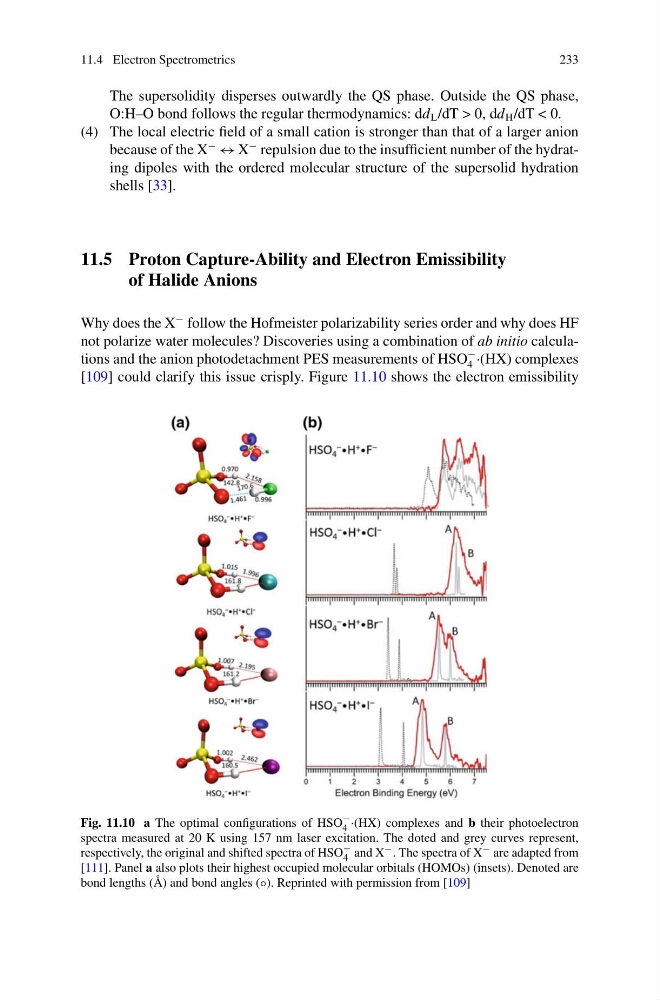
not polarize water molecules? Discoveries using a combination of ab initio calculations and the anion photodetachment PES measurements of HSO
−
4 ·(HX) complexes
[109] could clarify this issue crisply. Figure 11.10 shows the electron emissibility
Fig. 11.10 a The optimal configurations of HSO
−
4 ·(HX) complexes and b their photoelectron
spectra measured at 20 K using 157 nm laser excitation. The doted and grey curves represent,
respectively, the original and shifted spectra of HSO
−
4 and X − . The spectra of X − are adapted from
[111]. Panel a also plots their highest occupied molecular orbitals (HOMOs) (insets). Denoted are
bond lengths (Å) and bond angles (◦). Reprinted with permission from [109]
233
The supersolidity disperses outwardly the QS phase. Outside the QS phase,
O:H–O bond follows the regular thermodynamics: dd L /dT > 0, dd H /dT < 0.
(4) The local electric field of a small cation is stronger than that of a larger anion
because of the X
−
↔ X
− repulsion due to the insufficient number of the hydrating dipoles with the ordered molecular structure of the supersolid hydration
shells [33].
11.5 Proton Capture-Ability and Electron Emissibility
of Halide Anions
Why does the X
− follow the Hofmeister polarizability series order and why does HF
not polarize water molecules? Discoveries using a combination of ab initio calculations and the anion photodetachment PES measurements of HSO
−
4 ·(HX) complexes
[109] could clarify this issue crisply. Figure 11.10 shows the electron emissibility
Fig. 11.10 a The optimal configurations of HSO
−
4 ·(HX) complexes and b their photoelectron
spectra measured at 20 K using 157 nm laser excitation. The doted and grey curves represent,
respectively, the original and shifted spectra of HSO
−
4 and X − . The spectra of X − are adapted from
[111]. Panel a also plots their highest occupied molecular orbitals (HOMOs) (insets). Denoted are
bond lengths (Å) and bond angles (◦). Reprinted with permission from [109]