

232
11 Liquid Phase
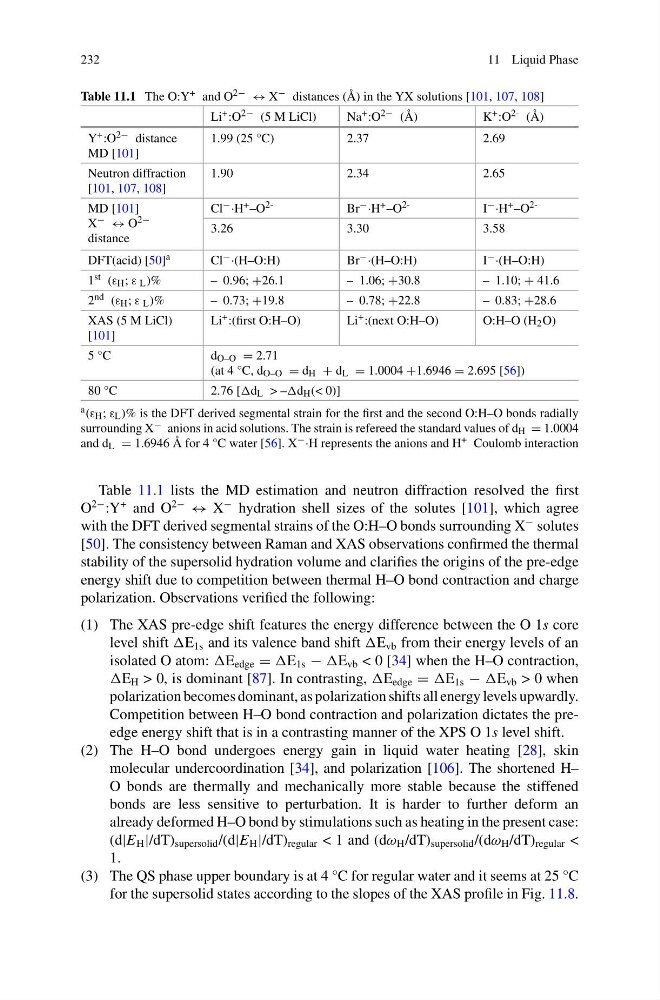
Table 11.1 The O:Y + and O 2− ↔ X − distances (Å) in the YX solutions [101, 107, 108]
Li + :O 2− (5 M LiCl)
Na + :O 2− (Å)
K + :O 2- (Å)
Y + :O 2− distance
MD [101]
1.99 (25 °C)
2.37
2.69
Neutron diffraction
[101, 107, 108]
1.90
2.34
2.65
MD [101]
X − ↔ O 2−
distance
Cl − ·H + –O 2Br − ·H + –O 2I − ·H + –O 23.26
3.30
3.58
DFT(acid) [50] a
Cl − ·(H–O:H)
Br − ·(H–O:H)
I − ·(H–O:H)
1 st (ε H ; ε L )%
– 0.96; +26.1
– 1.06; +30.8
– 1.10; + 41.6
2 nd (ε H ; ε L )%
– 0.73; +19.8
– 0.78; +22.8
– 0.83; +28.6
XAS (5 M LiCl)
[101]
Li + :(first O:H–O)
Li + :(next O:H–O)
O:H–O (H 2 O)
5 °C
d O–O = 2.71
(at 4 °C, d O–O = d H + d L = 1.0004 +1.6946 = 2.695 [56])
80 °C
2.76 [d L > –d H (< 0)]
a (ε H ; ε L )% is the DFT derived segmental strain for the first and the second O:H–O bonds radially
surrounding X − anions in acid solutions. The strain is refereed the standard values of d H = 1.0004
and d L = 1.6946 Å for 4 °C water [56]. X − ·H represents the anions and H + Coulomb interaction
Table 11.1 lists the MD estimation and neutron diffraction resolved the first
O
2− :Y
+ and O
2−
↔ X
− hydration shell sizes of the solutes [101], which agree
with the DFT derived segmental strains of the O:H–O bonds surrounding X
− solutes
[50]. The consistency between Raman and XAS observations confirmed the thermal
stability of the supersolid hydration volume and clarifies the origins of the pre-edge
energy shift due to competition between thermal H–O bond contraction and charge
polarization. Observations verified the following:
(1) The XAS pre-edge shift features the energy difference between the O 1s core
level shift E 1s and its valence band shift E vb from their energy levels of an
isolated O atom: E edge = E 1s − E vb < 0 [34] when the H–O contraction,
E H > 0, is dominant [87]. In contrasting, E edge = E 1s − E vb > 0 when
polarization becomes dominant, as polarization shifts all energy levels upwardly.
Competition between H–O bond contraction and polarization dictates the preedge energy shift that is in a contrasting manner of the XPS O 1s level shift.
(2) The H–O bond undergoes energy gain in liquid water heating [28], skin
molecular undercoordination [34], and polarization [106]. The shortened H–
O bonds are thermally and mechanically more stable because the stiffened
bonds are less sensitive to perturbation. It is harder to further deform an
already deformed H–O bond by stimulations such as heating in the present case:
(d|E H |/dT) supersolid /(d|E H |/dT) regular < 1 and (dω H /dT) supersolid /(dω H /dT) regular <
1.
(3) The QS phase upper boundary is at 4 °C for regular water and it seems at 25 °C
for the supersolid states according to the slopes of the XAS profile in Fig. 11.8.
11 Liquid Phase
Table 11.1 The O:Y + and O 2− ↔ X − distances (Å) in the YX solutions [101, 107, 108]
Li + :O 2− (5 M LiCl)
Na + :O 2− (Å)
K + :O 2- (Å)
Y + :O 2− distance
MD [101]
1.99 (25 °C)
2.37
2.69
Neutron diffraction
[101, 107, 108]
1.90
2.34
2.65
MD [101]
X − ↔ O 2−
distance
Cl − ·H + –O 2Br − ·H + –O 2I − ·H + –O 23.26
3.30
3.58
DFT(acid) [50] a
Cl − ·(H–O:H)
Br − ·(H–O:H)
I − ·(H–O:H)
1 st (ε H ; ε L )%
– 0.96; +26.1
– 1.06; +30.8
– 1.10; + 41.6
2 nd (ε H ; ε L )%
– 0.73; +19.8
– 0.78; +22.8
– 0.83; +28.6
XAS (5 M LiCl)
[101]
Li + :(first O:H–O)
Li + :(next O:H–O)
O:H–O (H 2 O)
5 °C
d O–O = 2.71
(at 4 °C, d O–O = d H + d L = 1.0004 +1.6946 = 2.695 [56])
80 °C
2.76 [d L > –d H (< 0)]
a (ε H ; ε L )% is the DFT derived segmental strain for the first and the second O:H–O bonds radially
surrounding X − anions in acid solutions. The strain is refereed the standard values of d H = 1.0004
and d L = 1.6946 Å for 4 °C water [56]. X − ·H represents the anions and H + Coulomb interaction
Table 11.1 lists the MD estimation and neutron diffraction resolved the first
O
2− :Y
+ and O
2−
↔ X
− hydration shell sizes of the solutes [101], which agree
with the DFT derived segmental strains of the O:H–O bonds surrounding X
− solutes
[50]. The consistency between Raman and XAS observations confirmed the thermal
stability of the supersolid hydration volume and clarifies the origins of the pre-edge
energy shift due to competition between thermal H–O bond contraction and charge
polarization. Observations verified the following:
(1) The XAS pre-edge shift features the energy difference between the O 1s core
level shift E 1s and its valence band shift E vb from their energy levels of an
isolated O atom: E edge = E 1s − E vb < 0 [34] when the H–O contraction,
E H > 0, is dominant [87]. In contrasting, E edge = E 1s − E vb > 0 when
polarization becomes dominant, as polarization shifts all energy levels upwardly.
Competition between H–O bond contraction and polarization dictates the preedge energy shift that is in a contrasting manner of the XPS O 1s level shift.
(2) The H–O bond undergoes energy gain in liquid water heating [28], skin
molecular undercoordination [34], and polarization [106]. The shortened H–
O bonds are thermally and mechanically more stable because the stiffened
bonds are less sensitive to perturbation. It is harder to further deform an
already deformed H–O bond by stimulations such as heating in the present case:
(d|E H |/dT) supersolid /(d|E H |/dT) regular < 1 and (dω H /dT) supersolid /(dω H /dT) regular <
1.
(3) The QS phase upper boundary is at 4 °C for regular water and it seems at 25 °C
for the supersolid states according to the slopes of the XAS profile in Fig. 11.8.