

234
11 Liquid Phase
and the proton capture-ability of halide and oxygen anions. The optimal HSO
−
4 ·(HX)
configuration shows that HCl, HBr, and HI dissolve into H
+ and X
− and then the H
+
binds to the neighboring O
2- . Ions have a higher electronegativity tend to capture the
proton that initially bonds to the less negative ions. The HF is not dissolvable and
keeps itself the contacted ion pair. Ions of highly negative are hard to emit electrons
under the excitation of 157 nm laser under the same temperature of 20 K.
Results also show the X:H–O cooperativity in its segmental length and the polarizability of the anions. The X in the HSO
−
4 ·(HX) complexes forms each two identical
O–H:X hydrogen bonds with its two neighboring O for X = Cl, Br, and I. The O–
H:X segmental lengths vary cooperatively—if the O–H is shorter, the H:X will be
longer [43]. As the X moves from Cl to Br and I, the anion polarization shortens the
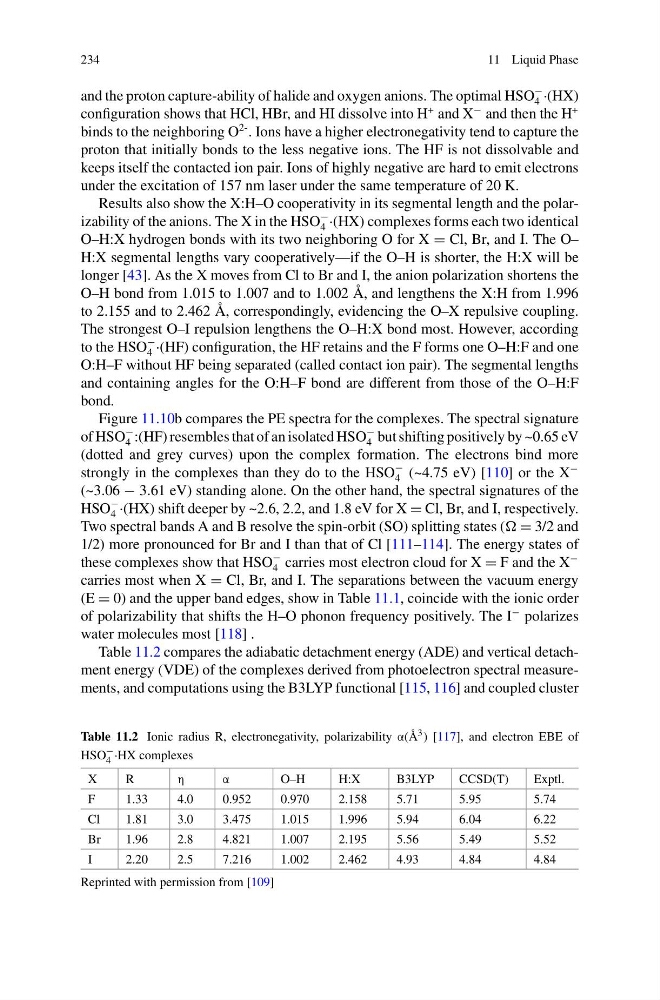
O–H bond from 1.015 to 1.007 and to 1.002 Å, and lengthens the X:H from 1.996
to 2.155 and to 2.462 Å, correspondingly, evidencing the O–X repulsive coupling.
The strongest O–I repulsion lengthens the O–H:X bond most. However, according
to the HSO
−
4 ·(HF) configuration, the HF retains and the F forms one O–H:F and one
O:H–F without HF being separated (called contact ion pair). The segmental lengths
and containing angles for the O:H–F bond are different from those of the O–H:F
bond.
Figure 11.10b compares the PE spectra for the complexes. The spectral signature
of HSO
−
4 :(HF) resembles that of an isolated HSO
−
4 but shifting positively by ~0.65 eV
(dotted and grey curves) upon the complex formation. The electrons bind more
strongly in the complexes than they do to the HSO
−
4 (~4.75 eV) [110] or the X
−
(~3.06 − 3.61 eV) standing alone. On the other hand, the spectral signatures of the
HSO
−
4 ·(HX) shift deeper by ~2.6, 2.2, and 1.8 eV for X = Cl, Br, and I, respectively.
Two spectral bands A and B resolve the spin-orbit (SO) splitting states ( = 3/2 and
1/2) more pronounced for Br and I than that of Cl [111–114]. The energy states of
these complexes show that HSO
−
4 carries most electron cloud for X = F and the X
−
carries most when X = Cl, Br, and I. The separations between the vacuum energy
(E = 0) and the upper band edges, show in Table 11.1, coincide with the ionic order
of polarizability that shifts the H–O phonon frequency positively. The I
− polarizes
water molecules most [118] .
Table 11.2 compares the adiabatic detachment energy (ADE) and vertical detachment energy (VDE) of the complexes derived from photoelectron spectral measurements, and computations using the B3LYP functional [115, 116] and coupled cluster
Table 11.2 Ionic radius R, electronegativity, polarizability α(Å 3 ) [117], and electron EBE of
HSO
−
4 ·HX complexes
X
R
η
α
O–H
H:X
B3LYP
CCSD(T)
Exptl.
F
1.33
4.0
0.952
0.970
2.158
5.71
5.95
5.74
Cl
1.81
3.0
3.475
1.015
1.996
5.94
6.04
6.22
Br
1.96
2.8
4.821
1.007
2.195
5.56
5.49
5.52
I
2.20
2.5
7.216
1.002
2.462
4.93
4.84
4.84
Reprinted with permission from [109]
11 Liquid Phase
and the proton capture-ability of halide and oxygen anions. The optimal HSO
−
4 ·(HX)
configuration shows that HCl, HBr, and HI dissolve into H
+ and X
− and then the H
+
binds to the neighboring O
2- . Ions have a higher electronegativity tend to capture the
proton that initially bonds to the less negative ions. The HF is not dissolvable and
keeps itself the contacted ion pair. Ions of highly negative are hard to emit electrons
under the excitation of 157 nm laser under the same temperature of 20 K.
Results also show the X:H–O cooperativity in its segmental length and the polarizability of the anions. The X in the HSO
−
4 ·(HX) complexes forms each two identical
O–H:X hydrogen bonds with its two neighboring O for X = Cl, Br, and I. The O–
H:X segmental lengths vary cooperatively—if the O–H is shorter, the H:X will be
longer [43]. As the X moves from Cl to Br and I, the anion polarization shortens the
O–H bond from 1.015 to 1.007 and to 1.002 Å, and lengthens the X:H from 1.996
to 2.155 and to 2.462 Å, correspondingly, evidencing the O–X repulsive coupling.
The strongest O–I repulsion lengthens the O–H:X bond most. However, according
to the HSO
−
4 ·(HF) configuration, the HF retains and the F forms one O–H:F and one
O:H–F without HF being separated (called contact ion pair). The segmental lengths
and containing angles for the O:H–F bond are different from those of the O–H:F
bond.
Figure 11.10b compares the PE spectra for the complexes. The spectral signature
of HSO
−
4 :(HF) resembles that of an isolated HSO
−
4 but shifting positively by ~0.65 eV
(dotted and grey curves) upon the complex formation. The electrons bind more
strongly in the complexes than they do to the HSO
−
4 (~4.75 eV) [110] or the X
−
(~3.06 − 3.61 eV) standing alone. On the other hand, the spectral signatures of the
HSO
−
4 ·(HX) shift deeper by ~2.6, 2.2, and 1.8 eV for X = Cl, Br, and I, respectively.
Two spectral bands A and B resolve the spin-orbit (SO) splitting states ( = 3/2 and
1/2) more pronounced for Br and I than that of Cl [111–114]. The energy states of
these complexes show that HSO
−
4 carries most electron cloud for X = F and the X
−
carries most when X = Cl, Br, and I. The separations between the vacuum energy
(E = 0) and the upper band edges, show in Table 11.1, coincide with the ionic order
of polarizability that shifts the H–O phonon frequency positively. The I
− polarizes
water molecules most [118] .
Table 11.2 compares the adiabatic detachment energy (ADE) and vertical detachment energy (VDE) of the complexes derived from photoelectron spectral measurements, and computations using the B3LYP functional [115, 116] and coupled cluster
Table 11.2 Ionic radius R, electronegativity, polarizability α(Å 3 ) [117], and electron EBE of
HSO
−
4 ·HX complexes
X
R
η
α
O–H
H:X
B3LYP
CCSD(T)
Exptl.
F
1.33
4.0
0.952
0.970
2.158
5.71
5.95
5.74
Cl
1.81
3.0
3.475
1.015
1.996
5.94
6.04
6.22
Br
1.96
2.8
4.821
1.007
2.195
5.56
5.49
5.52
I
2.20
2.5
7.216
1.002
2.462
4.93
4.84
4.84
Reprinted with permission from [109]