

192
9 Hybridized Bonding
0.25 ML-clean
0.50 ML
0.75 ML
1.00 ML
-8
-6
-4
-2
0
2
4
Δ
DOS
Energy (eV)
Bonding
Nonbonding
Holes
Antibonding
Ti(0001)-N
-8
-6
-4
-2
0
2
(1×1)9N - Clean
(1×1+√3×√3)12N - Clean
Δ
DOS
Energy (eV)
(a)
(b)
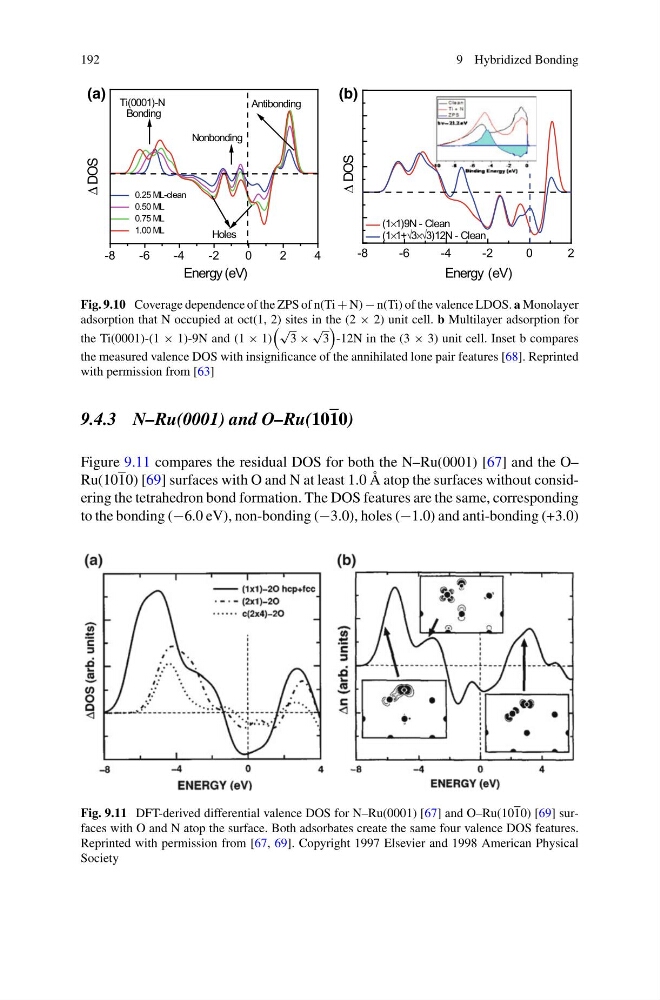
Fig. 9.10 Coverage dependence of the ZPS of n(Ti + N) − n(Ti) of the valence LDOS. a Monolayer
adsorption that N occupied at oct(1, 2) sites in the (2 × 2) unit cell. b Multilayer adsorption for
the Ti(0001)-(1 × 1)-9N and (1 × 1)
√
3 ×
√
3
-12N in the (3 × 3) unit cell. Inset b compares
the measured valence DOS with insignificance of the annihilated lone pair features [68]. Reprinted
with permission from [63]
9.4.3 N–Ru(0001) and O–Ru(1010)
Figure 9.11 compares the residual DOS for both the N–Ru(0001) [67] and the O–
Ru(1010) [69] surfaces with O and N at least 1.0 Å atop the surfaces without considering the tetrahedron bond formation. The DOS features are the same, corresponding
to the bonding (−6.0 eV), non-bonding (−3.0), holes (−1.0) and anti-bonding (+3.0)
Fig. 9.11 DFT-derived differential valence DOS for N–Ru(0001) [67] and O–Ru(1010) [69] surfaces with O and N atop the surface. Both adsorbates create the same four valence DOS features.
Reprinted with permission from [67, 69]. Copyright 1997 Elsevier and 1998 American Physical
Society
9 Hybridized Bonding
0.25 ML-clean
0.50 ML
0.75 ML
1.00 ML
-8
-6
-4
-2
0
2
4
Δ
DOS
Energy (eV)
Bonding
Nonbonding
Holes
Antibonding
Ti(0001)-N
-8
-6
-4
-2
0
2
(1×1)9N - Clean
(1×1+√3×√3)12N - Clean
Δ
DOS
Energy (eV)
(a)
(b)
Fig. 9.10 Coverage dependence of the ZPS of n(Ti + N) − n(Ti) of the valence LDOS. a Monolayer
adsorption that N occupied at oct(1, 2) sites in the (2 × 2) unit cell. b Multilayer adsorption for
the Ti(0001)-(1 × 1)-9N and (1 × 1)
√
3 ×
√
3
-12N in the (3 × 3) unit cell. Inset b compares
the measured valence DOS with insignificance of the annihilated lone pair features [68]. Reprinted
with permission from [63]
9.4.3 N–Ru(0001) and O–Ru(1010)
Figure 9.11 compares the residual DOS for both the N–Ru(0001) [67] and the O–
Ru(1010) [69] surfaces with O and N at least 1.0 Å atop the surfaces without considering the tetrahedron bond formation. The DOS features are the same, corresponding
to the bonding (−6.0 eV), non-bonding (−3.0), holes (−1.0) and anti-bonding (+3.0)
Fig. 9.11 DFT-derived differential valence DOS for N–Ru(0001) [67] and O–Ru(1010) [69] surfaces with O and N atop the surface. Both adsorbates create the same four valence DOS features.
Reprinted with permission from [67, 69]. Copyright 1997 Elsevier and 1998 American Physical
Society