

9.4 DFT Derivatives
191
9.4.2 N–Ti(0001)
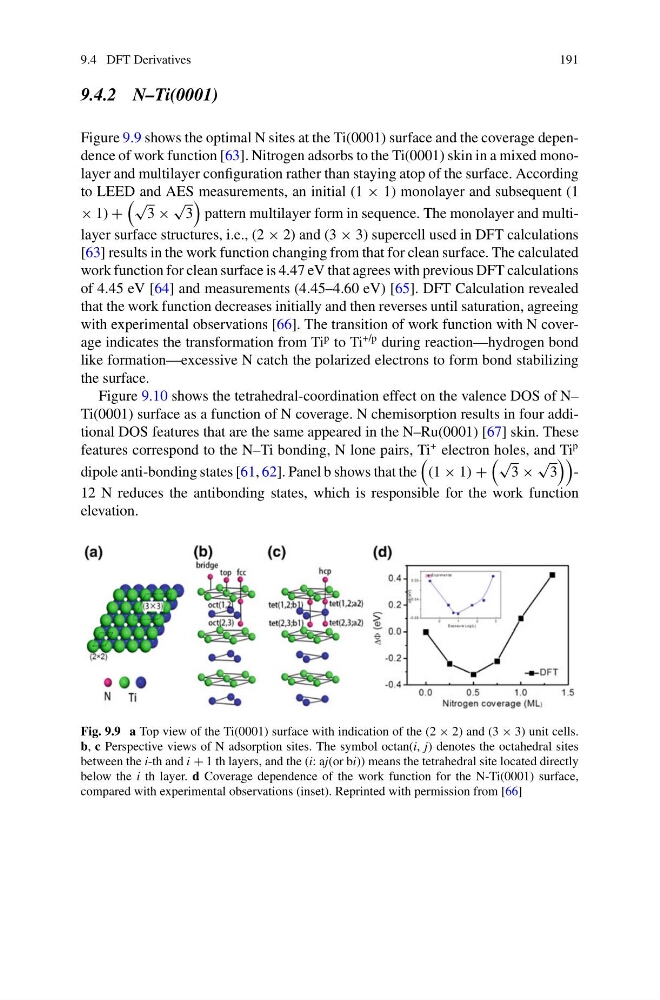
Figure 9.9 shows the optimal N sites at the Ti(0001) surface and the coverage dependence of work function [63]. Nitrogen adsorbs to the Ti(0001) skin in a mixed monolayer and multilayer configuration rather than staying atop of the surface. According
to LEED and AES measurements, an initial (1 × 1) monolayer and subsequent (1
× 1) +
√
3 ×
√
3
pattern multilayer form in sequence. The monolayer and multilayer surface structures, i.e., (2 × 2) and (3 × 3) supercell used in DFT calculations
[63] results in the work function changing from that for clean surface. The calculated
work function for clean surface is 4.47 eV that agrees with previous DFT calculations
of 4.45 eV [64] and measurements (4.45–4.60 eV) [65]. DFT Calculation revealed
that the work function decreases initially and then reverses until saturation, agreeing
with experimental observations [66]. The transition of work function with N coverage indicates the transformation from Ti
p to Ti
+/p during reaction—hydrogen bond
like formation—excessive N catch the polarized electrons to form bond stabilizing
the surface.
Figure 9.10 shows the tetrahedral-coordination effect on the valence DOS of N–
Ti(0001) surface as a function of N coverage. N chemisorption results in four additional DOS features that are the same appeared in the N–Ru(0001) [67] skin. These
features correspond to the N–Ti bonding, N lone pairs, Ti
+ electron holes, and Ti
p
dipole anti-bonding states [61, 62]. Panel b shows that the
(1 × 1) +
√
3 ×
√
3
-
12 N reduces the antibonding states, which is responsible for the work function
elevation.
Fig. 9.9 a Top view of the Ti(0001) surface with indication of the (2 × 2) and (3 × 3) unit cells.
b, c Perspective views of N adsorption sites. The symbol octan(i, j) denotes the octahedral sites
between the i-th and i + 1 th layers, and the (i: aj(or bi)) means the tetrahedral site located directly
below the i th layer. d Coverage dependence of the work function for the N-Ti(0001) surface,
compared with experimental observations (inset). Reprinted with permission from [66]
191
9.4.2 N–Ti(0001)
Figure 9.9 shows the optimal N sites at the Ti(0001) surface and the coverage dependence of work function [63]. Nitrogen adsorbs to the Ti(0001) skin in a mixed monolayer and multilayer configuration rather than staying atop of the surface. According
to LEED and AES measurements, an initial (1 × 1) monolayer and subsequent (1
× 1) +
√
3 ×
√
3
pattern multilayer form in sequence. The monolayer and multilayer surface structures, i.e., (2 × 2) and (3 × 3) supercell used in DFT calculations
[63] results in the work function changing from that for clean surface. The calculated
work function for clean surface is 4.47 eV that agrees with previous DFT calculations
of 4.45 eV [64] and measurements (4.45–4.60 eV) [65]. DFT Calculation revealed
that the work function decreases initially and then reverses until saturation, agreeing
with experimental observations [66]. The transition of work function with N coverage indicates the transformation from Ti
p to Ti
+/p during reaction—hydrogen bond
like formation—excessive N catch the polarized electrons to form bond stabilizing
the surface.
Figure 9.10 shows the tetrahedral-coordination effect on the valence DOS of N–
Ti(0001) surface as a function of N coverage. N chemisorption results in four additional DOS features that are the same appeared in the N–Ru(0001) [67] skin. These
features correspond to the N–Ti bonding, N lone pairs, Ti
+ electron holes, and Ti
p
dipole anti-bonding states [61, 62]. Panel b shows that the
(1 × 1) +
√
3 ×
√
3
-
12 N reduces the antibonding states, which is responsible for the work function
elevation.
Fig. 9.9 a Top view of the Ti(0001) surface with indication of the (2 × 2) and (3 × 3) unit cells.
b, c Perspective views of N adsorption sites. The symbol octan(i, j) denotes the octahedral sites
between the i-th and i + 1 th layers, and the (i: aj(or bi)) means the tetrahedral site located directly
below the i th layer. d Coverage dependence of the work function for the N-Ti(0001) surface,
compared with experimental observations (inset). Reprinted with permission from [66]