

190
9 Hybridized Bonding
Conventionally, the additional DOS features around −1.4 eV ~ −2.0 eV of the
copper oxide were argued as: (i) O–Cu anti-bonding states [4, 18, 55]; (ii) O 2p antibonding states [4, 20, 55], (iii) oxygen 2s states [56, 57] and, (iv) the O 2p electrons
with the spd hybridized electrons of Cu [9]. The additional DOS features around −
5.5 eV were interpreted as O 2p states adding to the valence band of the host surface
[4, 8, 20]. The sharp fall of the DOS features at E F > E > −3.0 eV corresponds to
the disappearance of the clean Cu surface states.
The DOS features appeared in the valence band or above of a chemisorbed surface,
the PES features of the O–Pd(110) [58], O–Cu(110) [12, 18, 20], O–Cu(111) [4],
O–Rh(001) [59] and S–Rh(110) and surfaces, as mentioned above, are substantially
the same despite their surface crystal geometries and morphologies. In place of the
conventional explanations in terms of individual orbital wise, the adsorbate-induced
four DOS features result from the effect of sp-orbital hybridization and correspond
to the antibond, nonbond, holes, and bonding states consistently.
9.4 DFT Derivatives
9.4.1 O–Ti(0001)
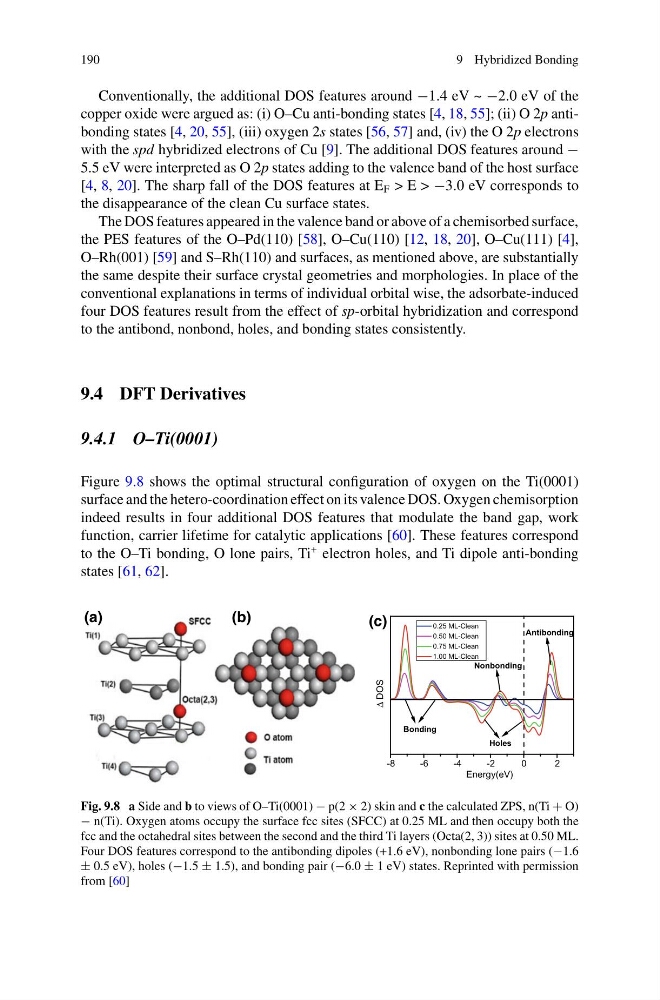
Figure 9.8 shows the optimal structural configuration of oxygen on the Ti(0001)
surface and the hetero-coordination effect on its valence DOS. Oxygen chemisorption
indeed results in four additional DOS features that modulate the band gap, work
function, carrier lifetime for catalytic applications [60]. These features correspond
to the O–Ti bonding, O lone pairs, Ti
+ electron holes, and Ti dipole anti-bonding
states [61, 62].
Nonbonding
-8
-6
-4
Energy(eV)
-2
0
2
Δ DOS
0.25 ML-Clean
0.50 ML-Clean
0.75 ML-Clean
1.00 ML-Clean
Bonding
Antibonding
(b)
(a)
Holes
(c)
Fig. 9.8 a Side and b to views of O–Ti(0001) − p(2 × 2) skin and c the calculated ZPS, n(Ti + O)
− n(Ti). Oxygen atoms occupy the surface fcc sites (SFCC) at 0.25 ML and then occupy both the
fcc and the octahedral sites between the second and the third Ti layers (Octa(2, 3)) sites at 0.50 ML.
Four DOS features correspond to the antibonding dipoles (+1.6 eV), nonbonding lone pairs (−1.6
± 0.5 eV), holes (−1.5 ± 1.5), and bonding pair (−6.0 ± 1 eV) states. Reprinted with permission
from [60]
9 Hybridized Bonding
Conventionally, the additional DOS features around −1.4 eV ~ −2.0 eV of the
copper oxide were argued as: (i) O–Cu anti-bonding states [4, 18, 55]; (ii) O 2p antibonding states [4, 20, 55], (iii) oxygen 2s states [56, 57] and, (iv) the O 2p electrons
with the spd hybridized electrons of Cu [9]. The additional DOS features around −
5.5 eV were interpreted as O 2p states adding to the valence band of the host surface
[4, 8, 20]. The sharp fall of the DOS features at E F > E > −3.0 eV corresponds to
the disappearance of the clean Cu surface states.
The DOS features appeared in the valence band or above of a chemisorbed surface,
the PES features of the O–Pd(110) [58], O–Cu(110) [12, 18, 20], O–Cu(111) [4],
O–Rh(001) [59] and S–Rh(110) and surfaces, as mentioned above, are substantially
the same despite their surface crystal geometries and morphologies. In place of the
conventional explanations in terms of individual orbital wise, the adsorbate-induced
four DOS features result from the effect of sp-orbital hybridization and correspond
to the antibond, nonbond, holes, and bonding states consistently.
9.4 DFT Derivatives
9.4.1 O–Ti(0001)
Figure 9.8 shows the optimal structural configuration of oxygen on the Ti(0001)
surface and the hetero-coordination effect on its valence DOS. Oxygen chemisorption
indeed results in four additional DOS features that modulate the band gap, work
function, carrier lifetime for catalytic applications [60]. These features correspond
to the O–Ti bonding, O lone pairs, Ti
+ electron holes, and Ti dipole anti-bonding
states [61, 62].
Nonbonding
-8
-6
-4
Energy(eV)
-2
0
2
Δ DOS
0.25 ML-Clean
0.50 ML-Clean
0.75 ML-Clean
1.00 ML-Clean
Bonding
Antibonding
(b)
(a)
Holes
(c)
Fig. 9.8 a Side and b to views of O–Ti(0001) − p(2 × 2) skin and c the calculated ZPS, n(Ti + O)
− n(Ti). Oxygen atoms occupy the surface fcc sites (SFCC) at 0.25 ML and then occupy both the
fcc and the octahedral sites between the second and the third Ti layers (Octa(2, 3)) sites at 0.50 ML.
Four DOS features correspond to the antibonding dipoles (+1.6 eV), nonbonding lone pairs (−1.6
± 0.5 eV), holes (−1.5 ± 1.5), and bonding pair (−6.0 ± 1 eV) states. Reprinted with permission
from [60]