

9.3 Coverage Resolved O–Cu Valence DOS Evolution
189
(a)
(b)
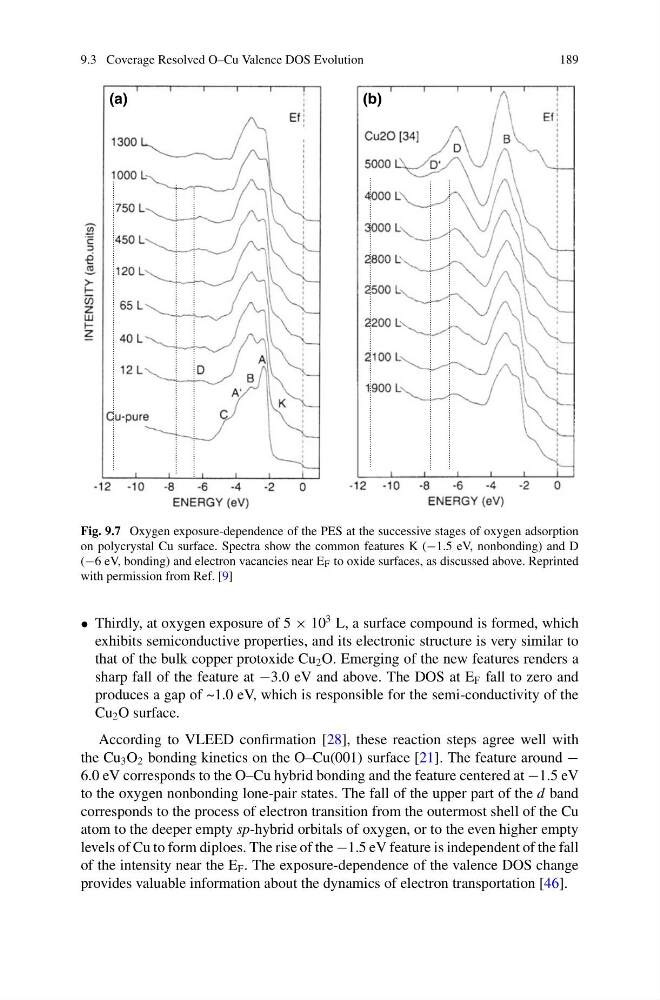
Fig. 9.7 Oxygen exposure-dependence of the PES at the successive stages of oxygen adsorption
on polycrystal Cu surface. Spectra show the common features K (−1.5 eV, nonbonding) and D
(−6 eV, bonding) and electron vacancies near E F to oxide surfaces, as discussed above. Reprinted
with permission from Ref. [9]
• Thirdly, at oxygen exposure of 5 × 10
3 L, a surface compound is formed, which
exhibits semiconductive properties, and its electronic structure is very similar to
that of the bulk copper protoxide Cu 2 O. Emerging of the new features renders a
sharp fall of the feature at −3.0 eV and above. The DOS at E F fall to zero and
produces a gap of ~1.0 eV, which is responsible for the semi-conductivity of the
Cu 2 O surface.
According to VLEED confirmation [28], these reaction steps agree well with
the Cu 3 O 2 bonding kinetics on the O–Cu(001) surface [21]. The feature around −
6.0 eV corresponds to the O–Cu hybrid bonding and the feature centered at −1.5 eV
to the oxygen nonbonding lone-pair states. The fall of the upper part of the d band
corresponds to the process of electron transition from the outermost shell of the Cu
atom to the deeper empty sp-hybrid orbitals of oxygen, or to the even higher empty
levels of Cu to form diploes. The rise of the −1.5 eV feature is independent of the fall
of the intensity near the E F . The exposure-dependence of the valence DOS change
provides valuable information about the dynamics of electron transportation [46].
189
(a)
(b)
Fig. 9.7 Oxygen exposure-dependence of the PES at the successive stages of oxygen adsorption
on polycrystal Cu surface. Spectra show the common features K (−1.5 eV, nonbonding) and D
(−6 eV, bonding) and electron vacancies near E F to oxide surfaces, as discussed above. Reprinted
with permission from Ref. [9]
• Thirdly, at oxygen exposure of 5 × 10
3 L, a surface compound is formed, which
exhibits semiconductive properties, and its electronic structure is very similar to
that of the bulk copper protoxide Cu 2 O. Emerging of the new features renders a
sharp fall of the feature at −3.0 eV and above. The DOS at E F fall to zero and
produces a gap of ~1.0 eV, which is responsible for the semi-conductivity of the
Cu 2 O surface.
According to VLEED confirmation [28], these reaction steps agree well with
the Cu 3 O 2 bonding kinetics on the O–Cu(001) surface [21]. The feature around −
6.0 eV corresponds to the O–Cu hybrid bonding and the feature centered at −1.5 eV
to the oxygen nonbonding lone-pair states. The fall of the upper part of the d band
corresponds to the process of electron transition from the outermost shell of the Cu
atom to the deeper empty sp-hybrid orbitals of oxygen, or to the even higher empty
levels of Cu to form diploes. The rise of the −1.5 eV feature is independent of the fall
of the intensity near the E F . The exposure-dependence of the valence DOS change
provides valuable information about the dynamics of electron transportation [46].