

152
7 Carbon Allotropes
E 1s (z) − E 1s (0)
E 1s (z , ) − E 1s (0)
=
E z
E z
=
C
−2.56
z
C
−2.56
z
; (z
,
= z)
(7.1)
With the given C 1s values (for z = 2, 3, 5.335) of 285.97, 284.87, and 284.27 eV
[88], one can easily calculate the values of E 1s (0) and 1s (12). The mean value of
is 282.57 ± 0.01 eV for an isolated C atom and the bulk shift 1s (12) =
1.321 ± 0.001 eV. Therefore, the following formulates the CN-resolved C 1s shift
(z > 2):
E 1s (z) = E 1s (0) + E (12)C
−2.56
z
= 282.57 ± 0.01 + 1.32C
−2.56
z
(eV) (7.2)
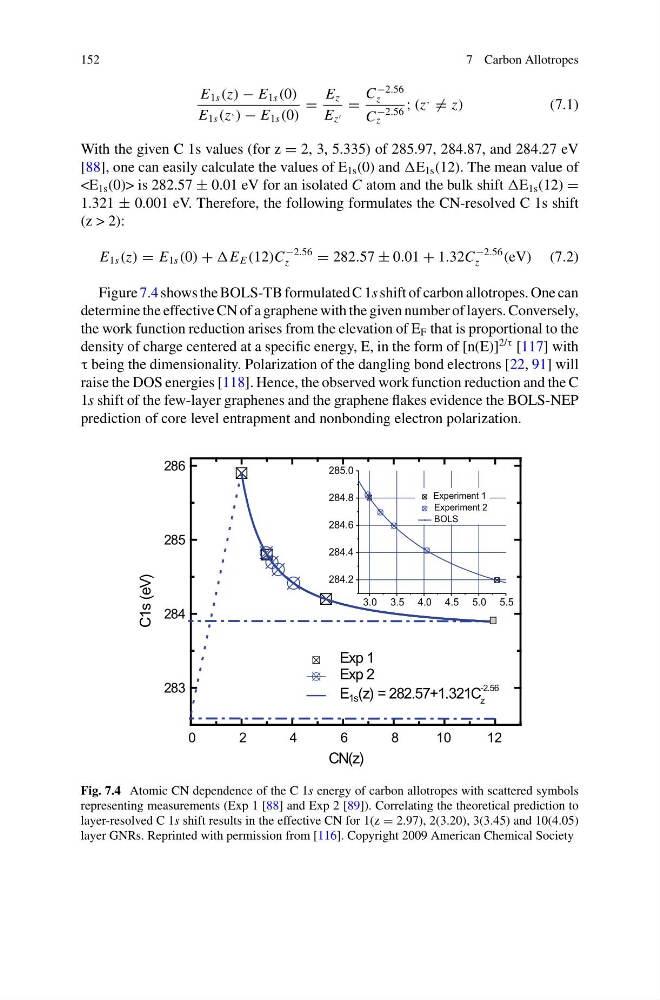
Figure 7.4 shows the BOLS-TB formulated C 1s shift of carbon allotropes. One can
determine the effective CN of a graphene with the given number of layers. Conversely,
the work function reduction arises from the elevation of E F that is proportional to the
density of charge centered at a specific energy, E, in the form of [n(E)]
2/τ [117] with
τ being the dimensionality. Polarization of the dangling bond electrons [22, 91] will
raise the DOS energies [118]. Hence, the observed work function reduction and the C
1s shift of the few-layer graphenes and the graphene flakes evidence the BOLS-NEP
prediction of core level entrapment and nonbonding electron polarization.
0
2
4
6
8
1 0
1 2
283
284
285
286
C1s (eV)
CN(z)
Exp 1
Exp 2
E 1s (z) = 282.57+1.321C
-2.56
z
3.0 3.5 4.0 4.5 5.0 5.5
284.2
284.4
284.6
284.8
285.0
Experiment 1
Experiment 2
BOLS
Fig. 7.4 Atomic CN dependence of the C 1s energy of carbon allotropes with scattered symbols
representing measurements (Exp 1 [88] and Exp 2 [89]). Correlating the theoretical prediction to
layer-resolved C 1s shift results in the effective CN for 1(z = 2.97), 2(3.20), 3(3.45) and 10(4.05)
layer GNRs. Reprinted with permission from [116]. Copyright 2009 American Chemical Society
7 Carbon Allotropes
E 1s (z) − E 1s (0)
E 1s (z , ) − E 1s (0)
=
E z
E z
=
C
−2.56
z
C
−2.56
z
; (z
,
= z)
(7.1)
With the given C 1s values (for z = 2, 3, 5.335) of 285.97, 284.87, and 284.27 eV
[88], one can easily calculate the values of E 1s (0) and 1s (12). The mean value of
1.321 ± 0.001 eV. Therefore, the following formulates the CN-resolved C 1s shift
(z > 2):
E 1s (z) = E 1s (0) + E (12)C
−2.56
z
= 282.57 ± 0.01 + 1.32C
−2.56
z
(eV) (7.2)
Figure 7.4 shows the BOLS-TB formulated C 1s shift of carbon allotropes. One can
determine the effective CN of a graphene with the given number of layers. Conversely,
the work function reduction arises from the elevation of E F that is proportional to the
density of charge centered at a specific energy, E, in the form of [n(E)]
2/τ [117] with
τ being the dimensionality. Polarization of the dangling bond electrons [22, 91] will
raise the DOS energies [118]. Hence, the observed work function reduction and the C
1s shift of the few-layer graphenes and the graphene flakes evidence the BOLS-NEP
prediction of core level entrapment and nonbonding electron polarization.
0
2
4
6
8
1 0
1 2
283
284
285
286
C1s (eV)
CN(z)
Exp 1
Exp 2
E 1s (z) = 282.57+1.321C
-2.56
z
3.0 3.5 4.0 4.5 5.0 5.5
284.2
284.4
284.6
284.8
285.0
Experiment 1
Experiment 2
BOLS
Fig. 7.4 Atomic CN dependence of the C 1s energy of carbon allotropes with scattered symbols
representing measurements (Exp 1 [88] and Exp 2 [89]). Correlating the theoretical prediction to
layer-resolved C 1s shift results in the effective CN for 1(z = 2.97), 2(3.20), 3(3.45) and 10(4.05)
layer GNRs. Reprinted with permission from [116]. Copyright 2009 American Chemical Society