

7.4 ZPS: Monolayer Skin Entrapment and Defect Polarization
153
7.4 ZPS: Monolayer Skin Entrapment and Defect
Polarization
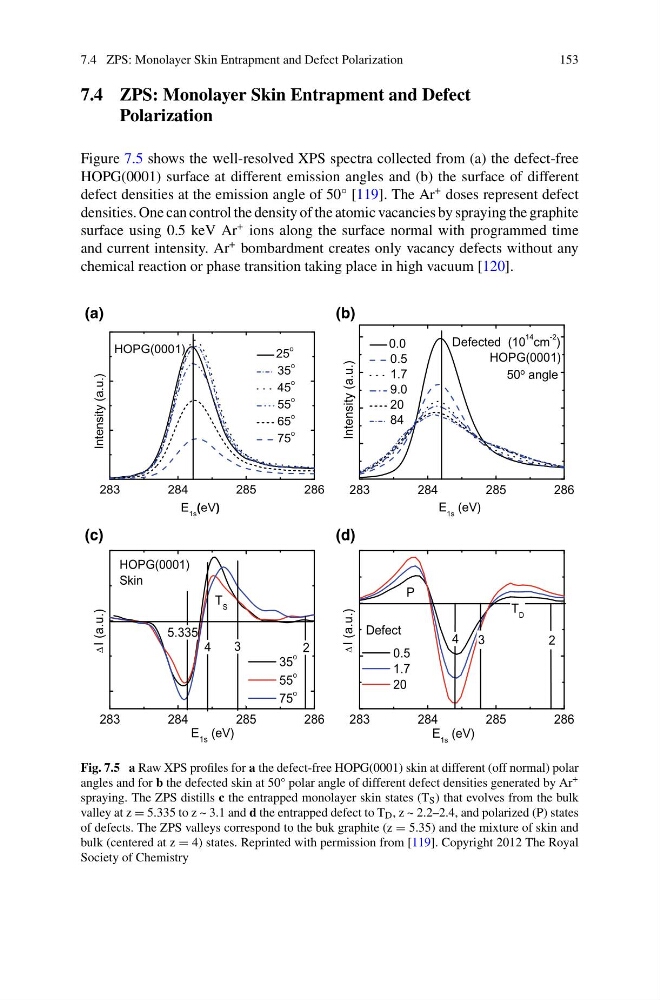
Figure 7.5 shows the well-resolved XPS spectra collected from (a) the defect-free
HOPG(0001) surface at different emission angles and (b) the surface of different
defect densities at the emission angle of 50° [119]. The Ar
+ doses represent defect
densities. One can control the density of the atomic vacancies by spraying the graphite
surface using 0.5 keV Ar
+ ions along the surface normal with programmed time
and current intensity. Ar
+ bombardment creates only vacancy defects without any
chemical reaction or phase transition taking place in high vacuum [120].
Intensity (a.u.)
E 1s (eV)
25
o
35
o
45
o
55
o
65
o
75
o
(a)
HOPG(0001)
Intensity (a.u.)
E 1s (eV)
0.0
0.5
1.7
9.0
20
84
(b)
50 o angle
Defected (10
14 cm
-2
)
HOPG(0001)
E 1s (eV)
I (a.u.)
35
o
55
o
75
o
5.335
4
3
2
T S
HOPG(0001)
Skin
(c)
283
284
285
286
283
284
285
286
283
284
285
286
283
284
285
286
I (a.u.)
E 1s (eV)
0.5
1.7
20
3
2
T D
P
(d)
Defect
4
Fig. 7.5 a Raw XPS profiles for a the defect-free HOPG(0001) skin at different (off normal) polar
angles and for b the defected skin at 50° polar angle of different defect densities generated by Ar +
spraying. The ZPS distills c the entrapped monolayer skin states (T S ) that evolves from the bulk
valley at z = 5.335 to z ~ 3.1 and d the entrapped defect to T D , z ~ 2.2–2.4, and polarized (P) states
of defects. The ZPS valleys correspond to the buk graphite (z = 5.35) and the mixture of skin and
bulk (centered at z = 4) states. Reprinted with permission from [119]. Copyright 2012 The Royal
Society of Chemistry
153
7.4 ZPS: Monolayer Skin Entrapment and Defect
Polarization
Figure 7.5 shows the well-resolved XPS spectra collected from (a) the defect-free
HOPG(0001) surface at different emission angles and (b) the surface of different
defect densities at the emission angle of 50° [119]. The Ar
+ doses represent defect
densities. One can control the density of the atomic vacancies by spraying the graphite
surface using 0.5 keV Ar
+ ions along the surface normal with programmed time
and current intensity. Ar
+ bombardment creates only vacancy defects without any
chemical reaction or phase transition taking place in high vacuum [120].
Intensity (a.u.)
E 1s (eV)
25
o
35
o
45
o
55
o
65
o
75
o
(a)
HOPG(0001)
Intensity (a.u.)
E 1s (eV)
0.0
0.5
1.7
9.0
20
84
(b)
50 o angle
Defected (10
14 cm
-2
)
HOPG(0001)
E 1s (eV)
I (a.u.)
35
o
55
o
75
o
5.335
4
3
2
T S
HOPG(0001)
Skin
(c)
283
284
285
286
283
284
285
286
283
284
285
286
283
284
285
286
I (a.u.)
E 1s (eV)
0.5
1.7
20
3
2
T D
P
(d)
Defect
4
Fig. 7.5 a Raw XPS profiles for a the defect-free HOPG(0001) skin at different (off normal) polar
angles and for b the defected skin at 50° polar angle of different defect densities generated by Ar +
spraying. The ZPS distills c the entrapped monolayer skin states (T S ) that evolves from the bulk
valley at z = 5.335 to z ~ 3.1 and d the entrapped defect to T D , z ~ 2.2–2.4, and polarized (P) states
of defects. The ZPS valleys correspond to the buk graphite (z = 5.35) and the mixture of skin and
bulk (centered at z = 4) states. Reprinted with permission from [119]. Copyright 2012 The Royal
Society of Chemistry