

7.2 Experimental Observations
151
[89]. This observation follows the same trend demonstrated by C 60 - deposited on
CuPc substrate as detected using UPS, XPS, and synchrotron radiation [90]. Lin et al.
[111] examined systematically the suspended and grounded graphene of different
number of layers and confirmed the same trend of C 1s and work function change.
The C 1s shift of other allotropes also show the same atomic-CN dependent trend
[112]. Variation of the emission and azimuth angles [113] and surface termination
affect the C 1s spectral features [114]. The cooperative relaxation of the C 1s and
the work function indicates that quantum entrapment and polarization take place
simultaneously and their extents increase as the atomic CN is reduced.
7.3 BOLS-TB Formulation and Quantification
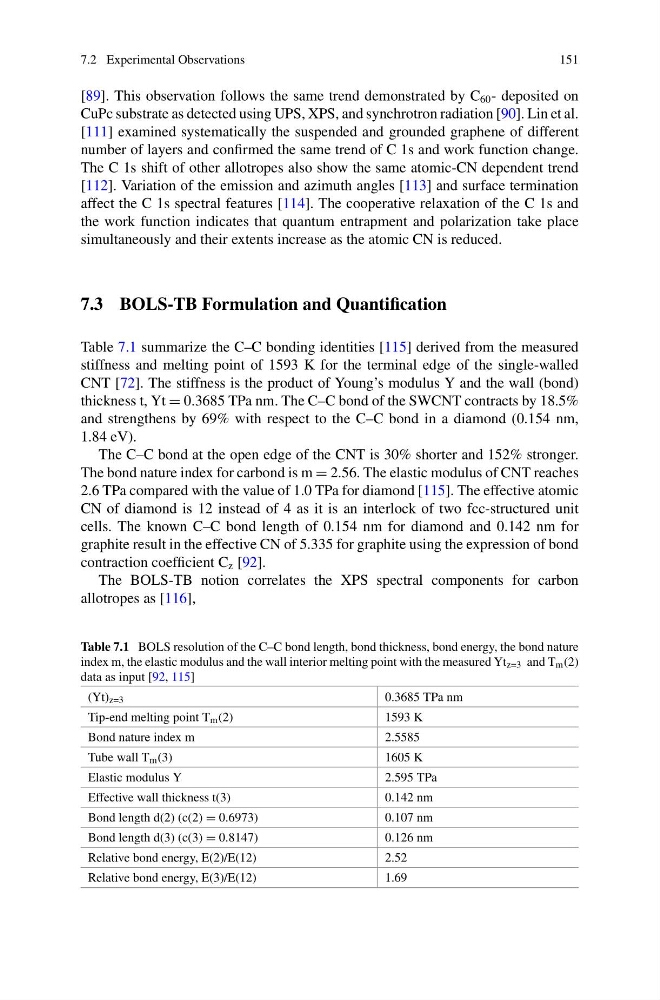
Table 7.1 summarize the C–C bonding identities [115] derived from the measured
stiffness and melting point of 1593 K for the terminal edge of the single-walled
CNT [72]. The stiffness is the product of Young’s modulus Y and the wall (bond)
thickness t, Yt = 0.3685 TPa nm. The C–C bond of the SWCNT contracts by 18.5%
and strengthens by 69% with respect to the C–C bond in a diamond (0.154 nm,
1.84 eV).
The C–C bond at the open edge of the CNT is 30% shorter and 152% stronger.
The bond nature index for carbond is m = 2.56. The elastic modulus of CNT reaches
2.6 TPa compared with the value of 1.0 TPa for diamond [115]. The effective atomic
CN of diamond is 12 instead of 4 as it is an interlock of two fcc-structured unit
cells. The known C–C bond length of 0.154 nm for diamond and 0.142 nm for
graphite result in the effective CN of 5.335 for graphite using the expression of bond
contraction coefficient C z [92].
The BOLS-TB notion correlates the XPS spectral components for carbon
allotropes as [116],
Table 7.1 BOLS resolution of the C–C bond length, bond thickness, bond energy, the bond nature
index m, the elastic modulus and the wall interior melting point with the measured Yt z=3 and T m (2)
data as input [92, 115]
(Yt) z=3
0.3685 TPa nm
Tip-end melting point T m (2)
1593 K
Bond nature index m
2.5585
Tube wall T m (3)
1605 K
Elastic modulus Y
2.595 TPa
Effective wall thickness t(3)
0.142 nm
Bond length d(2) (c(2) = 0.6973)
0.107 nm
Bond length d(3) (c(3) = 0.8147)
0.126 nm
Relative bond energy, E(2)/E(12)
2.52
Relative bond energy, E(3)/E(12)
1.69
151
[89]. This observation follows the same trend demonstrated by C 60 - deposited on
CuPc substrate as detected using UPS, XPS, and synchrotron radiation [90]. Lin et al.
[111] examined systematically the suspended and grounded graphene of different
number of layers and confirmed the same trend of C 1s and work function change.
The C 1s shift of other allotropes also show the same atomic-CN dependent trend
[112]. Variation of the emission and azimuth angles [113] and surface termination
affect the C 1s spectral features [114]. The cooperative relaxation of the C 1s and
the work function indicates that quantum entrapment and polarization take place
simultaneously and their extents increase as the atomic CN is reduced.
7.3 BOLS-TB Formulation and Quantification
Table 7.1 summarize the C–C bonding identities [115] derived from the measured
stiffness and melting point of 1593 K for the terminal edge of the single-walled
CNT [72]. The stiffness is the product of Young’s modulus Y and the wall (bond)
thickness t, Yt = 0.3685 TPa nm. The C–C bond of the SWCNT contracts by 18.5%
and strengthens by 69% with respect to the C–C bond in a diamond (0.154 nm,
1.84 eV).
The C–C bond at the open edge of the CNT is 30% shorter and 152% stronger.
The bond nature index for carbond is m = 2.56. The elastic modulus of CNT reaches
2.6 TPa compared with the value of 1.0 TPa for diamond [115]. The effective atomic
CN of diamond is 12 instead of 4 as it is an interlock of two fcc-structured unit
cells. The known C–C bond length of 0.154 nm for diamond and 0.142 nm for
graphite result in the effective CN of 5.335 for graphite using the expression of bond
contraction coefficient C z [92].
The BOLS-TB notion correlates the XPS spectral components for carbon
allotropes as [116],
Table 7.1 BOLS resolution of the C–C bond length, bond thickness, bond energy, the bond nature
index m, the elastic modulus and the wall interior melting point with the measured Yt z=3 and T m (2)
data as input [92, 115]
(Yt) z=3
0.3685 TPa nm
Tip-end melting point T m (2)
1593 K
Bond nature index m
2.5585
Tube wall T m (3)
1605 K
Elastic modulus Y
2.595 TPa
Effective wall thickness t(3)
0.142 nm
Bond length d(2) (c(2) = 0.6973)
0.107 nm
Bond length d(3) (c(3) = 0.8147)
0.126 nm
Relative bond energy, E(2)/E(12)
2.52
Relative bond energy, E(3)/E(12)
1.69