

150
7 Carbon Allotropes
The knock-on energy threshold for ejecting an in-lattice carbon atom with three
bonds is 17.0 eV, corresponding to a beam-energy of 86 keV, and hence those atoms
are not ejected by the 80-keV beams. However, this threshold drops below the maximum transfer energy to 15 eV for sites with a neighboring vacancy and may be even
less, where atoms at the edge may have several vacant next-nearest-neighbor sites.
The observation means that the minimal energy (15/2 = 7.50 eV/bond) required for
breaking a bond between two-coordinated carbon atoms is 32% times higher than
that (17/3 = 5.67 eV/bond) required for breaking a bond between three-coordinated
carbon atoms in the suspended graphene [49].
7.2.3 XPS: Core Level and Work Function
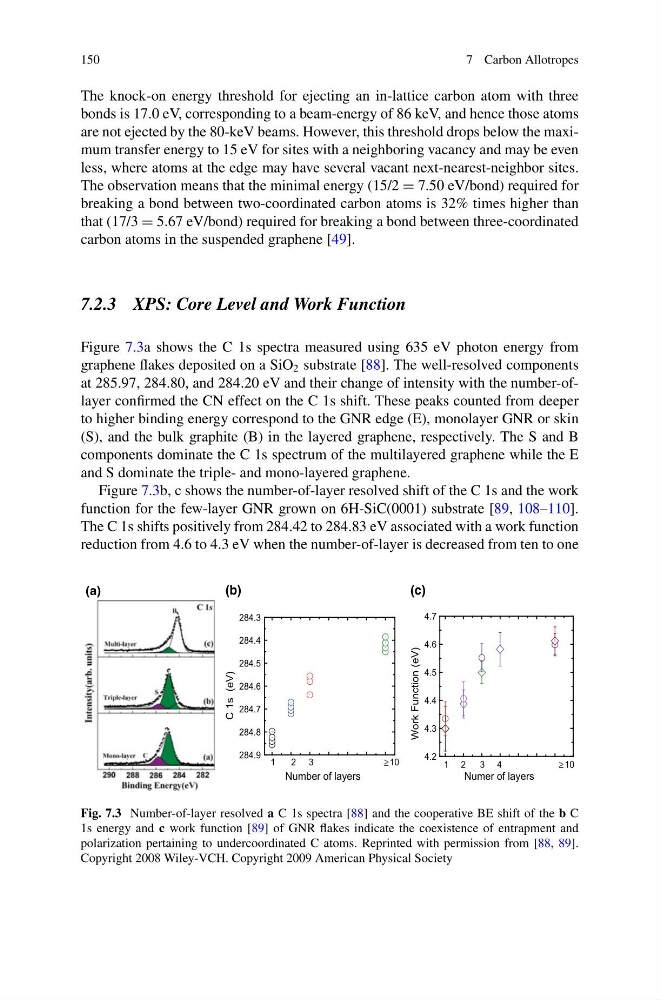
Figure 7.3a shows the C 1s spectra measured using 635 eV photon energy from
graphene flakes deposited on a SiO 2 substrate [88]. The well-resolved components
at 285.97, 284.80, and 284.20 eV and their change of intensity with the number-oflayer confirmed the CN effect on the C 1s shift. These peaks counted from deeper
to higher binding energy correspond to the GNR edge (E), monolayer GNR or skin
(S), and the bulk graphite (B) in the layered graphene, respectively. The S and B
components dominate the C 1s spectrum of the multilayered graphene while the E
and S dominate the triple- and mono-layered graphene.
Figure 7.3b, c shows the number-of-layer resolved shift of the C 1s and the work
function for the few-layer GNR grown on 6H-SiC(0001) substrate [89, 108–110].
The C 1s shifts positively from 284.42 to 284.83 eV associated with a work function
reduction from 4.6 to 4.3 eV when the number-of-layer is decreased from ten to one
284.9
284.8
284.7
284.6
284.5
284.4
284.3
C 1s (eV)
Number of layers
1
2 3
≥ 10
(b)
4.2
4.3
4.4
4.5
4.6
4.7
≥ 10
4
3
2
Work Function (eV)
Numer of layers
(c)
1
(a)
Fig. 7.3 Number-of-layer resolved a C 1s spectra [88] and the cooperative BE shift of the b C
1s energy and c work function [89] of GNR flakes indicate the coexistence of entrapment and
polarization pertaining to undercoordinated C atoms. Reprinted with permission from [88, 89].
Copyright 2008 Wiley-VCH. Copyright 2009 American Physical Society
7 Carbon Allotropes
The knock-on energy threshold for ejecting an in-lattice carbon atom with three
bonds is 17.0 eV, corresponding to a beam-energy of 86 keV, and hence those atoms
are not ejected by the 80-keV beams. However, this threshold drops below the maximum transfer energy to 15 eV for sites with a neighboring vacancy and may be even
less, where atoms at the edge may have several vacant next-nearest-neighbor sites.
The observation means that the minimal energy (15/2 = 7.50 eV/bond) required for
breaking a bond between two-coordinated carbon atoms is 32% times higher than
that (17/3 = 5.67 eV/bond) required for breaking a bond between three-coordinated
carbon atoms in the suspended graphene [49].
7.2.3 XPS: Core Level and Work Function
Figure 7.3a shows the C 1s spectra measured using 635 eV photon energy from
graphene flakes deposited on a SiO 2 substrate [88]. The well-resolved components
at 285.97, 284.80, and 284.20 eV and their change of intensity with the number-oflayer confirmed the CN effect on the C 1s shift. These peaks counted from deeper
to higher binding energy correspond to the GNR edge (E), monolayer GNR or skin
(S), and the bulk graphite (B) in the layered graphene, respectively. The S and B
components dominate the C 1s spectrum of the multilayered graphene while the E
and S dominate the triple- and mono-layered graphene.
Figure 7.3b, c shows the number-of-layer resolved shift of the C 1s and the work
function for the few-layer GNR grown on 6H-SiC(0001) substrate [89, 108–110].
The C 1s shifts positively from 284.42 to 284.83 eV associated with a work function
reduction from 4.6 to 4.3 eV when the number-of-layer is decreased from ten to one
284.9
284.8
284.7
284.6
284.5
284.4
284.3
C 1s (eV)
Number of layers
1
2 3
≥ 10
(b)
4.2
4.3
4.4
4.5
4.6
4.7
≥ 10
4
3
2
Work Function (eV)
Numer of layers
(c)
1
(a)
Fig. 7.3 Number-of-layer resolved a C 1s spectra [88] and the cooperative BE shift of the b C
1s energy and c work function [89] of GNR flakes indicate the coexistence of entrapment and
polarization pertaining to undercoordinated C atoms. Reprinted with permission from [88, 89].
Copyright 2008 Wiley-VCH. Copyright 2009 American Physical Society