

7.2 Experimental Observations
149
distance along the edge, see Fig. 7.1c. BOLS-TB and DFT derived edge LDOS for
atomic vacancy and GNR edge manifest a sharp resonant peak at E F , which is the
same to that probed using STS from an atomic vacancy of graphite skin [43]. The
locally and densely entrapped bonding electrons pin the DFPs through polarization.
However, along the armchair-GNR edge and the reconstructed-zigzag-GNR edge,
the quasi-triple-bond formation between the nearest edge atoms of d distance or less
prevents the DFPs formation.
7.2.2 TEM: CN-Resolved C–C Bond Energy
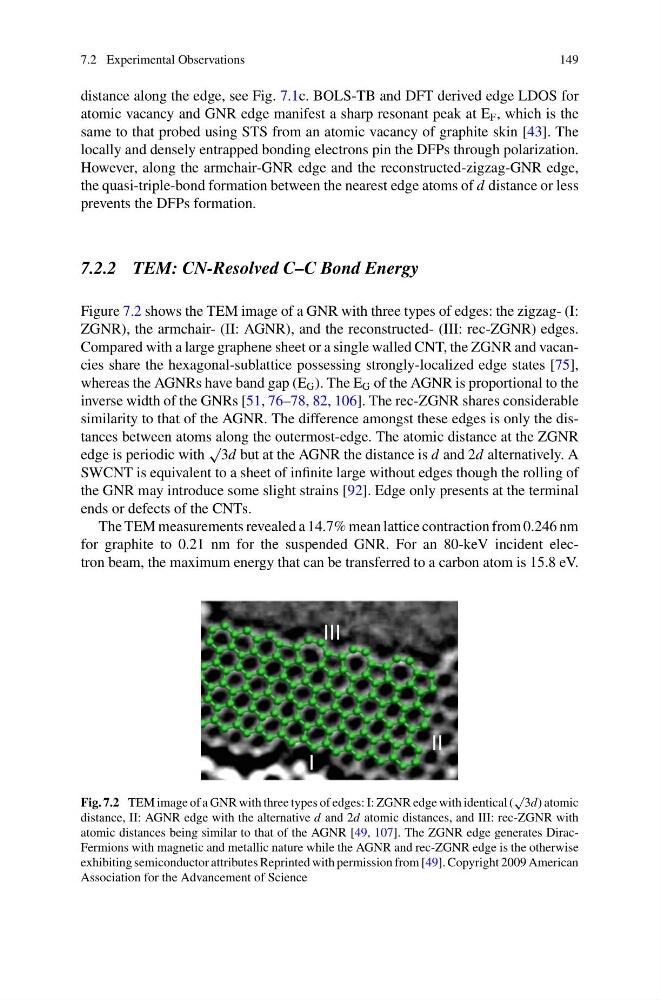
Figure 7.2 shows the TEM image of a GNR with three types of edges: the zigzag- (I:
ZGNR), the armchair- (II: AGNR), and the reconstructed- (III: rec-ZGNR) edges.
Compared with a large graphene sheet or a single walled CNT, the ZGNR and vacancies share the hexagonal-sublattice possessing strongly-localized edge states [75],
whereas the AGNRs have band gap (E G ). The E G of the AGNR is proportional to the
inverse width of the GNRs [51, 76–78, 82, 106]. The rec-ZGNR shares considerable
similarity to that of the AGNR. The difference amongst these edges is only the distances between atoms along the outermost-edge. The atomic distance at the ZGNR
edge is periodic with
√
3d but at the AGNR the distance is d and 2d alternatively. A
SWCNT is equivalent to a sheet of infinite large without edges though the rolling of
the GNR may introduce some slight strains [92]. Edge only presents at the terminal
ends or defects of the CNTs.
The TEM measurements revealed a 14.7% mean lattice contraction from 0.246 nm
for graphite to 0.21 nm for the suspended GNR. For an 80-keV incident electron beam, the maximum energy that can be transferred to a carbon atom is 15.8 eV.
II
III
I
Fig. 7.2 TEM image of a GNR with three types of edges: I: ZGNR edge with identical (
√
3d) atomic
distance, II: AGNR edge with the alternative d and 2d atomic distances, and III: rec-ZGNR with
atomic distances being similar to that of the AGNR [49, 107]. The ZGNR edge generates DiracFermions with magnetic and metallic nature while the AGNR and rec-ZGNR edge is the otherwise
exhibiting semiconductor attributes Reprinted with permission from [49]. Copyright 2009 American
Association for the Advancement of Science
149
distance along the edge, see Fig. 7.1c. BOLS-TB and DFT derived edge LDOS for
atomic vacancy and GNR edge manifest a sharp resonant peak at E F , which is the
same to that probed using STS from an atomic vacancy of graphite skin [43]. The
locally and densely entrapped bonding electrons pin the DFPs through polarization.
However, along the armchair-GNR edge and the reconstructed-zigzag-GNR edge,
the quasi-triple-bond formation between the nearest edge atoms of d distance or less
prevents the DFPs formation.
7.2.2 TEM: CN-Resolved C–C Bond Energy
Figure 7.2 shows the TEM image of a GNR with three types of edges: the zigzag- (I:
ZGNR), the armchair- (II: AGNR), and the reconstructed- (III: rec-ZGNR) edges.
Compared with a large graphene sheet or a single walled CNT, the ZGNR and vacancies share the hexagonal-sublattice possessing strongly-localized edge states [75],
whereas the AGNRs have band gap (E G ). The E G of the AGNR is proportional to the
inverse width of the GNRs [51, 76–78, 82, 106]. The rec-ZGNR shares considerable
similarity to that of the AGNR. The difference amongst these edges is only the distances between atoms along the outermost-edge. The atomic distance at the ZGNR
edge is periodic with
√
3d but at the AGNR the distance is d and 2d alternatively. A
SWCNT is equivalent to a sheet of infinite large without edges though the rolling of
the GNR may introduce some slight strains [92]. Edge only presents at the terminal
ends or defects of the CNTs.
The TEM measurements revealed a 14.7% mean lattice contraction from 0.246 nm
for graphite to 0.21 nm for the suspended GNR. For an 80-keV incident electron beam, the maximum energy that can be transferred to a carbon atom is 15.8 eV.
II
III
I
Fig. 7.2 TEM image of a GNR with three types of edges: I: ZGNR edge with identical (
√
3d) atomic
distance, II: AGNR edge with the alternative d and 2d atomic distances, and III: rec-ZGNR with
atomic distances being similar to that of the AGNR [49, 107]. The ZGNR edge generates DiracFermions with magnetic and metallic nature while the AGNR and rec-ZGNR edge is the otherwise
exhibiting semiconductor attributes Reprinted with permission from [49]. Copyright 2009 American
Association for the Advancement of Science