

5.3 ZPS of Rh, W, and Re Kink Edges
89
the (1 × 2) while every other pairing-raw of atoms is missing in the (1 × 1) + (1 ×
2) surface. A is the atom near the missing-row vacancy M.
Although the surface coverage remains 0.5 ML, the effective CN of the E atom
near the (1 × 2) single-missing-row vacancy is slightly lower than that of the other.
Panel (c) is the bcc(110) vicinal surfaces with indicated red edge atoms. In contrast
to the smooth hcp(0001) surface, the (1231) surface is much rougher with higher
fraction of even undercoordinated kink atoms. These even undercoordinated atoms
will enhance the BOLS-NEP effect on entrapment and polarization, giving rise unexpected properties such as the Dirac-Fermion carrier of the topological insulators. ZPS
can resolve the effect of tiny CN difference on the CLS.
5.3.2 Rh(110) and (111) Vicinal Edges
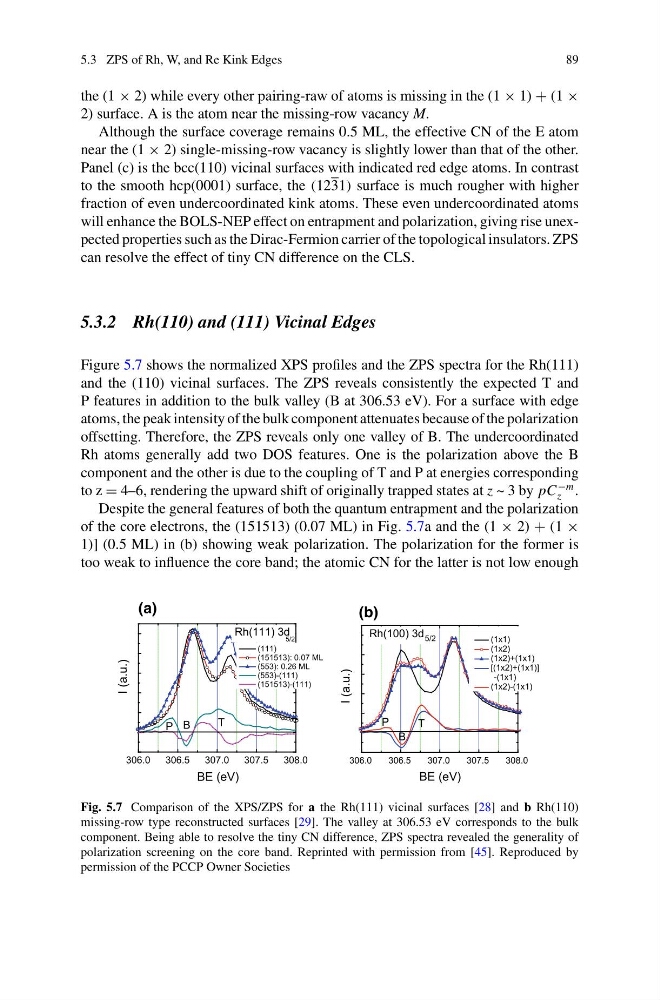
Figure 5.7 shows the normalized XPS profiles and the ZPS spectra for the Rh(111)
and the (110) vicinal surfaces. The ZPS reveals consistently the expected T and
P features in addition to the bulk valley (B at 306.53 eV). For a surface with edge
atoms, the peak intensity of the bulk component attenuates because of the polarization
offsetting. Therefore, the ZPS reveals only one valley of B. The undercoordinated
Rh atoms generally add two DOS features. One is the polarization above the B
component and the other is due to the coupling of T and P at energies corresponding
to z = 4–6, rendering the upward shift of originally trapped states at z ~ 3 by pC
−m
z .
Despite the general features of both the quantum entrapment and the polarization
of the core electrons, the (151513) (0.07 ML) in Fig. 5.7a and the (1 × 2) + (1 ×
1)] (0.5 ML) in (b) showing weak polarization. The polarization for the former is
too weak to influence the core band; the atomic CN for the latter is not low enough
306.0
306.5
307.0
307.5
308.0
I (a.u.)
BE (eV)
(111)
(151513): 0.07 ML
(553): 0.26 ML
(553)-(111)
(151513)-(111)
Rh(111) 3d
5/2
(a)
P
T
B
306.0
306.5
307.0
307.5
308.0
I (a.u.)
BE (eV)
(1x1)
(1x2)
(1x2)+(1x1)
[(1x2)+(1x1)]
-(1x1)
(1x2)-(1x1)
(b)
Rh(100) 3d 5/2
P
T
B
Fig. 5.7 Comparison of the XPS/ZPS for a the Rh(111) vicinal surfaces [28] and b Rh(110)
missing-row type reconstructed surfaces [29]. The valley at 306.53 eV corresponds to the bulk
component. Being able to resolve the tiny CN difference, ZPS spectra revealed the generality of
polarization screening on the core band. Reprinted with permission from [45]. Reproduced by
permission of the PCCP Owner Societies
89
the (1 × 2) while every other pairing-raw of atoms is missing in the (1 × 1) + (1 ×
2) surface. A is the atom near the missing-row vacancy M.
Although the surface coverage remains 0.5 ML, the effective CN of the E atom
near the (1 × 2) single-missing-row vacancy is slightly lower than that of the other.
Panel (c) is the bcc(110) vicinal surfaces with indicated red edge atoms. In contrast
to the smooth hcp(0001) surface, the (1231) surface is much rougher with higher
fraction of even undercoordinated kink atoms. These even undercoordinated atoms
will enhance the BOLS-NEP effect on entrapment and polarization, giving rise unexpected properties such as the Dirac-Fermion carrier of the topological insulators. ZPS
can resolve the effect of tiny CN difference on the CLS.
5.3.2 Rh(110) and (111) Vicinal Edges
Figure 5.7 shows the normalized XPS profiles and the ZPS spectra for the Rh(111)
and the (110) vicinal surfaces. The ZPS reveals consistently the expected T and
P features in addition to the bulk valley (B at 306.53 eV). For a surface with edge
atoms, the peak intensity of the bulk component attenuates because of the polarization
offsetting. Therefore, the ZPS reveals only one valley of B. The undercoordinated
Rh atoms generally add two DOS features. One is the polarization above the B
component and the other is due to the coupling of T and P at energies corresponding
to z = 4–6, rendering the upward shift of originally trapped states at z ~ 3 by pC
−m
z .
Despite the general features of both the quantum entrapment and the polarization
of the core electrons, the (151513) (0.07 ML) in Fig. 5.7a and the (1 × 2) + (1 ×
1)] (0.5 ML) in (b) showing weak polarization. The polarization for the former is
too weak to influence the core band; the atomic CN for the latter is not low enough
306.0
306.5
307.0
307.5
308.0
I (a.u.)
BE (eV)
(111)
(151513): 0.07 ML
(553): 0.26 ML
(553)-(111)
(151513)-(111)
Rh(111) 3d
5/2
(a)
P
T
B
306.0
306.5
307.0
307.5
308.0
I (a.u.)
BE (eV)
(1x1)
(1x2)
(1x2)+(1x1)
[(1x2)+(1x1)]
-(1x1)
(1x2)-(1x1)
(b)
Rh(100) 3d 5/2
P
T
B
Fig. 5.7 Comparison of the XPS/ZPS for a the Rh(111) vicinal surfaces [28] and b Rh(110)
missing-row type reconstructed surfaces [29]. The valley at 306.53 eV corresponds to the bulk
component. Being able to resolve the tiny CN difference, ZPS spectra revealed the generality of
polarization screening on the core band. Reprinted with permission from [45]. Reproduced by
permission of the PCCP Owner Societies