

88
5 Adatoms, Defects, and Kink Edges
beneficial to oxidation but the Rh adatoms as a donor-type catalyst for reduction. During the reaction, Pt adatoms tend to capturing electrons from the reactant while the
Rh adatoms tend to donating. Strikingly, the undercoordination-induced entrapment
dominance of Pt and the polarization dominance may explain why Au and Pt adatoms
prefer different oxygen vacancy sites on the TiO 2 (110) surface (see Fig. 5.3). Along
with this guideline, it is possible to devise and search for new catalysts at different
needs using the ZPS spectrometrics.
5.3 ZPS of Rh, W, and Re Kink Edges
5.3.1 Atomic Arrangement at Edges
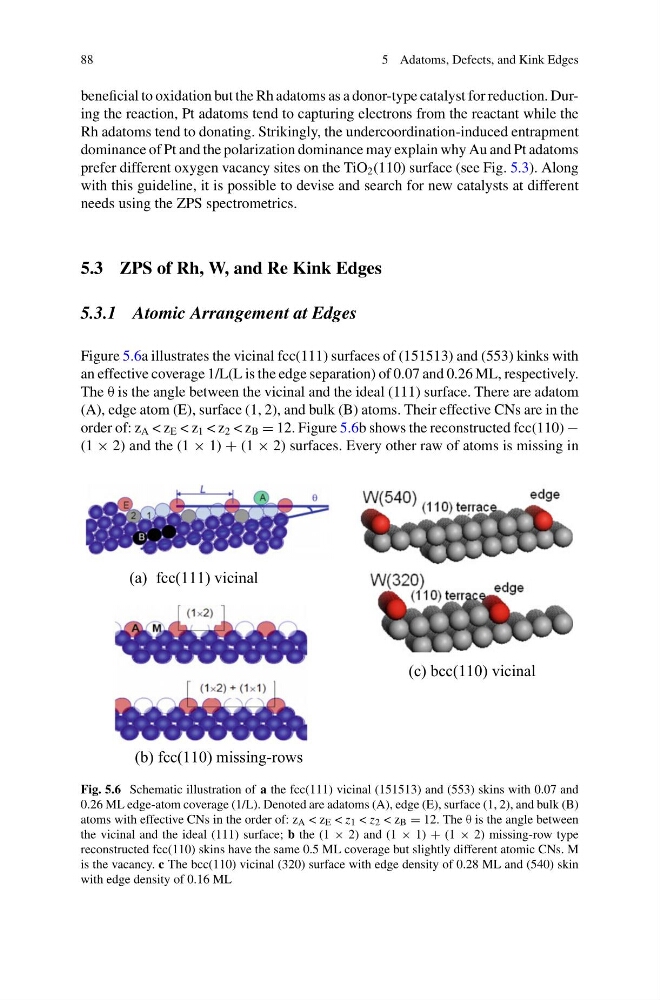
Figure 5.6a illustrates the vicinal fcc(111) surfaces of (151513) and (553) kinks with
an effective coverage 1/L(L is the edge separation) of 0.07 and 0.26 ML, respectively.
The θ is the angle between the vicinal and the ideal (111) surface. There are adatom
(A), edge atom (E), surface (1, 2), and bulk (B) atoms. Their effective CNs are in the
order of: z A < z E < z 1 < z 2 < z B = 12. Figure 5.6b shows the reconstructed fcc(110) −
(1 × 2) and the (1 × 1) + (1 × 2) surfaces. Every other raw of atoms is missing in
(c) bcc(110) vicinal
(a) fcc(111) vicinal
(b) fcc(110) missing-rows
Fig. 5.6 Schematic illustration of a the fcc(111) vicinal (151513) and (553) skins with 0.07 and
0.26 ML edge-atom coverage (1/L). Denoted are adatoms (A), edge (E), surface (1, 2), and bulk (B)
atoms with effective CNs in the order of: z A < z E < z 1 < z 2 < z B = 12. The θ is the angle between
the vicinal and the ideal (111) surface; b the (1 × 2) and (1 × 1) + (1 × 2) missing-row type
reconstructed fcc(110) skins have the same 0.5 ML coverage but slightly different atomic CNs. M
is the vacancy. c The bcc(110) vicinal (320) surface with edge density of 0.28 ML and (540) skin
with edge density of 0.16 ML
5 Adatoms, Defects, and Kink Edges
beneficial to oxidation but the Rh adatoms as a donor-type catalyst for reduction. During the reaction, Pt adatoms tend to capturing electrons from the reactant while the
Rh adatoms tend to donating. Strikingly, the undercoordination-induced entrapment
dominance of Pt and the polarization dominance may explain why Au and Pt adatoms
prefer different oxygen vacancy sites on the TiO 2 (110) surface (see Fig. 5.3). Along
with this guideline, it is possible to devise and search for new catalysts at different
needs using the ZPS spectrometrics.
5.3 ZPS of Rh, W, and Re Kink Edges
5.3.1 Atomic Arrangement at Edges
Figure 5.6a illustrates the vicinal fcc(111) surfaces of (151513) and (553) kinks with
an effective coverage 1/L(L is the edge separation) of 0.07 and 0.26 ML, respectively.
The θ is the angle between the vicinal and the ideal (111) surface. There are adatom
(A), edge atom (E), surface (1, 2), and bulk (B) atoms. Their effective CNs are in the
order of: z A < z E < z 1 < z 2 < z B = 12. Figure 5.6b shows the reconstructed fcc(110) −
(1 × 2) and the (1 × 1) + (1 × 2) surfaces. Every other raw of atoms is missing in
(c) bcc(110) vicinal
(a) fcc(111) vicinal
(b) fcc(110) missing-rows
Fig. 5.6 Schematic illustration of a the fcc(111) vicinal (151513) and (553) skins with 0.07 and
0.26 ML edge-atom coverage (1/L). Denoted are adatoms (A), edge (E), surface (1, 2), and bulk (B)
atoms with effective CNs in the order of: z A < z E < z 1 < z 2 < z B = 12. The θ is the angle between
the vicinal and the ideal (111) surface; b the (1 × 2) and (1 × 1) + (1 × 2) missing-row type
reconstructed fcc(110) skins have the same 0.5 ML coverage but slightly different atomic CNs. M
is the vacancy. c The bcc(110) vicinal (320) surface with edge density of 0.28 ML and (540) skin
with edge density of 0.16 ML