

5.2 ZPS of Pt and Rh Adatoms: Catalytic Nature
87
70.0 70.5 71.0 71.5 72.0
-0.3
0.0
0.3
0.6
0.9
T
I (a.u.)
BE (eV)
(1x1)
HEX
HEX-(1x1)
Pt(100) 4f 7/2
B
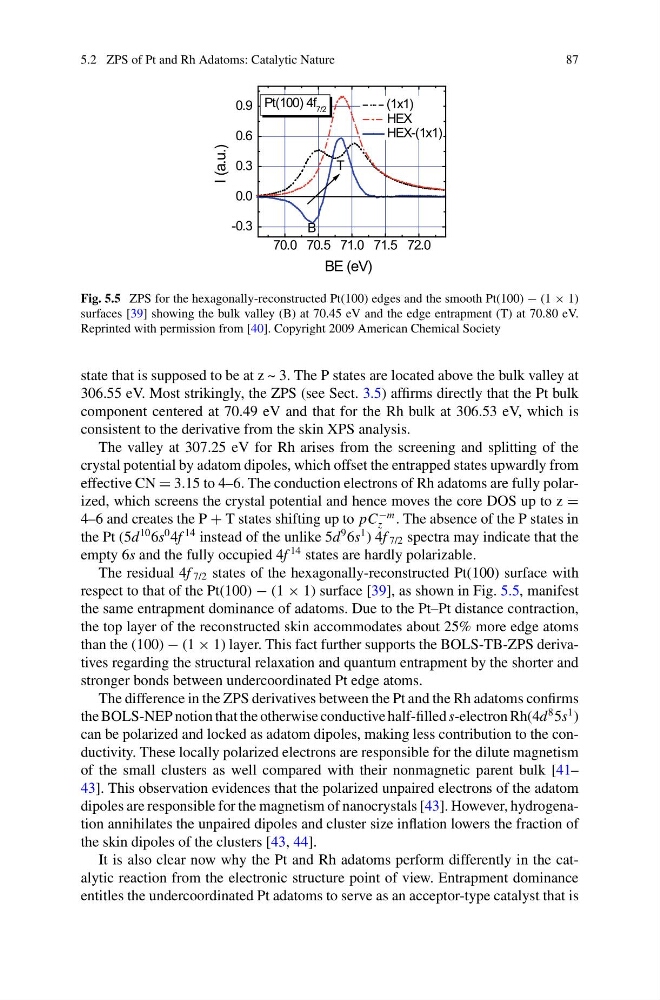
Fig. 5.5 ZPS for the hexagonally-reconstructed Pt(100) edges and the smooth Pt(100) − (1 × 1)
surfaces [39] showing the bulk valley (B) at 70.45 eV and the edge entrapment (T) at 70.80 eV.
Reprinted with permission from [40]. Copyright 2009 American Chemical Society
state that is supposed to be at z ~ 3. The P states are located above the bulk valley at
306.55 eV. Most strikingly, the ZPS (see Sect. 3.5) affirms directly that the Pt bulk
component centered at 70.49 eV and that for the Rh bulk at 306.53 eV, which is
consistent to the derivative from the skin XPS analysis.
The valley at 307.25 eV for Rh arises from the screening and splitting of the
crystal potential by adatom dipoles, which offset the entrapped states upwardly from
effective CN = 3.15 to 4–6. The conduction electrons of Rh adatoms are fully polarized, which screens the crystal potential and hence moves the core DOS up to z =
4–6 and creates the P + T states shifting up to pC
−m
z . The absence of the P states in
the Pt (5d
10 6s
0 4f
14 instead of the unlike 5d
9 6s
1 ) 4f 7/2 spectra may indicate that the
empty 6s and the fully occupied 4f
14 states are hardly polarizable.
The residual 4f 7/2 states of the hexagonally-reconstructed Pt(100) surface with
respect to that of the Pt(100) − (1 × 1) surface [39], as shown in Fig. 5.5, manifest
the same entrapment dominance of adatoms. Due to the Pt–Pt distance contraction,
the top layer of the reconstructed skin accommodates about 25% more edge atoms
than the (100) − (1 × 1) layer. This fact further supports the BOLS-TB-ZPS derivatives regarding the structural relaxation and quantum entrapment by the shorter and
stronger bonds between undercoordinated Pt edge atoms.
The difference in the ZPS derivatives between the Pt and the Rh adatoms confirms
the BOLS-NEP notion that the otherwise conductive half-filled s-electron Rh(4d
8 5s
1 )
can be polarized and locked as adatom dipoles, making less contribution to the conductivity. These locally polarized electrons are responsible for the dilute magnetism
of the small clusters as well compared with their nonmagnetic parent bulk [41–
43]. This observation evidences that the polarized unpaired electrons of the adatom
dipoles are responsible for the magnetism of nanocrystals [43]. However, hydrogenation annihilates the unpaired dipoles and cluster size inflation lowers the fraction of
the skin dipoles of the clusters [43, 44].
It is also clear now why the Pt and Rh adatoms perform differently in the catalytic reaction from the electronic structure point of view. Entrapment dominance
entitles the undercoordinated Pt adatoms to serve as an acceptor-type catalyst that is
87
70.0 70.5 71.0 71.5 72.0
-0.3
0.0
0.3
0.6
0.9
T
I (a.u.)
BE (eV)
(1x1)
HEX
HEX-(1x1)
Pt(100) 4f 7/2
B
Fig. 5.5 ZPS for the hexagonally-reconstructed Pt(100) edges and the smooth Pt(100) − (1 × 1)
surfaces [39] showing the bulk valley (B) at 70.45 eV and the edge entrapment (T) at 70.80 eV.
Reprinted with permission from [40]. Copyright 2009 American Chemical Society
state that is supposed to be at z ~ 3. The P states are located above the bulk valley at
306.55 eV. Most strikingly, the ZPS (see Sect. 3.5) affirms directly that the Pt bulk
component centered at 70.49 eV and that for the Rh bulk at 306.53 eV, which is
consistent to the derivative from the skin XPS analysis.
The valley at 307.25 eV for Rh arises from the screening and splitting of the
crystal potential by adatom dipoles, which offset the entrapped states upwardly from
effective CN = 3.15 to 4–6. The conduction electrons of Rh adatoms are fully polarized, which screens the crystal potential and hence moves the core DOS up to z =
4–6 and creates the P + T states shifting up to pC
−m
z . The absence of the P states in
the Pt (5d
10 6s
0 4f
14 instead of the unlike 5d
9 6s
1 ) 4f 7/2 spectra may indicate that the
empty 6s and the fully occupied 4f
14 states are hardly polarizable.
The residual 4f 7/2 states of the hexagonally-reconstructed Pt(100) surface with
respect to that of the Pt(100) − (1 × 1) surface [39], as shown in Fig. 5.5, manifest
the same entrapment dominance of adatoms. Due to the Pt–Pt distance contraction,
the top layer of the reconstructed skin accommodates about 25% more edge atoms
than the (100) − (1 × 1) layer. This fact further supports the BOLS-TB-ZPS derivatives regarding the structural relaxation and quantum entrapment by the shorter and
stronger bonds between undercoordinated Pt edge atoms.
The difference in the ZPS derivatives between the Pt and the Rh adatoms confirms
the BOLS-NEP notion that the otherwise conductive half-filled s-electron Rh(4d
8 5s
1 )
can be polarized and locked as adatom dipoles, making less contribution to the conductivity. These locally polarized electrons are responsible for the dilute magnetism
of the small clusters as well compared with their nonmagnetic parent bulk [41–
43]. This observation evidences that the polarized unpaired electrons of the adatom
dipoles are responsible for the magnetism of nanocrystals [43]. However, hydrogenation annihilates the unpaired dipoles and cluster size inflation lowers the fraction of
the skin dipoles of the clusters [43, 44].
It is also clear now why the Pt and Rh adatoms perform differently in the catalytic reaction from the electronic structure point of view. Entrapment dominance
entitles the undercoordinated Pt adatoms to serve as an acceptor-type catalyst that is