

86
5 Adatoms, Defects, and Kink Edges
chemisorbed, and reconstructed skins. The ZPS resolves a tiny change of atomic CN
and a trace of adsorption.
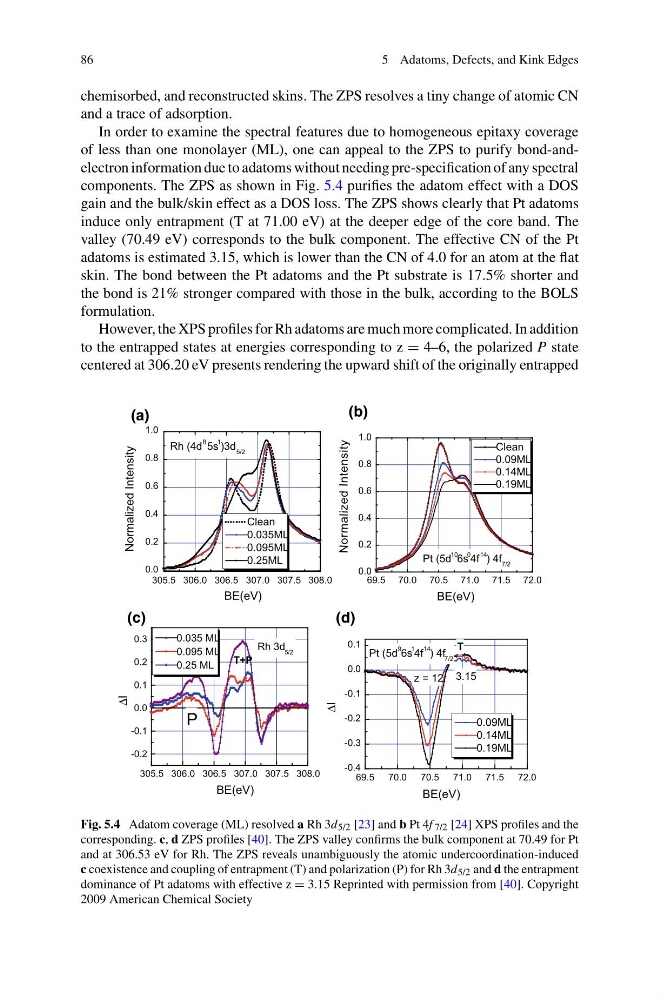
In order to examine the spectral features due to homogeneous epitaxy coverage
of less than one monolayer (ML), one can appeal to the ZPS to purify bond-andelectron information due to adatoms without needing pre-specification of any spectral
components. The ZPS as shown in Fig. 5.4 purifies the adatom effect with a DOS
gain and the bulk/skin effect as a DOS loss. The ZPS shows clearly that Pt adatoms
induce only entrapment (T at 71.00 eV) at the deeper edge of the core band. The
valley (70.49 eV) corresponds to the bulk component. The effective CN of the Pt
adatoms is estimated 3.15, which is lower than the CN of 4.0 for an atom at the flat
skin. The bond between the Pt adatoms and the Pt substrate is 17.5% shorter and
the bond is 21% stronger compared with those in the bulk, according to the BOLS
formulation.
However, the XPS profiles for Rh adatoms are much more complicated. In addition
to the entrapped states at energies corresponding to z = 4–6, the polarized P state
centered at 306.20 eV presents rendering the upward shift of the originally entrapped
305.5 306.0 306.5 307.0 307.5 308.0
0.0
0.2
0.4
0.6
0.8
1.0
Clean
0.035ML
0.095ML
0.25ML
Rh (4d
8 5s
1
)3d 5/2
Normalized Intensity
BE(eV)
(a)
305.5 306.0 306.5 307.0 307.5 308.0
-0.2
-0.1
0.0
0.1
0.2
0.3
Rh 3d 5/2
0.035 ML
0.095 ML
0.25 ML
ΔI
BE(eV)
(c)
P
T+P
69.5 70.0 70.5 71.0 71.5 72.0
0.0
0.2
0.4
0.6
0.8
1.0
Clean
0.09ML
0.14ML
0.19ML
Pt (5d
10
6s
0
4f
14
) 4f 7/2
Normalized Intensity
BE(eV)
(b)
69.5 70.0 70.5 71.0 71.5 72.0
-0.4
-0.3
-0.2
-0.1
0.0
0.1
Pt (5d
9
6s
1
4f
14
) 4f 7/2
0.09ML
0.14ML
0.19ML
ΔI
BE(eV)
3.15
z = 12
(d)
T
Fig. 5.4 Adatom coverage (ML) resolved a Rh 3d 5/2 [23] and b Pt 4f 7/2 [24] XPS profiles and the
corresponding. c, d ZPS profiles [40]. The ZPS valley confirms the bulk component at 70.49 for Pt
and at 306.53 eV for Rh. The ZPS reveals unambiguously the atomic undercoordination-induced
c coexistence and coupling of entrapment (T) and polarization (P) for Rh 3d 5/2 and d the entrapment
dominance of Pt adatoms with effective z = 3.15 Reprinted with permission from [40]. Copyright
2009 American Chemical Society
5 Adatoms, Defects, and Kink Edges
chemisorbed, and reconstructed skins. The ZPS resolves a tiny change of atomic CN
and a trace of adsorption.
In order to examine the spectral features due to homogeneous epitaxy coverage
of less than one monolayer (ML), one can appeal to the ZPS to purify bond-andelectron information due to adatoms without needing pre-specification of any spectral
components. The ZPS as shown in Fig. 5.4 purifies the adatom effect with a DOS
gain and the bulk/skin effect as a DOS loss. The ZPS shows clearly that Pt adatoms
induce only entrapment (T at 71.00 eV) at the deeper edge of the core band. The
valley (70.49 eV) corresponds to the bulk component. The effective CN of the Pt
adatoms is estimated 3.15, which is lower than the CN of 4.0 for an atom at the flat
skin. The bond between the Pt adatoms and the Pt substrate is 17.5% shorter and
the bond is 21% stronger compared with those in the bulk, according to the BOLS
formulation.
However, the XPS profiles for Rh adatoms are much more complicated. In addition
to the entrapped states at energies corresponding to z = 4–6, the polarized P state
centered at 306.20 eV presents rendering the upward shift of the originally entrapped
305.5 306.0 306.5 307.0 307.5 308.0
0.0
0.2
0.4
0.6
0.8
1.0
Clean
0.035ML
0.095ML
0.25ML
Rh (4d
8 5s
1
)3d 5/2
Normalized Intensity
BE(eV)
(a)
305.5 306.0 306.5 307.0 307.5 308.0
-0.2
-0.1
0.0
0.1
0.2
0.3
Rh 3d 5/2
0.035 ML
0.095 ML
0.25 ML
ΔI
BE(eV)
(c)
P
T+P
69.5 70.0 70.5 71.0 71.5 72.0
0.0
0.2
0.4
0.6
0.8
1.0
Clean
0.09ML
0.14ML
0.19ML
Pt (5d
10
6s
0
4f
14
) 4f 7/2
Normalized Intensity
BE(eV)
(b)
69.5 70.0 70.5 71.0 71.5 72.0
-0.4
-0.3
-0.2
-0.1
0.0
0.1
Pt (5d
9
6s
1
4f
14
) 4f 7/2
0.09ML
0.14ML
0.19ML
ΔI
BE(eV)
3.15
z = 12
(d)
T
Fig. 5.4 Adatom coverage (ML) resolved a Rh 3d 5/2 [23] and b Pt 4f 7/2 [24] XPS profiles and the
corresponding. c, d ZPS profiles [40]. The ZPS valley confirms the bulk component at 70.49 for Pt
and at 306.53 eV for Rh. The ZPS reveals unambiguously the atomic undercoordination-induced
c coexistence and coupling of entrapment (T) and polarization (P) for Rh 3d 5/2 and d the entrapment
dominance of Pt adatoms with effective z = 3.15 Reprinted with permission from [40]. Copyright
2009 American Chemical Society