

90
5 Adatoms, Defects, and Kink Edges
to induce the polarization though the overall entrapment does happen in both cases.
Although the (1 × 2) and the (1 × 2) + (1 × 1), in (b), share the same 0.5 ML
coverage, the doubly-edged adatoms show stronger polarization screening effect
than the singly-edged atoms (Fig. 5.7b). Therefore, the ZPS is insofar most sensitive
to a tiny change of atomic CN.
5.3.3 W(110) Vicinal Edges
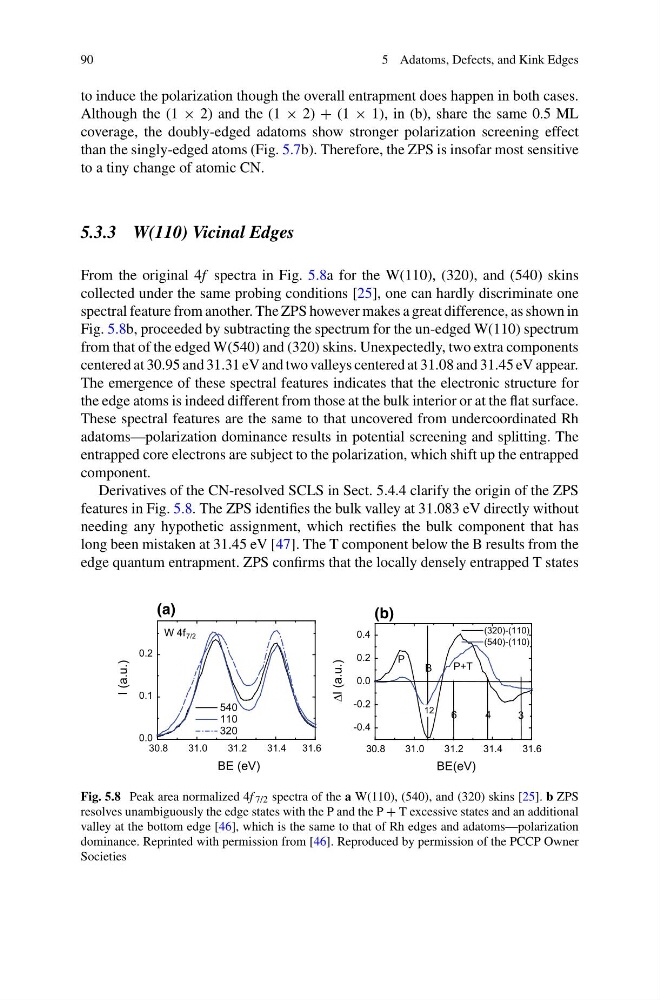
From the original 4f spectra in Fig. 5.8a for the W(110), (320), and (540) skins
collected under the same probing conditions [25], one can hardly discriminate one
spectral feature from another. The ZPS however makes a great difference, as shown in
Fig. 5.8b, proceeded by subtracting the spectrum for the un-edged W(110) spectrum
from that of the edged W(540) and (320) skins. Unexpectedly, two extra components
centered at 30.95 and 31.31 eV and two valleys centered at 31.08 and 31.45 eV appear.
The emergence of these spectral features indicates that the electronic structure for
the edge atoms is indeed different from those at the bulk interior or at the flat surface.
These spectral features are the same to that uncovered from undercoordinated Rh
adatoms—polarization dominance results in potential screening and splitting. The
entrapped core electrons are subject to the polarization, which shift up the entrapped
component.
Derivatives of the CN-resolved SCLS in Sect. 5.4.4 clarify the origin of the ZPS
features in Fig. 5.8. The ZPS identifies the bulk valley at 31.083 eV directly without
needing any hypothetic assignment, which rectifies the bulk component that has
long been mistaken at 31.45 eV [47]. The T component below the B results from the
edge quantum entrapment. ZPS confirms that the locally densely entrapped T states
0.0
0.1
0.2
BE (eV)
I (a.u.)
540
110
320
(a)
W 4f 7/2
30.8
31.0
31.2
31.4
31.6
30.8
31.0
31.2
31.4
31.6
-0.4
-0.2
0.0
0.2
0.4
BE(eV)
ΔI (a.u.)
(320)-(110)
(540)-(110)
P
P+T
B
6
4
3
12
(b)
Fig. 5.8 Peak area normalized 4f 7/2 spectra of the a W(110), (540), and (320) skins [25]. b ZPS
resolves unambiguously the edge states with the P and the P + T excessive states and an additional
valley at the bottom edge [46], which is the same to that of Rh edges and adatoms—polarization
dominance. Reprinted with permission from [46]. Reproduced by permission of the PCCP Owner
Societies
5 Adatoms, Defects, and Kink Edges
to induce the polarization though the overall entrapment does happen in both cases.
Although the (1 × 2) and the (1 × 2) + (1 × 1), in (b), share the same 0.5 ML
coverage, the doubly-edged adatoms show stronger polarization screening effect
than the singly-edged atoms (Fig. 5.7b). Therefore, the ZPS is insofar most sensitive
to a tiny change of atomic CN.
5.3.3 W(110) Vicinal Edges
From the original 4f spectra in Fig. 5.8a for the W(110), (320), and (540) skins
collected under the same probing conditions [25], one can hardly discriminate one
spectral feature from another. The ZPS however makes a great difference, as shown in
Fig. 5.8b, proceeded by subtracting the spectrum for the un-edged W(110) spectrum
from that of the edged W(540) and (320) skins. Unexpectedly, two extra components
centered at 30.95 and 31.31 eV and two valleys centered at 31.08 and 31.45 eV appear.
The emergence of these spectral features indicates that the electronic structure for
the edge atoms is indeed different from those at the bulk interior or at the flat surface.
These spectral features are the same to that uncovered from undercoordinated Rh
adatoms—polarization dominance results in potential screening and splitting. The
entrapped core electrons are subject to the polarization, which shift up the entrapped
component.
Derivatives of the CN-resolved SCLS in Sect. 5.4.4 clarify the origin of the ZPS
features in Fig. 5.8. The ZPS identifies the bulk valley at 31.083 eV directly without
needing any hypothetic assignment, which rectifies the bulk component that has
long been mistaken at 31.45 eV [47]. The T component below the B results from the
edge quantum entrapment. ZPS confirms that the locally densely entrapped T states
0.0
0.1
0.2
BE (eV)
I (a.u.)
540
110
320
(a)
W 4f 7/2
30.8
31.0
31.2
31.4
31.6
30.8
31.0
31.2
31.4
31.6
-0.4
-0.2
0.0
0.2
0.4
BE(eV)
ΔI (a.u.)
(320)-(110)
(540)-(110)
P
P+T
B
6
4
3
12
(b)
Fig. 5.8 Peak area normalized 4f 7/2 spectra of the a W(110), (540), and (320) skins [25]. b ZPS
resolves unambiguously the edge states with the P and the P + T excessive states and an additional
valley at the bottom edge [46], which is the same to that of Rh edges and adatoms—polarization
dominance. Reprinted with permission from [46]. Reproduced by permission of the PCCP Owner
Societies