

A distinction is sometimes made between structure factor intensities related by
inversion, known as Friedel pairs, and intensities related by an inversion plus any
nonidentity operation of the point group symmetry of the crystal, which are may be
referred to as Bijvoet pairs. However, this distinction is not universal, and the terms
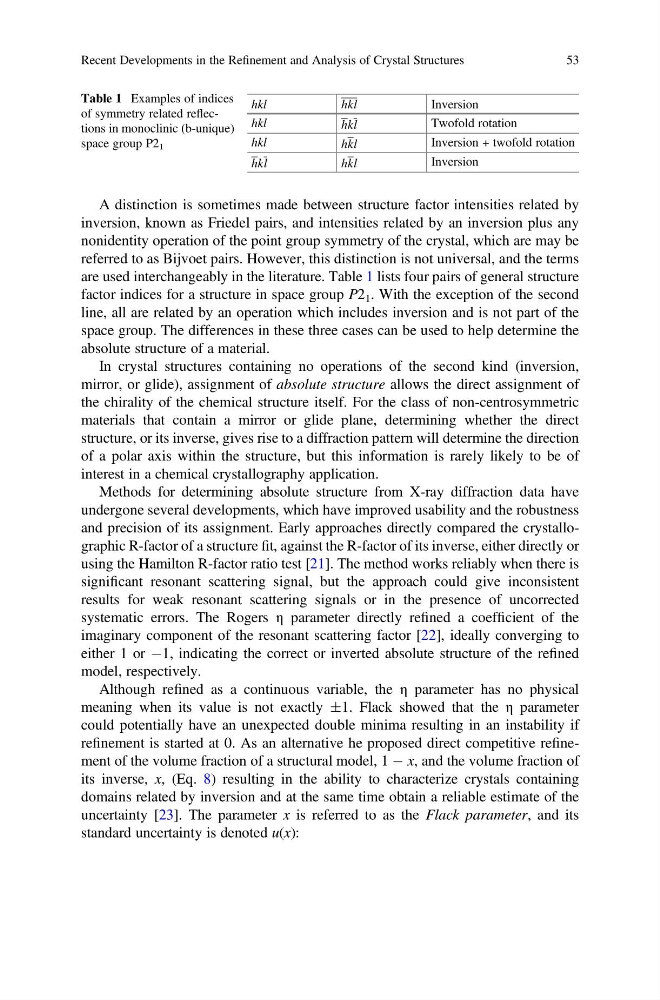
are used interchangeably in the literature. Table 1 lists four pairs of general structure
factor indices for a structure in space group P2 1 . With the exception of the second
line, all are related by an operation which includes inversion and is not part of the
space group. The differences in these three cases can be used to help determine the
absolute structure of a material.
In crystal structures containing no operations of the second kind (inversion,
mirror, or glide), assignment of absolute structure allows the direct assignment of
the chirality of the chemical structure itself. For the class of non-centrosymmetric
materials that contain a mirror or glide plane, determining whether the direct
structure, or its inverse, gives rise to a diffraction pattern will determine the direction
of a polar axis within the structure, but this information is rarely likely to be of
interest in a chemical crystallography application.
Methods for determining absolute structure from X-ray diffraction data have
undergone several developments, which have improved usability and the robustness
and precision of its assignment. Early approaches directly compared the crystallographic R-factor of a structure fit, against the R-factor of its inverse, either directly or
using the Hamilton R-factor ratio test [21]. The method works reliably when there is
significant resonant scattering signal, but the approach could give inconsistent
results for weak resonant scattering signals or in the presence of uncorrected
systematic errors. The Rogers η parameter directly refined a coefficient of the
imaginary component of the resonant scattering factor [22], ideally converging to
either 1 or À1, indicating the correct or inverted absolute structure of the refined
model, respectively.
Although refined as a continuous variable, the η parameter has no physical
meaning when its value is not exactly Æ1. Flack showed that the η parameter
could potentially have an unexpected double minima resulting in an instability if
refinement is started at 0. As an alternative he proposed direct competitive refinement of the volume fraction of a structural model, 1 À x, and the volume fraction of
its inverse, x, (Eq. 8) resulting in the ability to characterize crystals containing
domains related by inversion and at the same time obtain a reliable estimate of the
uncertainty [23]. The parameter x is referred to as the Flack parameter, and its
standard uncertainty is denoted u(x):
Table 1 Examples of indices
of symmetry related reflections in monoclinic (b-unique)
space group P2 1
hkl
hkl
Inversion
hkl
hkl
Twofold rotation
hkl
hkl
Inversion + twofold rotation
hkl
h kl
Inversion
Recent Developments in the Refinement and Analysis of Crystal Structures
53
inversion, known as Friedel pairs, and intensities related by an inversion plus any
nonidentity operation of the point group symmetry of the crystal, which are may be
referred to as Bijvoet pairs. However, this distinction is not universal, and the terms
are used interchangeably in the literature. Table 1 lists four pairs of general structure
factor indices for a structure in space group P2 1 . With the exception of the second
line, all are related by an operation which includes inversion and is not part of the
space group. The differences in these three cases can be used to help determine the
absolute structure of a material.
In crystal structures containing no operations of the second kind (inversion,
mirror, or glide), assignment of absolute structure allows the direct assignment of
the chirality of the chemical structure itself. For the class of non-centrosymmetric
materials that contain a mirror or glide plane, determining whether the direct
structure, or its inverse, gives rise to a diffraction pattern will determine the direction
of a polar axis within the structure, but this information is rarely likely to be of
interest in a chemical crystallography application.
Methods for determining absolute structure from X-ray diffraction data have
undergone several developments, which have improved usability and the robustness
and precision of its assignment. Early approaches directly compared the crystallographic R-factor of a structure fit, against the R-factor of its inverse, either directly or
using the Hamilton R-factor ratio test [21]. The method works reliably when there is
significant resonant scattering signal, but the approach could give inconsistent
results for weak resonant scattering signals or in the presence of uncorrected
systematic errors. The Rogers η parameter directly refined a coefficient of the
imaginary component of the resonant scattering factor [22], ideally converging to
either 1 or À1, indicating the correct or inverted absolute structure of the refined
model, respectively.
Although refined as a continuous variable, the η parameter has no physical
meaning when its value is not exactly Æ1. Flack showed that the η parameter
could potentially have an unexpected double minima resulting in an instability if
refinement is started at 0. As an alternative he proposed direct competitive refinement of the volume fraction of a structural model, 1 À x, and the volume fraction of
its inverse, x, (Eq. 8) resulting in the ability to characterize crystals containing
domains related by inversion and at the same time obtain a reliable estimate of the
uncertainty [23]. The parameter x is referred to as the Flack parameter, and its
standard uncertainty is denoted u(x):
Table 1 Examples of indices
of symmetry related reflections in monoclinic (b-unique)
space group P2 1
hkl
hkl
Inversion
hkl
hkl
Twofold rotation
hkl
hkl
Inversion + twofold rotation
hkl
h kl
Inversion
Recent Developments in the Refinement and Analysis of Crystal Structures
53