

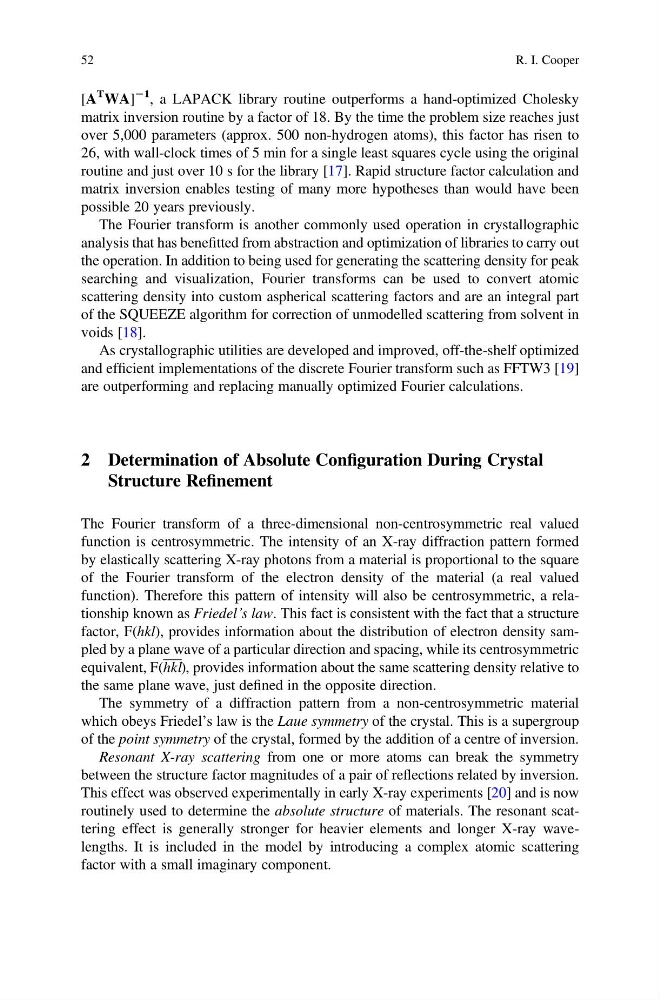
[A
T WA]
21 , a LAPACK library routine outperforms a hand-optimized Cholesky
matrix inversion routine by a factor of 18. By the time the problem size reaches just
over 5,000 parameters (approx. 500 non-hydrogen atoms), this factor has risen to
26, with wall-clock times of 5 min for a single least squares cycle using the original
routine and just over 10 s for the library [17]. Rapid structure factor calculation and
matrix inversion enables testing of many more hypotheses than would have been
possible 20 years previously.
The Fourier transform is another commonly used operation in crystallographic
analysis that has benefitted from abstraction and optimization of libraries to carry out
the operation. In addition to being used for generating the scattering density for peak
searching and visualization, Fourier transforms can be used to convert atomic
scattering density into custom aspherical scattering factors and are an integral part
of the SQUEEZE algorithm for correction of unmodelled scattering from solvent in
voids [18].
As crystallographic utilities are developed and improved, off-the-shelf optimized
and efficient implementations of the discrete Fourier transform such as FFTW3 [19]
are outperforming and replacing manually optimized Fourier calculations.
2 Determination of Absolute Configuration During Crystal
Structure Refinement
The Fourier transform of a three-dimensional non-centrosymmetric real valued
function is centrosymmetric. The intensity of an X-ray diffraction pattern formed
by elastically scattering X-ray photons from a material is proportional to the square
of the Fourier transform of the electron density of the material (a real valued
function). Therefore this pattern of intensity will also be centrosymmetric, a relationship known as Friedel’s law. This fact is consistent with the fact that a structure
factor, F(hkl), provides information about the distribution of electron density sampled by a plane wave of a particular direction and spacing, while its centrosymmetric
equivalent, F(hkl), provides information about the same scattering density relative to
the same plane wave, just defined in the opposite direction.
The symmetry of a diffraction pattern from a non-centrosymmetric material
which obeys Friedel’s law is the Laue symmetry of the crystal. This is a supergroup
of the point symmetry of the crystal, formed by the addition of a centre of inversion.
Resonant X-ray scattering from one or more atoms can break the symmetry
between the structure factor magnitudes of a pair of reflections related by inversion.
This effect was observed experimentally in early X-ray experiments [20] and is now
routinely used to determine the absolute structure of materials. The resonant scattering effect is generally stronger for heavier elements and longer X-ray wavelengths. It is included in the model by introducing a complex atomic scattering
factor with a small imaginary component.
52
R. I. Cooper
T WA]
21 , a LAPACK library routine outperforms a hand-optimized Cholesky
matrix inversion routine by a factor of 18. By the time the problem size reaches just
over 5,000 parameters (approx. 500 non-hydrogen atoms), this factor has risen to
26, with wall-clock times of 5 min for a single least squares cycle using the original
routine and just over 10 s for the library [17]. Rapid structure factor calculation and
matrix inversion enables testing of many more hypotheses than would have been
possible 20 years previously.
The Fourier transform is another commonly used operation in crystallographic
analysis that has benefitted from abstraction and optimization of libraries to carry out
the operation. In addition to being used for generating the scattering density for peak
searching and visualization, Fourier transforms can be used to convert atomic
scattering density into custom aspherical scattering factors and are an integral part
of the SQUEEZE algorithm for correction of unmodelled scattering from solvent in
voids [18].
As crystallographic utilities are developed and improved, off-the-shelf optimized
and efficient implementations of the discrete Fourier transform such as FFTW3 [19]
are outperforming and replacing manually optimized Fourier calculations.
2 Determination of Absolute Configuration During Crystal
Structure Refinement
The Fourier transform of a three-dimensional non-centrosymmetric real valued
function is centrosymmetric. The intensity of an X-ray diffraction pattern formed
by elastically scattering X-ray photons from a material is proportional to the square
of the Fourier transform of the electron density of the material (a real valued
function). Therefore this pattern of intensity will also be centrosymmetric, a relationship known as Friedel’s law. This fact is consistent with the fact that a structure
factor, F(hkl), provides information about the distribution of electron density sampled by a plane wave of a particular direction and spacing, while its centrosymmetric
equivalent, F(hkl), provides information about the same scattering density relative to
the same plane wave, just defined in the opposite direction.
The symmetry of a diffraction pattern from a non-centrosymmetric material
which obeys Friedel’s law is the Laue symmetry of the crystal. This is a supergroup
of the point symmetry of the crystal, formed by the addition of a centre of inversion.
Resonant X-ray scattering from one or more atoms can break the symmetry
between the structure factor magnitudes of a pair of reflections related by inversion.
This effect was observed experimentally in early X-ray experiments [20] and is now
routinely used to determine the absolute structure of materials. The resonant scattering effect is generally stronger for heavier elements and longer X-ray wavelengths. It is included in the model by introducing a complex atomic scattering
factor with a small imaginary component.
52
R. I. Cooper