

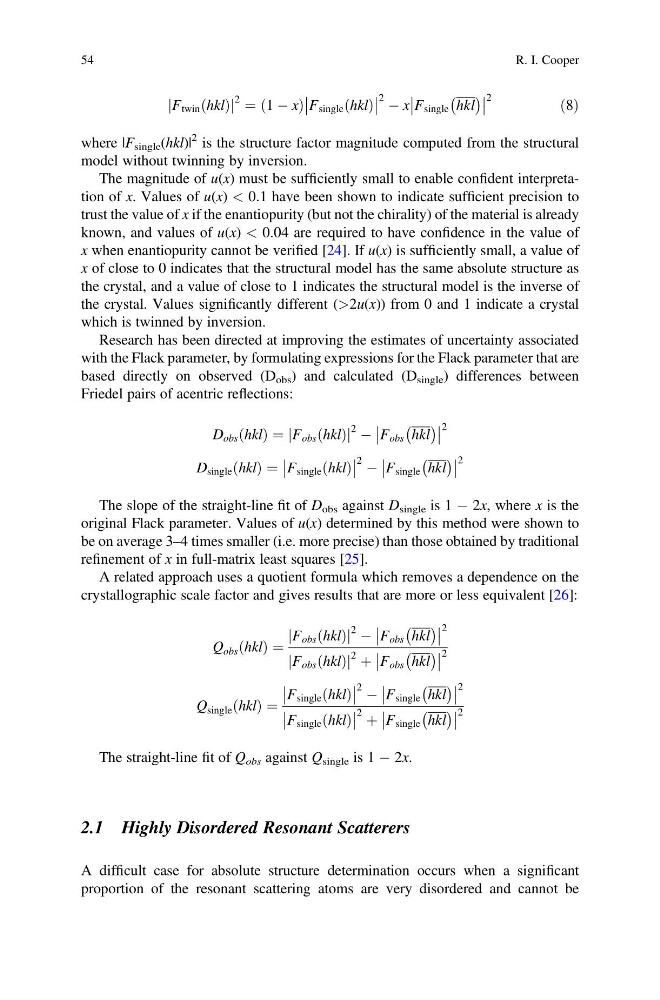
F twin hkl
ð Þ
j
j
2 ¼ 1 À x
ð
Þ F single hkl
ð Þ
2 À x F single hkl
À Á
2
ð8Þ
where |F single (hkl)|
2 is the structure factor magnitude computed from the structural
model without twinning by inversion.
The magnitude of u(x) must be sufficiently small to enable confident interpretation of x. Values of u(x) < 0.1 have been shown to indicate sufficient precision to
trust the value of x if the enantiopurity (but not the chirality) of the material is already
known, and values of u(x) < 0.04 are required to have confidence in the value of
x when enantiopurity cannot be verified [24]. If u(x) is sufficiently small, a value of
x of close to 0 indicates that the structural model has the same absolute structure as
the crystal, and a value of close to 1 indicates the structural model is the inverse of
the crystal. Values significantly different (>2u(x)) from 0 and 1 indicate a crystal
which is twinned by inversion.
Research has been directed at improving the estimates of uncertainty associated
with the Flack parameter, by formulating expressions for the Flack parameter that are
based directly on observed (D obs ) and calculated (D single ) differences between
Friedel pairs of acentric reflections:
D obs hkl
ð Þ ¼ F obs hkl
ð Þ
j
j
2 À F obs hkl
À Á
2
D single hkl
ð Þ ¼ F single hkl
ð Þ
2 À F single hkl
À Á
2
The slope of the straight-line fit of D obs against D single is 1 À 2x, where x is the
original Flack parameter. Values of u(x) determined by this method were shown to
be on average 3–4 times smaller (i.e. more precise) than those obtained by traditional
refinement of x in full-matrix least squares [25].
A related approach uses a quotient formula which removes a dependence on the
crystallographic scale factor and gives results that are more or less equivalent [26]:
Q obs hkl
ð Þ ¼
F obs hkl
ð Þ
j
j
2 À F obs hkl
À Á
2
F obs hkl
ð Þ
j
j
2 þ F obs hkl
À Á
2
Q single hkl
ð Þ ¼
F single hkl
ð Þ
2 À F single hkl
À Á
2
F single hkl
ð Þ
2 þ F single hkl
À Á
2
The straight-line fit of Q obs against Q single is 1 À 2x.
2.1 Highly Disordered Resonant Scatterers
A difficult case for absolute structure determination occurs when a significant
proportion of the resonant scattering atoms are very disordered and cannot be
54
R. I. Cooper
ð Þ
j
j
2 ¼ 1 À x
ð
Þ F single hkl
ð Þ
2 À x F single hkl
À Á
2
ð8Þ
where |F single (hkl)|
2 is the structure factor magnitude computed from the structural
model without twinning by inversion.
The magnitude of u(x) must be sufficiently small to enable confident interpretation of x. Values of u(x) < 0.1 have been shown to indicate sufficient precision to
trust the value of x if the enantiopurity (but not the chirality) of the material is already
known, and values of u(x) < 0.04 are required to have confidence in the value of
x when enantiopurity cannot be verified [24]. If u(x) is sufficiently small, a value of
x of close to 0 indicates that the structural model has the same absolute structure as
the crystal, and a value of close to 1 indicates the structural model is the inverse of
the crystal. Values significantly different (>2u(x)) from 0 and 1 indicate a crystal
which is twinned by inversion.
Research has been directed at improving the estimates of uncertainty associated
with the Flack parameter, by formulating expressions for the Flack parameter that are
based directly on observed (D obs ) and calculated (D single ) differences between
Friedel pairs of acentric reflections:
D obs hkl
ð Þ ¼ F obs hkl
ð Þ
j
j
2 À F obs hkl
À Á
2
D single hkl
ð Þ ¼ F single hkl
ð Þ
2 À F single hkl
À Á
2
The slope of the straight-line fit of D obs against D single is 1 À 2x, where x is the
original Flack parameter. Values of u(x) determined by this method were shown to
be on average 3–4 times smaller (i.e. more precise) than those obtained by traditional
refinement of x in full-matrix least squares [25].
A related approach uses a quotient formula which removes a dependence on the
crystallographic scale factor and gives results that are more or less equivalent [26]:
Q obs hkl
ð Þ ¼
F obs hkl
ð Þ
j
j
2 À F obs hkl
À Á
2
F obs hkl
ð Þ
j
j
2 þ F obs hkl
À Á
2
Q single hkl
ð Þ ¼
F single hkl
ð Þ
2 À F single hkl
À Á
2
F single hkl
ð Þ
2 þ F single hkl
À Á
2
The straight-line fit of Q obs against Q single is 1 À 2x.
2.1 Highly Disordered Resonant Scatterers
A difficult case for absolute structure determination occurs when a significant
proportion of the resonant scattering atoms are very disordered and cannot be
54
R. I. Cooper