

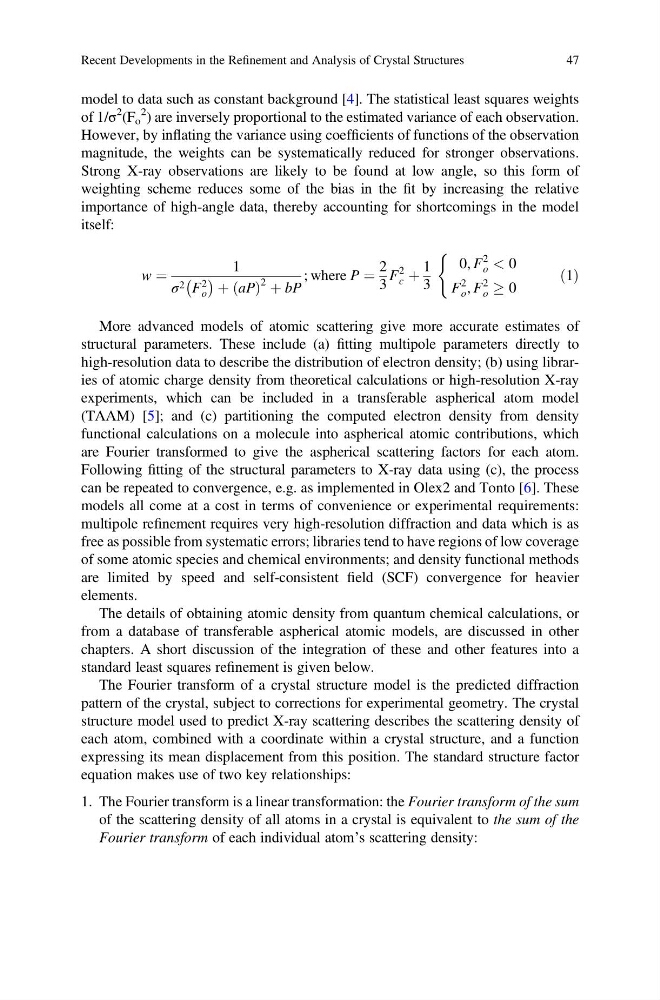
model to data such as constant background [4]. The statistical least squares weights
of 1/σ
2 (F o
2 ) are inversely proportional to the estimated variance of each observation.
However, by inflating the variance using coefficients of functions of the observation
magnitude, the weights can be systematically reduced for stronger observations.
Strong X-ray observations are likely to be found at low angle, so this form of
weighting scheme reduces some of the bias in the fit by increasing the relative
importance of high-angle data, thereby accounting for shortcomings in the model
itself:
w ¼
1
σ 2 F
2
o
À Á þ aP
ð Þ
2 þ bP
; where P ¼
2
3
F
2
c þ
1
3
0, F
2
o < 0
F
2
o , F
2
o ! 0
(
ð1Þ
More advanced models of atomic scattering give more accurate estimates of
structural parameters. These include (a) fitting multipole parameters directly to
high-resolution data to describe the distribution of electron density; (b) using libraries of atomic charge density from theoretical calculations or high-resolution X-ray
experiments, which can be included in a transferable aspherical atom model
(TAAM) [5]; and (c) partitioning the computed electron density from density
functional calculations on a molecule into aspherical atomic contributions, which
are Fourier transformed to give the aspherical scattering factors for each atom.
Following fitting of the structural parameters to X-ray data using (c), the process
can be repeated to convergence, e.g. as implemented in Olex2 and Tonto [6]. These
models all come at a cost in terms of convenience or experimental requirements:
multipole refinement requires very high-resolution diffraction and data which is as
free as possible from systematic errors; libraries tend to have regions of low coverage
of some atomic species and chemical environments; and density functional methods
are limited by speed and self-consistent field (SCF) convergence for heavier
elements.
The details of obtaining atomic density from quantum chemical calculations, or
from a database of transferable aspherical atomic models, are discussed in other
chapters. A short discussion of the integration of these and other features into a
standard least squares refinement is given below.
The Fourier transform of a crystal structure model is the predicted diffraction
pattern of the crystal, subject to corrections for experimental geometry. The crystal
structure model used to predict X-ray scattering describes the scattering density of
each atom, combined with a coordinate within a crystal structure, and a function
expressing its mean displacement from this position. The standard structure factor
equation makes use of two key relationships:
1. The Fourier transform is a linear transformation: the Fourier transform of the sum
of the scattering density of all atoms in a crystal is equivalent to the sum of the
Fourier transform of each individual atom’s scattering density:
Recent Developments in the Refinement and Analysis of Crystal Structures
47
of 1/σ
2 (F o
2 ) are inversely proportional to the estimated variance of each observation.
However, by inflating the variance using coefficients of functions of the observation
magnitude, the weights can be systematically reduced for stronger observations.
Strong X-ray observations are likely to be found at low angle, so this form of
weighting scheme reduces some of the bias in the fit by increasing the relative
importance of high-angle data, thereby accounting for shortcomings in the model
itself:
w ¼
1
σ 2 F
2
o
À Á þ aP
ð Þ
2 þ bP
; where P ¼
2
3
F
2
c þ
1
3
0, F
2
o < 0
F
2
o , F
2
o ! 0
(
ð1Þ
More advanced models of atomic scattering give more accurate estimates of
structural parameters. These include (a) fitting multipole parameters directly to
high-resolution data to describe the distribution of electron density; (b) using libraries of atomic charge density from theoretical calculations or high-resolution X-ray
experiments, which can be included in a transferable aspherical atom model
(TAAM) [5]; and (c) partitioning the computed electron density from density
functional calculations on a molecule into aspherical atomic contributions, which
are Fourier transformed to give the aspherical scattering factors for each atom.
Following fitting of the structural parameters to X-ray data using (c), the process
can be repeated to convergence, e.g. as implemented in Olex2 and Tonto [6]. These
models all come at a cost in terms of convenience or experimental requirements:
multipole refinement requires very high-resolution diffraction and data which is as
free as possible from systematic errors; libraries tend to have regions of low coverage
of some atomic species and chemical environments; and density functional methods
are limited by speed and self-consistent field (SCF) convergence for heavier
elements.
The details of obtaining atomic density from quantum chemical calculations, or
from a database of transferable aspherical atomic models, are discussed in other
chapters. A short discussion of the integration of these and other features into a
standard least squares refinement is given below.
The Fourier transform of a crystal structure model is the predicted diffraction
pattern of the crystal, subject to corrections for experimental geometry. The crystal
structure model used to predict X-ray scattering describes the scattering density of
each atom, combined with a coordinate within a crystal structure, and a function
expressing its mean displacement from this position. The standard structure factor
equation makes use of two key relationships:
1. The Fourier transform is a linear transformation: the Fourier transform of the sum
of the scattering density of all atoms in a crystal is equivalent to the sum of the
Fourier transform of each individual atom’s scattering density:
Recent Developments in the Refinement and Analysis of Crystal Structures
47