

FT
X
j
ρ j
!
¼
X
j
FT ρ
ð Þ j
ð2Þ
for j atoms, each with scattering density, ρ j , centred at an atom position within a
crystal. This allows the overall Fourier transform of a crystal to be expressed as a
sum of the Fourier transforms of individual atoms, so that the model can be defined
and optimized in a simple equation.
2. The convolution theorem demonstrates the equivalence of the Fourier transform
of a convolution of two or more functions and the product of the individual
Fourier transforms of the functions (Eq. 3):
FT A B
ð
Þ¼FT A
ð Þ Â FT B
ð Þ
ð3Þ
A convolution operation, denoted ⨂, is defined as the integral, evaluated for all
shifts, of the product of two functions, after one is reversed and shifted. A crystal
structure model can be broken down into three key functions from which we can
reconstruct the entire crystal scattering density using convolutions: firstly, a position
relative to a periodic lattice, the position is represented by an infinitely sharp delta
function; secondly, the scattering density of an atom at rest (for electrons a sharply
peaked distribution and for neutrons an (effectively) infinitely sharp delta function
with the scattering density of the relevant atomic nucleus; and, thirdly, a model for
displacement of an atom from its mean position. The third term usually takes the
form of a univariate or trivariate Gaussian distribution representing isotropic or
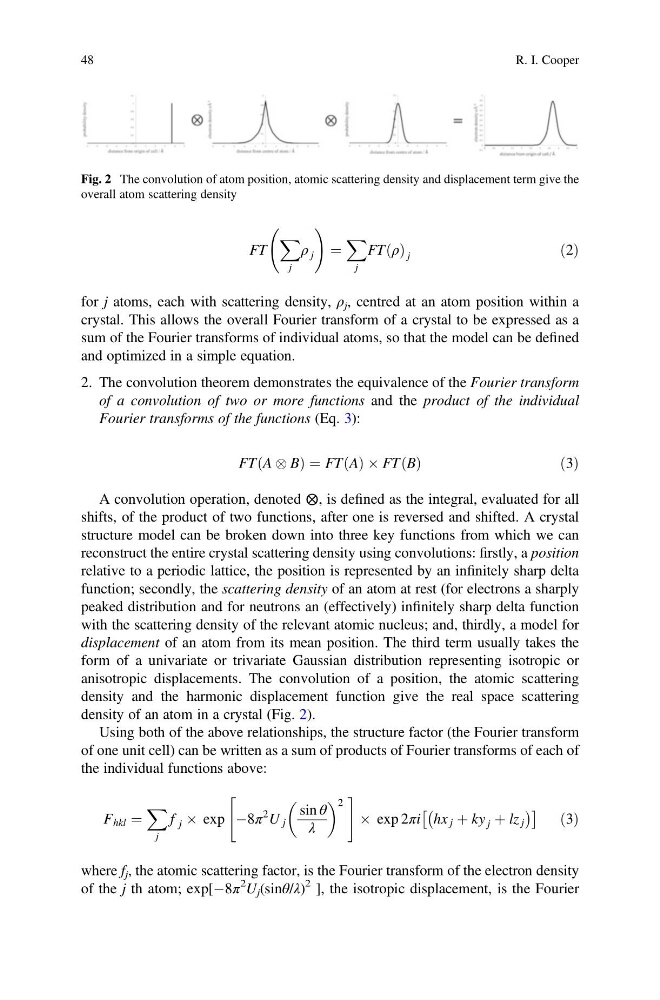
anisotropic displacements. The convolution of a position, the atomic scattering
density and the harmonic displacement function give the real space scattering
density of an atom in a crystal (Fig. 2).
Using both of the above relationships, the structure factor (the Fourier transform
of one unit cell) can be written as a sum of products of Fourier transforms of each of
the individual functions above:
F hkl ¼
X
j
f j  exp À8π
2 U j
sin θ
λ
2
"
#
 exp 2πi hx j þ ky j þ lz j
À
Á
Â
Ã
ð3Þ
where f j , the atomic scattering factor, is the Fourier transform of the electron density
of the j th atom; exp[À8π
2 U j (sinθ/λ)
2 ], the isotropic displacement, is the Fourier
Fig. 2 The convolution of atom position, atomic scattering density and displacement term give the
overall atom scattering density
48
R. I. Cooper
X
j
ρ j
!
¼
X
j
FT ρ
ð Þ j
ð2Þ
for j atoms, each with scattering density, ρ j , centred at an atom position within a
crystal. This allows the overall Fourier transform of a crystal to be expressed as a
sum of the Fourier transforms of individual atoms, so that the model can be defined
and optimized in a simple equation.
2. The convolution theorem demonstrates the equivalence of the Fourier transform
of a convolution of two or more functions and the product of the individual
Fourier transforms of the functions (Eq. 3):
FT A B
ð
Þ¼FT A
ð Þ Â FT B
ð Þ
ð3Þ
A convolution operation, denoted ⨂, is defined as the integral, evaluated for all
shifts, of the product of two functions, after one is reversed and shifted. A crystal
structure model can be broken down into three key functions from which we can
reconstruct the entire crystal scattering density using convolutions: firstly, a position
relative to a periodic lattice, the position is represented by an infinitely sharp delta
function; secondly, the scattering density of an atom at rest (for electrons a sharply
peaked distribution and for neutrons an (effectively) infinitely sharp delta function
with the scattering density of the relevant atomic nucleus; and, thirdly, a model for
displacement of an atom from its mean position. The third term usually takes the
form of a univariate or trivariate Gaussian distribution representing isotropic or
anisotropic displacements. The convolution of a position, the atomic scattering
density and the harmonic displacement function give the real space scattering
density of an atom in a crystal (Fig. 2).
Using both of the above relationships, the structure factor (the Fourier transform
of one unit cell) can be written as a sum of products of Fourier transforms of each of
the individual functions above:
F hkl ¼
X
j
f j  exp À8π
2 U j
sin θ
λ
2
"
#
 exp 2πi hx j þ ky j þ lz j
À
Á
Â
Ã
ð3Þ
where f j , the atomic scattering factor, is the Fourier transform of the electron density
of the j th atom; exp[À8π
2 U j (sinθ/λ)
2 ], the isotropic displacement, is the Fourier
Fig. 2 The convolution of atom position, atomic scattering density and displacement term give the
overall atom scattering density
48
R. I. Cooper