

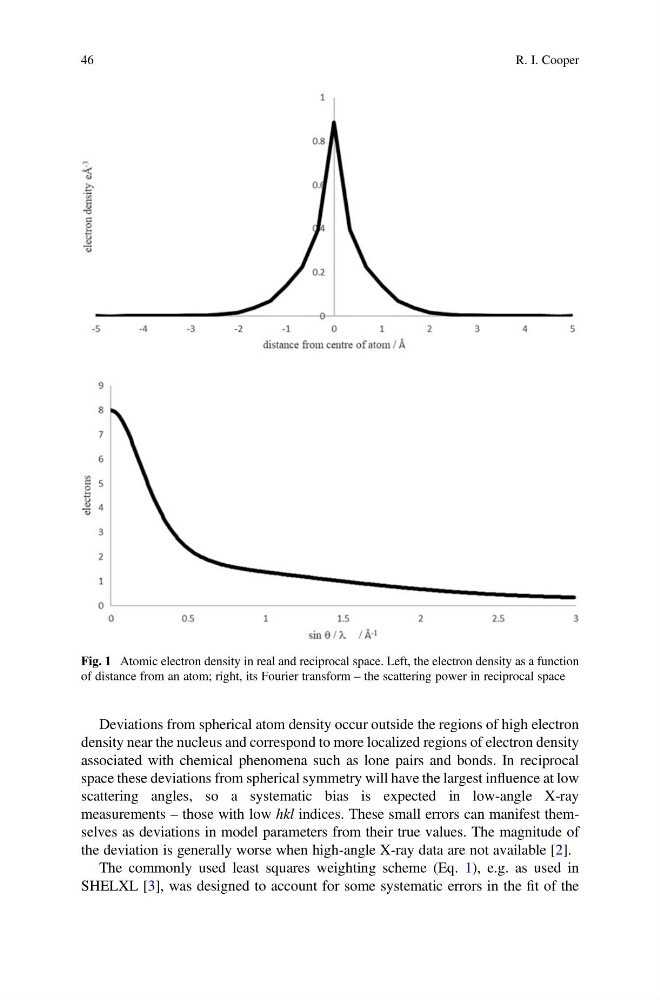
Deviations from spherical atom density occur outside the regions of high electron
density near the nucleus and correspond to more localized regions of electron density
associated with chemical phenomena such as lone pairs and bonds. In reciprocal
space these deviations from spherical symmetry will have the largest influence at low
scattering angles, so a systematic bias is expected in low-angle X-ray
measurements – those with low hkl indices. These small errors can manifest themselves as deviations in model parameters from their true values. The magnitude of
the deviation is generally worse when high-angle X-ray data are not available [2].
The commonly used least squares weighting scheme (Eq. 1), e.g. as used in
SHELXL [3], was designed to account for some systematic errors in the fit of the
Fig. 1 Atomic electron density in real and reciprocal space. Left, the electron density as a function
of distance from an atom; right, its Fourier transform – the scattering power in reciprocal space
46
R. I. Cooper
density near the nucleus and correspond to more localized regions of electron density
associated with chemical phenomena such as lone pairs and bonds. In reciprocal
space these deviations from spherical symmetry will have the largest influence at low
scattering angles, so a systematic bias is expected in low-angle X-ray
measurements – those with low hkl indices. These small errors can manifest themselves as deviations in model parameters from their true values. The magnitude of
the deviation is generally worse when high-angle X-ray data are not available [2].
The commonly used least squares weighting scheme (Eq. 1), e.g. as used in
SHELXL [3], was designed to account for some systematic errors in the fit of the
Fig. 1 Atomic electron density in real and reciprocal space. Left, the electron density as a function
of distance from an atom; right, its Fourier transform – the scattering power in reciprocal space
46
R. I. Cooper