

single-crystal [2 + 2] cycloaddition reactions, where dimerisation of one molecule
pre-organises neighbouring molecules for better orbital overlap and more efficient
dimerisation, lowering the energetic barrier to conversion and thereby propagating a
1D chain reaction [60, 61].
It is worth noting that the excitation rate k depends on the power and wavelength
of the excitation source and will also depend on the size and shape (morphology) of
the crystal and its physical properties including absorption cross-section, refractive
index and any light-scattering and/or reflection effects. The electronic absorptions
that lead to the photoisomerisation are typically charge-transfer bands close to the
onset of the UV-vis absorption, and the band positions and band widths determine
whether the photoexcitation can be induced over a narrow or wide distribution of
wavelengths.
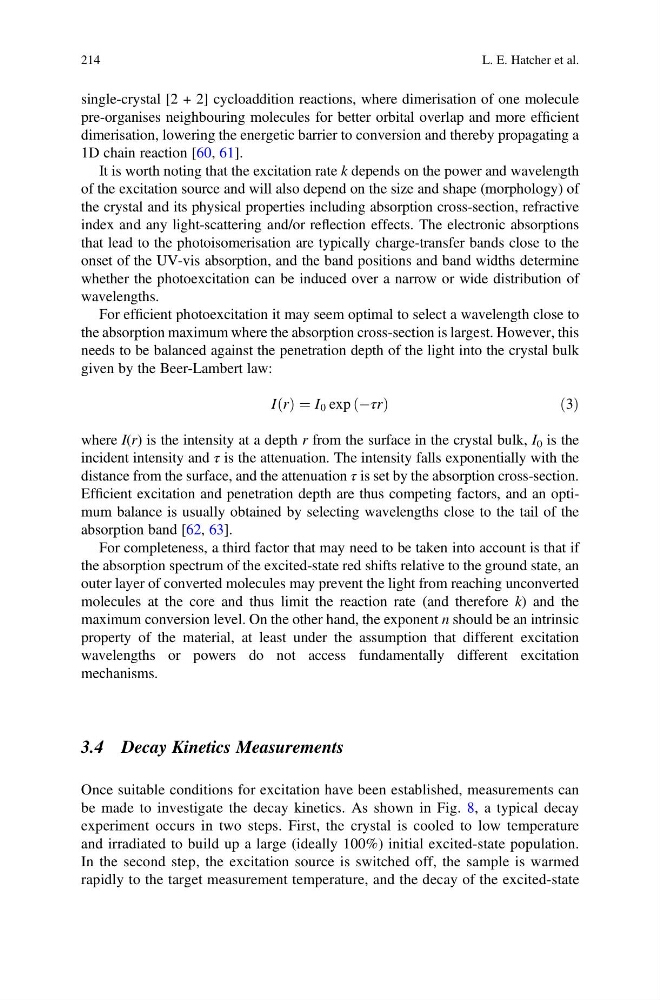
For efficient photoexcitation it may seem optimal to select a wavelength close to
the absorption maximum where the absorption cross-section is largest. However, this
needs to be balanced against the penetration depth of the light into the crystal bulk
given by the Beer-Lambert law:
I r
ð Þ ¼ I 0 exp Àτr
ð
Þ
ð3Þ
where I(r) is the intensity at a depth r from the surface in the crystal bulk, I 0 is the
incident intensity and τ is the attenuation. The intensity falls exponentially with the
distance from the surface, and the attenuation τ is set by the absorption cross-section.
Efficient excitation and penetration depth are thus competing factors, and an optimum balance is usually obtained by selecting wavelengths close to the tail of the
absorption band [62, 63].
For completeness, a third factor that may need to be taken into account is that if
the absorption spectrum of the excited-state red shifts relative to the ground state, an
outer layer of converted molecules may prevent the light from reaching unconverted
molecules at the core and thus limit the reaction rate (and therefore k) and the
maximum conversion level. On the other hand, the exponent n should be an intrinsic
property of the material, at least under the assumption that different excitation
wavelengths or powers do not access fundamentally different excitation
mechanisms.
3.4 Decay Kinetics Measurements
Once suitable conditions for excitation have been established, measurements can
be made to investigate the decay kinetics. As shown in Fig. 8, a typical decay
experiment occurs in two steps. First, the crystal is cooled to low temperature
and irradiated to build up a large (ideally 100%) initial excited-state population.
In the second step, the excitation source is switched off, the sample is warmed
rapidly to the target measurement temperature, and the decay of the excited-state
214
L. E. Hatcher et al.
pre-organises neighbouring molecules for better orbital overlap and more efficient
dimerisation, lowering the energetic barrier to conversion and thereby propagating a
1D chain reaction [60, 61].
It is worth noting that the excitation rate k depends on the power and wavelength
of the excitation source and will also depend on the size and shape (morphology) of
the crystal and its physical properties including absorption cross-section, refractive
index and any light-scattering and/or reflection effects. The electronic absorptions
that lead to the photoisomerisation are typically charge-transfer bands close to the
onset of the UV-vis absorption, and the band positions and band widths determine
whether the photoexcitation can be induced over a narrow or wide distribution of
wavelengths.
For efficient photoexcitation it may seem optimal to select a wavelength close to
the absorption maximum where the absorption cross-section is largest. However, this
needs to be balanced against the penetration depth of the light into the crystal bulk
given by the Beer-Lambert law:
I r
ð Þ ¼ I 0 exp Àτr
ð
Þ
ð3Þ
where I(r) is the intensity at a depth r from the surface in the crystal bulk, I 0 is the
incident intensity and τ is the attenuation. The intensity falls exponentially with the
distance from the surface, and the attenuation τ is set by the absorption cross-section.
Efficient excitation and penetration depth are thus competing factors, and an optimum balance is usually obtained by selecting wavelengths close to the tail of the
absorption band [62, 63].
For completeness, a third factor that may need to be taken into account is that if
the absorption spectrum of the excited-state red shifts relative to the ground state, an
outer layer of converted molecules may prevent the light from reaching unconverted
molecules at the core and thus limit the reaction rate (and therefore k) and the
maximum conversion level. On the other hand, the exponent n should be an intrinsic
property of the material, at least under the assumption that different excitation
wavelengths or powers do not access fundamentally different excitation
mechanisms.
3.4 Decay Kinetics Measurements
Once suitable conditions for excitation have been established, measurements can
be made to investigate the decay kinetics. As shown in Fig. 8, a typical decay
experiment occurs in two steps. First, the crystal is cooled to low temperature
and irradiated to build up a large (ideally 100%) initial excited-state population.
In the second step, the excitation source is switched off, the sample is warmed
rapidly to the target measurement temperature, and the decay of the excited-state
214
L. E. Hatcher et al.