

volume fraction α(t) of the excited-state isomer at a time t from the start of the
excitation as:
α t
ð Þ ¼ 1 À exp Àkt
n
ð
Þ
ð1Þ
where k is a rate constant and n is the (usually integer) Avrami exponent. n is related
to the dimensionality D of the transformation and provides information about the
level of cooperativity:
D ¼ n À 1
ð2Þ
n ¼ 1 (D ¼ 0) implies non-cooperative, homogenous excitation throughout the bulk
of the crystal. For materials such as [Pd(Bu 4 dien)(NO 2 )]BPh 4 that have been
designed according to the “reaction cavity” concept outlined in Sect. 2, the
isomerisation takes place in a cavity shielded by bulky ligands and induces minimal
strain in the surrounding crystal bulk. The excitation is therefore expected to be
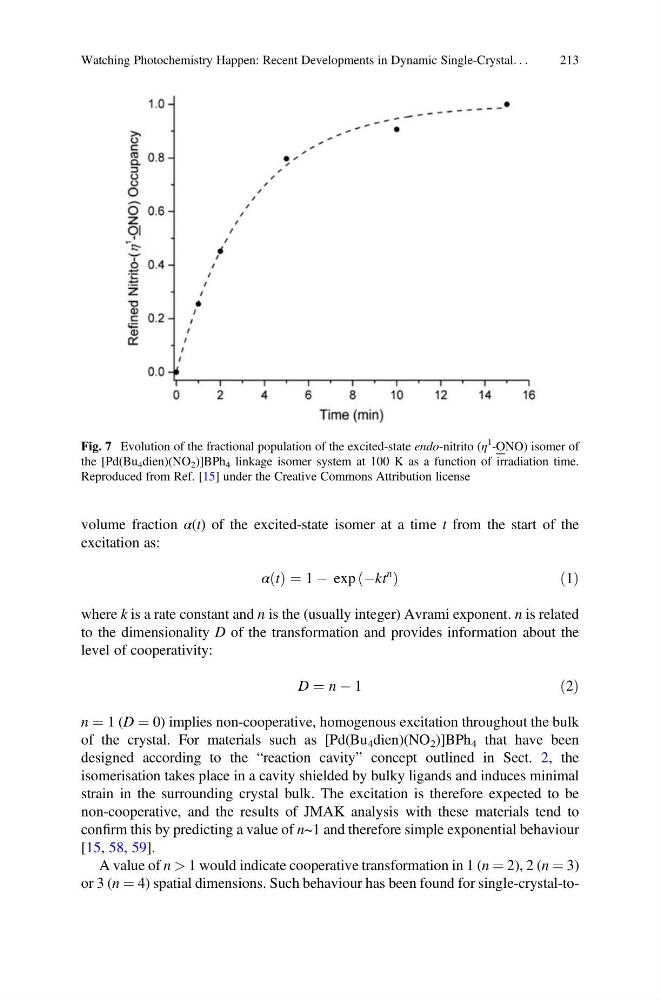
non-cooperative, and the results of JMAK analysis with these materials tend to
confirm this by predicting a value of n~1 and therefore simple exponential behaviour
[15, 58, 59].
A value of n > 1 would indicate cooperative transformation in 1 (n ¼ 2), 2 (n ¼ 3)
or 3 (n ¼ 4) spatial dimensions. Such behaviour has been found for single-crystal-toFig. 7 Evolution of the fractional population of the excited-state endo-nitrito (η
1
-ONO) isomer of
the [Pd(Bu 4 dien)(NO 2 )]BPh 4 linkage isomer system at 100 K as a function of irradiation time.
Reproduced from Ref. [15] under the Creative Commons Attribution license
Watching Photochemistry Happen: Recent Developments in Dynamic Single-Crystal. . .
213
excitation as:
α t
ð Þ ¼ 1 À exp Àkt
n
ð
Þ
ð1Þ
where k is a rate constant and n is the (usually integer) Avrami exponent. n is related
to the dimensionality D of the transformation and provides information about the
level of cooperativity:
D ¼ n À 1
ð2Þ
n ¼ 1 (D ¼ 0) implies non-cooperative, homogenous excitation throughout the bulk
of the crystal. For materials such as [Pd(Bu 4 dien)(NO 2 )]BPh 4 that have been
designed according to the “reaction cavity” concept outlined in Sect. 2, the
isomerisation takes place in a cavity shielded by bulky ligands and induces minimal
strain in the surrounding crystal bulk. The excitation is therefore expected to be
non-cooperative, and the results of JMAK analysis with these materials tend to
confirm this by predicting a value of n~1 and therefore simple exponential behaviour
[15, 58, 59].
A value of n > 1 would indicate cooperative transformation in 1 (n ¼ 2), 2 (n ¼ 3)
or 3 (n ¼ 4) spatial dimensions. Such behaviour has been found for single-crystal-toFig. 7 Evolution of the fractional population of the excited-state endo-nitrito (η
1
-ONO) isomer of
the [Pd(Bu 4 dien)(NO 2 )]BPh 4 linkage isomer system at 100 K as a function of irradiation time.
Reproduced from Ref. [15] under the Creative Commons Attribution license
Watching Photochemistry Happen: Recent Developments in Dynamic Single-Crystal. . .
213