

3.3 Excitation Kinetics Measurements
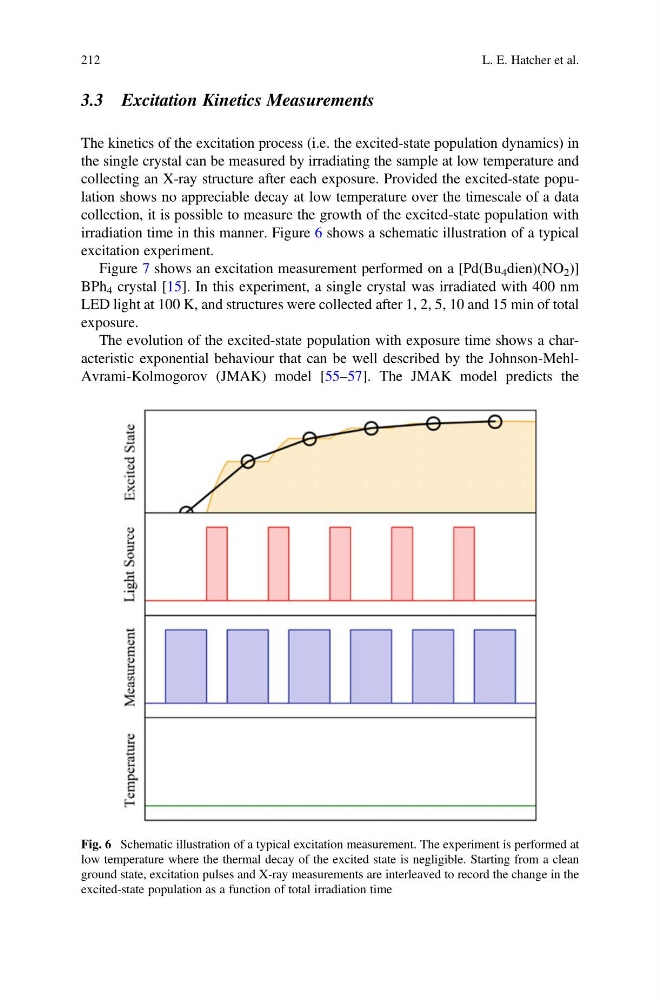
The kinetics of the excitation process (i.e. the excited-state population dynamics) in
the single crystal can be measured by irradiating the sample at low temperature and
collecting an X-ray structure after each exposure. Provided the excited-state population shows no appreciable decay at low temperature over the timescale of a data
collection, it is possible to measure the growth of the excited-state population with
irradiation time in this manner. Figure 6 shows a schematic illustration of a typical
excitation experiment.
Figure 7 shows an excitation measurement performed on a [Pd(Bu 4 dien)(NO 2 )]
BPh 4 crystal [15]. In this experiment, a single crystal was irradiated with 400 nm
LED light at 100 K, and structures were collected after 1, 2, 5, 10 and 15 min of total
exposure.
The evolution of the excited-state population with exposure time shows a characteristic exponential behaviour that can be well described by the Johnson-MehlAvrami-Kolmogorov (JMAK) model [55–57]. The JMAK model predicts the
Fig. 6 Schematic illustration of a typical excitation measurement. The experiment is performed at
low temperature where the thermal decay of the excited state is negligible. Starting from a clean
ground state, excitation pulses and X-ray measurements are interleaved to record the change in the
excited-state population as a function of total irradiation time
212
L. E. Hatcher et al.
The kinetics of the excitation process (i.e. the excited-state population dynamics) in
the single crystal can be measured by irradiating the sample at low temperature and
collecting an X-ray structure after each exposure. Provided the excited-state population shows no appreciable decay at low temperature over the timescale of a data
collection, it is possible to measure the growth of the excited-state population with
irradiation time in this manner. Figure 6 shows a schematic illustration of a typical
excitation experiment.
Figure 7 shows an excitation measurement performed on a [Pd(Bu 4 dien)(NO 2 )]
BPh 4 crystal [15]. In this experiment, a single crystal was irradiated with 400 nm
LED light at 100 K, and structures were collected after 1, 2, 5, 10 and 15 min of total
exposure.
The evolution of the excited-state population with exposure time shows a characteristic exponential behaviour that can be well described by the Johnson-MehlAvrami-Kolmogorov (JMAK) model [55–57]. The JMAK model predicts the
Fig. 6 Schematic illustration of a typical excitation measurement. The experiment is performed at
low temperature where the thermal decay of the excited state is negligible. Starting from a clean
ground state, excitation pulses and X-ray measurements are interleaved to record the change in the
excited-state population as a function of total irradiation time
212
L. E. Hatcher et al.