

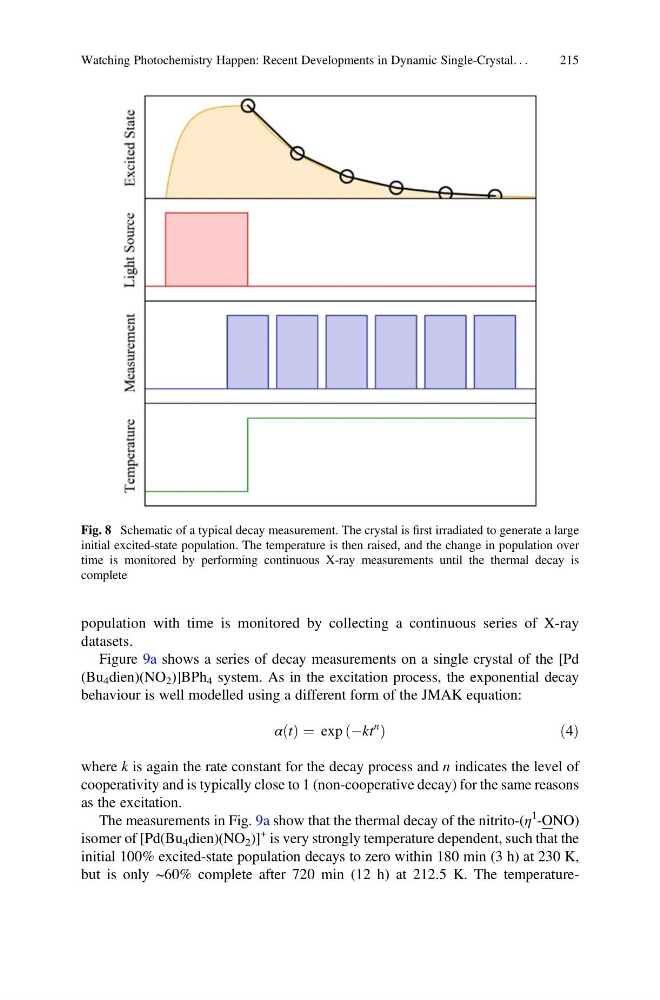
population with time is monitored by collecting a continuous series of X-ray
datasets.
Figure 9a shows a series of decay measurements on a single crystal of the [Pd
(Bu 4 dien)(NO 2 )]BPh 4 system. As in the excitation process, the exponential decay
behaviour is well modelled using a different form of the JMAK equation:
α t
ð Þ ¼ exp Àkt
n
ð
Þ
ð4Þ
where k is again the rate constant for the decay process and n indicates the level of
cooperativity and is typically close to 1 (non-cooperative decay) for the same reasons
as the excitation.
The measurements in Fig. 9a show that the thermal decay of the nitrito-(η
1 -ONO)
isomer of [Pd(Bu 4 dien)(NO 2 )]
+ is very strongly temperature dependent, such that the
initial 100% excited-state population decays to zero within 180 min (3 h) at 230 K,
but is only ~60% complete after 720 min (12 h) at 212.5 K. The temperatureFig. 8 Schematic of a typical decay measurement. The crystal is first irradiated to generate a large
initial excited-state population. The temperature is then raised, and the change in population over
time is monitored by performing continuous X-ray measurements until the thermal decay is
complete
Watching Photochemistry Happen: Recent Developments in Dynamic Single-Crystal. . .
215
datasets.
Figure 9a shows a series of decay measurements on a single crystal of the [Pd
(Bu 4 dien)(NO 2 )]BPh 4 system. As in the excitation process, the exponential decay
behaviour is well modelled using a different form of the JMAK equation:
α t
ð Þ ¼ exp Àkt
n
ð
Þ
ð4Þ
where k is again the rate constant for the decay process and n indicates the level of
cooperativity and is typically close to 1 (non-cooperative decay) for the same reasons
as the excitation.
The measurements in Fig. 9a show that the thermal decay of the nitrito-(η
1 -ONO)
isomer of [Pd(Bu 4 dien)(NO 2 )]
+ is very strongly temperature dependent, such that the
initial 100% excited-state population decays to zero within 180 min (3 h) at 230 K,
but is only ~60% complete after 720 min (12 h) at 212.5 K. The temperatureFig. 8 Schematic of a typical decay measurement. The crystal is first irradiated to generate a large
initial excited-state population. The temperature is then raised, and the change in population over
time is monitored by performing continuous X-ray measurements until the thermal decay is
complete
Watching Photochemistry Happen: Recent Developments in Dynamic Single-Crystal. . .
215