

constituent atoms [37]. The interfacial angles could be related to the fundamental
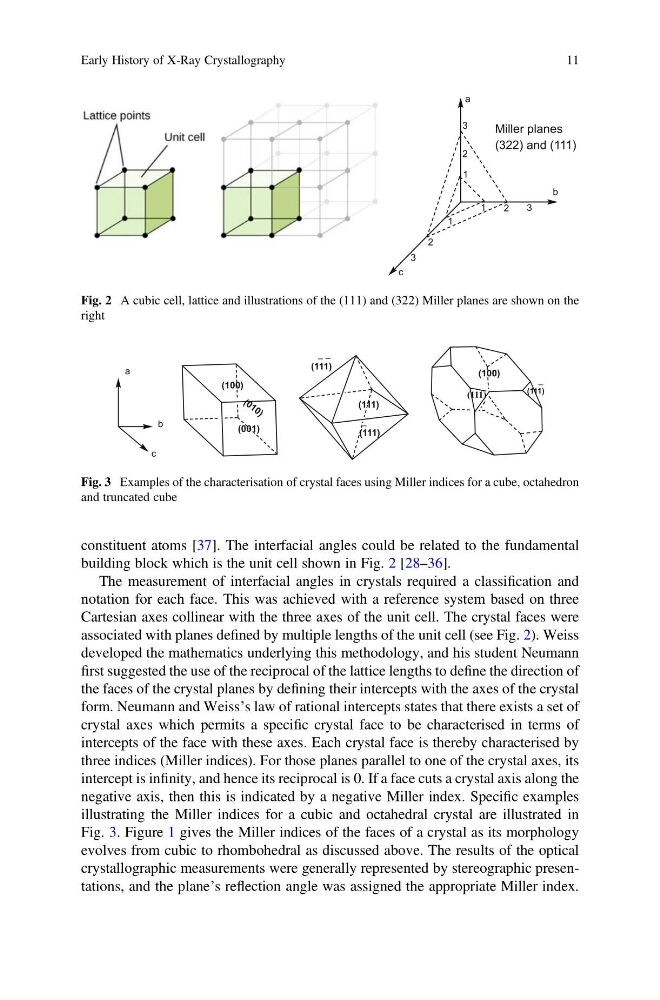
building block which is the unit cell shown in Fig. 2 [28–36].
The measurement of interfacial angles in crystals required a classification and
notation for each face. This was achieved with a reference system based on three
Cartesian axes collinear with the three axes of the unit cell. The crystal faces were
associated with planes defined by multiple lengths of the unit cell (see Fig. 2). Weiss
developed the mathematics underlying this methodology, and his student Neumann
first suggested the use of the reciprocal of the lattice lengths to define the direction of
the faces of the crystal planes by defining their intercepts with the axes of the crystal
form. Neumann and Weiss’s law of rational intercepts states that there exists a set of
crystal axes which permits a specific crystal face to be characterised in terms of
intercepts of the face with these axes. Each crystal face is thereby characterised by
three indices (Miller indices). For those planes parallel to one of the crystal axes, its
intercept is infinity, and hence its reciprocal is 0. If a face cuts a crystal axis along the
negative axis, then this is indicated by a negative Miller index. Specific examples
illustrating the Miller indices for a cubic and octahedral crystal are illustrated in
Fig. 3. Figure 1 gives the Miller indices of the faces of a crystal as its morphology
evolves from cubic to rhombohedral as discussed above. The results of the optical
crystallographic measurements were generally represented by stereographic presentations, and the plane’s reflection angle was assigned the appropriate Miller index.
3
2
1
3
2
1
3
2
1
a
b
c
Miller planes
(322) and (111)
Fig. 2 A cubic cell, lattice and illustrations of the (111) and (322) Miller planes are shown on the
right
(100)
a
b
c
( 0 1 0 )
(001)
(111)
(111)
_
_
(111)
_
(100)
(111)
(111)
_
Fig. 3 Examples of the characterisation of crystal faces using Miller indices for a cube, octahedron
and truncated cube
Early History of X-Ray Crystallography
11
building block which is the unit cell shown in Fig. 2 [28–36].
The measurement of interfacial angles in crystals required a classification and
notation for each face. This was achieved with a reference system based on three
Cartesian axes collinear with the three axes of the unit cell. The crystal faces were
associated with planes defined by multiple lengths of the unit cell (see Fig. 2). Weiss
developed the mathematics underlying this methodology, and his student Neumann
first suggested the use of the reciprocal of the lattice lengths to define the direction of
the faces of the crystal planes by defining their intercepts with the axes of the crystal
form. Neumann and Weiss’s law of rational intercepts states that there exists a set of
crystal axes which permits a specific crystal face to be characterised in terms of
intercepts of the face with these axes. Each crystal face is thereby characterised by
three indices (Miller indices). For those planes parallel to one of the crystal axes, its
intercept is infinity, and hence its reciprocal is 0. If a face cuts a crystal axis along the
negative axis, then this is indicated by a negative Miller index. Specific examples
illustrating the Miller indices for a cubic and octahedral crystal are illustrated in
Fig. 3. Figure 1 gives the Miller indices of the faces of a crystal as its morphology
evolves from cubic to rhombohedral as discussed above. The results of the optical
crystallographic measurements were generally represented by stereographic presentations, and the plane’s reflection angle was assigned the appropriate Miller index.
3
2
1
3
2
1
3
2
1
a
b
c
Miller planes
(322) and (111)
Fig. 2 A cubic cell, lattice and illustrations of the (111) and (322) Miller planes are shown on the
right
(100)
a
b
c
( 0 1 0 )
(001)
(111)
(111)
_
_
(111)
_
(100)
(111)
(111)
_
Fig. 3 Examples of the characterisation of crystal faces using Miller indices for a cube, octahedron
and truncated cube
Early History of X-Ray Crystallography
11