

hexagons, and they speculated that in three dimensions construction blocks based on
the Platonic solids could achieve the same result. Mathematically it was shown that
pentagons could not completely tile 2D space and consequently Platonic solids with
fivefold symmetry (icosahedron and the dodecahedron) were excluded as potential
building blocks for crystals, leaving tetrahedra, cubes and octahedra as the remaining
polyhedral building blocks. Kepler in the early seventeenth century rigorously
established that the complete 3D space filling could be achieved by the cube, the
octahedron, the rhomb-dodecahedron and the hexagonal prism. The observation that
calcite could be fractured into smaller rhombohedra provided support for this view.
Haüy argued that repeated cleavage would lead ultimately to the smallest and
fundamental crystallite that could not be cleaved further without altering its essential
physical and chemical nature, and this evolved into what we now describe as the
unit cell [21].
Guglielmini and Carpeller at the end of the seventeenth century were the first to
suggest that crystals shapes were related to chemical composition. For example,
common salt was characterised by a cube, vitriol by a rhombohedral parallelepiped,
nitre by a hexagonal prism and alum by an octahedron. Later studies demonstrated
that the same chemical salt could crystallise in more than one modification and the
significant and measurable feature of a crystal was not its shape but the “constancy of
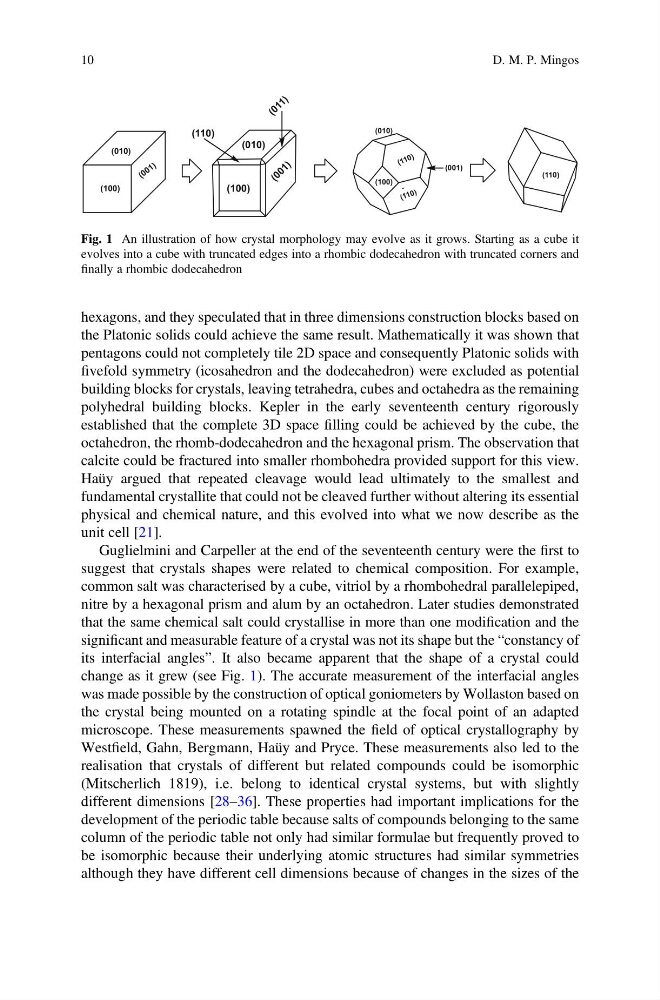
its interfacial angles”. It also became apparent that the shape of a crystal could
change as it grew (see Fig. 1). The accurate measurement of the interfacial angles
was made possible by the construction of optical goniometers by Wollaston based on
the crystal being mounted on a rotating spindle at the focal point of an adapted
microscope. These measurements spawned the field of optical crystallography by
Westfield, Gahn, Bergmann, Haüy and Pryce. These measurements also led to the
realisation that crystals of different but related compounds could be isomorphic
(Mitscherlich 1819), i.e. belong to identical crystal systems, but with slightly
different dimensions [28–36]. These properties had important implications for the
development of the periodic table because salts of compounds belonging to the same
column of the periodic table not only had similar formulae but frequently proved to
be isomorphic because their underlying atomic structures had similar symmetries
although they have different cell dimensions because of changes in the sizes of the
(100)
(100)
(100)
(010)
(010)
(010)
( 0 0 1 )
( 0 0 1 )
(110)
( 0 1 1 )
(1 1 0 )
(1 10 )
-
(001)
(110)
Fig. 1 An illustration of how crystal morphology may evolve as it grows. Starting as a cube it
evolves into a cube with truncated edges into a rhombic dodecahedron with truncated corners and
finally a rhombic dodecahedron
10
D. M. P. Mingos
the Platonic solids could achieve the same result. Mathematically it was shown that
pentagons could not completely tile 2D space and consequently Platonic solids with
fivefold symmetry (icosahedron and the dodecahedron) were excluded as potential
building blocks for crystals, leaving tetrahedra, cubes and octahedra as the remaining
polyhedral building blocks. Kepler in the early seventeenth century rigorously
established that the complete 3D space filling could be achieved by the cube, the
octahedron, the rhomb-dodecahedron and the hexagonal prism. The observation that
calcite could be fractured into smaller rhombohedra provided support for this view.
Haüy argued that repeated cleavage would lead ultimately to the smallest and
fundamental crystallite that could not be cleaved further without altering its essential
physical and chemical nature, and this evolved into what we now describe as the
unit cell [21].
Guglielmini and Carpeller at the end of the seventeenth century were the first to
suggest that crystals shapes were related to chemical composition. For example,
common salt was characterised by a cube, vitriol by a rhombohedral parallelepiped,
nitre by a hexagonal prism and alum by an octahedron. Later studies demonstrated
that the same chemical salt could crystallise in more than one modification and the
significant and measurable feature of a crystal was not its shape but the “constancy of
its interfacial angles”. It also became apparent that the shape of a crystal could
change as it grew (see Fig. 1). The accurate measurement of the interfacial angles
was made possible by the construction of optical goniometers by Wollaston based on
the crystal being mounted on a rotating spindle at the focal point of an adapted
microscope. These measurements spawned the field of optical crystallography by
Westfield, Gahn, Bergmann, Haüy and Pryce. These measurements also led to the
realisation that crystals of different but related compounds could be isomorphic
(Mitscherlich 1819), i.e. belong to identical crystal systems, but with slightly
different dimensions [28–36]. These properties had important implications for the
development of the periodic table because salts of compounds belonging to the same
column of the periodic table not only had similar formulae but frequently proved to
be isomorphic because their underlying atomic structures had similar symmetries
although they have different cell dimensions because of changes in the sizes of the
(100)
(100)
(100)
(010)
(010)
(010)
( 0 0 1 )
( 0 0 1 )
(110)
( 0 1 1 )
(1 1 0 )
(1 10 )
-
(001)
(110)
Fig. 1 An illustration of how crystal morphology may evolve as it grows. Starting as a cube it
evolves into a cube with truncated edges into a rhombic dodecahedron with truncated corners and
finally a rhombic dodecahedron
10
D. M. P. Mingos