

Bravais calculated the unit area of a given lattice plane and showed that it is the
inverse of the rectilinear area of the plane [28–36]. He ordered the lattice planes
according to their decreasing rectilinear densities and developed the hypothesis that
the most important planes of a crystal habit are those with maximum rectilinear
densities. The Bravais law expresses this as “The cleavage planes of a crystal are the
planes with the highest interplanar distances”; although as Fedorov and Friedel
pointed out 50 years later, the order of the most important faces observed does not
always coincide with the identical theoretical order because some faces may be
missing. In modern terms crystal growth is controlled by kinetic as well as thermodynamic factors.
Weiss’ major contribution was the classification of crystals into categories based
on an analysis of the symmetry around the main axes. This regular arrangement
defines what is now described as the crystal lattice. The classification of crystals as
cubic, tetragonal, orthogonal, monoclinic and triclinic based on three axes and three
angles and hexagonal and trigonal based on four axes three of which are separated by
120
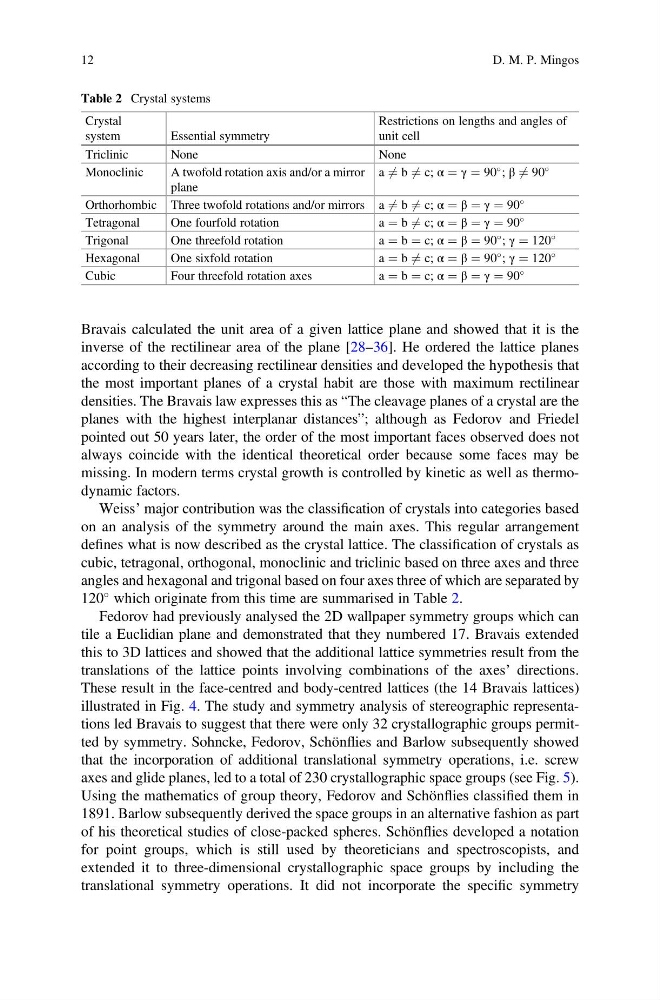
which originate from this time are summarised in Table 2.
Fedorov had previously analysed the 2D wallpaper symmetry groups which can
tile a Euclidian plane and demonstrated that they numbered 17. Bravais extended
this to 3D lattices and showed that the additional lattice symmetries result from the
translations of the lattice points involving combinations of the axes’ directions.
These result in the face-centred and body-centred lattices (the 14 Bravais lattices)
illustrated in Fig. 4. The study and symmetry analysis of stereographic representations led Bravais to suggest that there were only 32 crystallographic groups permitted by symmetry. Sohncke, Fedorov, Schönflies and Barlow subsequently showed
that the incorporation of additional translational symmetry operations, i.e. screw
axes and glide planes, led to a total of 230 crystallographic space groups (see Fig. 5).
Using the mathematics of group theory, Fedorov and Schönflies classified them in
1891. Barlow subsequently derived the space groups in an alternative fashion as part
of his theoretical studies of close-packed spheres. Schönflies developed a notation
for point groups, which is still used by theoreticians and spectroscopists, and
extended it to three-dimensional crystallographic space groups by including the
translational symmetry operations. It did not incorporate the specific symmetry
Table 2 Crystal systems
Crystal
system
Essential symmetry
Restrictions on lengths and angles of
unit cell
Triclinic
None
None
Monoclinic
A twofold rotation axis and/or a mirror
plane
a 6 ¼ b 6 ¼ c; α ¼ γ ¼ 90
; β 6 ¼ 90
Orthorhombic Three twofold rotations and/or mirrors a 6 ¼ b 6 ¼ c; α ¼ β ¼ γ ¼ 90
Tetragonal
One fourfold rotation
a ¼ b 6 ¼ c; α ¼ β ¼ γ ¼ 90
Trigonal
One threefold rotation
a ¼ b ¼ c; α ¼ β ¼ 90
; γ ¼ 120
Hexagonal
One sixfold rotation
a ¼ b 6 ¼ c; α ¼ β ¼ 90
; γ ¼ 120
Cubic
Four threefold rotation axes
a ¼ b ¼ c; α ¼ β ¼ γ ¼ 90
12
D. M. P. Mingos
inverse of the rectilinear area of the plane [28–36]. He ordered the lattice planes
according to their decreasing rectilinear densities and developed the hypothesis that
the most important planes of a crystal habit are those with maximum rectilinear
densities. The Bravais law expresses this as “The cleavage planes of a crystal are the
planes with the highest interplanar distances”; although as Fedorov and Friedel
pointed out 50 years later, the order of the most important faces observed does not
always coincide with the identical theoretical order because some faces may be
missing. In modern terms crystal growth is controlled by kinetic as well as thermodynamic factors.
Weiss’ major contribution was the classification of crystals into categories based
on an analysis of the symmetry around the main axes. This regular arrangement
defines what is now described as the crystal lattice. The classification of crystals as
cubic, tetragonal, orthogonal, monoclinic and triclinic based on three axes and three
angles and hexagonal and trigonal based on four axes three of which are separated by
120
which originate from this time are summarised in Table 2.
Fedorov had previously analysed the 2D wallpaper symmetry groups which can
tile a Euclidian plane and demonstrated that they numbered 17. Bravais extended
this to 3D lattices and showed that the additional lattice symmetries result from the
translations of the lattice points involving combinations of the axes’ directions.
These result in the face-centred and body-centred lattices (the 14 Bravais lattices)
illustrated in Fig. 4. The study and symmetry analysis of stereographic representations led Bravais to suggest that there were only 32 crystallographic groups permitted by symmetry. Sohncke, Fedorov, Schönflies and Barlow subsequently showed
that the incorporation of additional translational symmetry operations, i.e. screw
axes and glide planes, led to a total of 230 crystallographic space groups (see Fig. 5).
Using the mathematics of group theory, Fedorov and Schönflies classified them in
1891. Barlow subsequently derived the space groups in an alternative fashion as part
of his theoretical studies of close-packed spheres. Schönflies developed a notation
for point groups, which is still used by theoreticians and spectroscopists, and
extended it to three-dimensional crystallographic space groups by including the
translational symmetry operations. It did not incorporate the specific symmetry
Table 2 Crystal systems
Crystal
system
Essential symmetry
Restrictions on lengths and angles of
unit cell
Triclinic
None
None
Monoclinic
A twofold rotation axis and/or a mirror
plane
a 6 ¼ b 6 ¼ c; α ¼ γ ¼ 90
; β 6 ¼ 90
Orthorhombic Three twofold rotations and/or mirrors a 6 ¼ b 6 ¼ c; α ¼ β ¼ γ ¼ 90
Tetragonal
One fourfold rotation
a ¼ b 6 ¼ c; α ¼ β ¼ γ ¼ 90
Trigonal
One threefold rotation
a ¼ b ¼ c; α ¼ β ¼ 90
; γ ¼ 120
Hexagonal
One sixfold rotation
a ¼ b 6 ¼ c; α ¼ β ¼ 90
; γ ¼ 120
Cubic
Four threefold rotation axes
a ¼ b ¼ c; α ¼ β ¼ γ ¼ 90
12
D. M. P. Mingos