

previous work had shown that using bis(nitrile)oxalamide as the co-former, the
polymerisation of diiodobutadiyne is enabled at ambient temperature and pressure;
however, it was hindered using pyridine-based oxalamides due to steric effects. In
two papers, the authors were able to demonstrate that by application of pressure, the
polymerisation could be achieved using the sterically hindered pyridine molecules.
The reaction could be observed through a colour change in the solid as pressure was
applied to the system which was then correlated to the reaction occurring in the
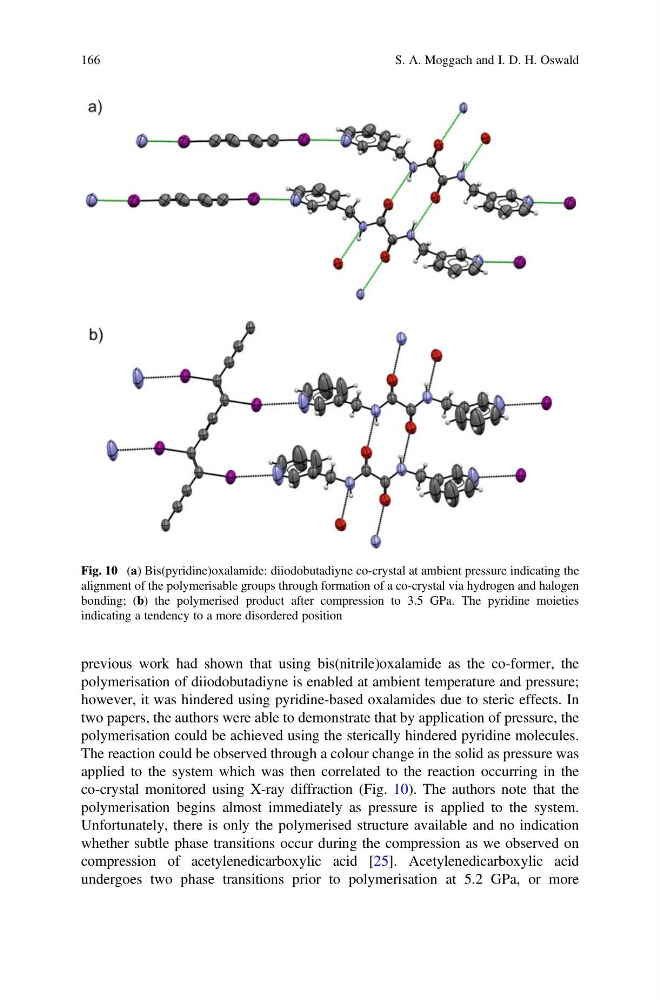
co-crystal monitored using X-ray diffraction (Fig. 10). The authors note that the
polymerisation begins almost immediately as pressure is applied to the system.
Unfortunately, there is only the polymerised structure available and no indication
whether subtle phase transitions occur during the compression as we observed on
compression of acetylenedicarboxylic acid [25]. Acetylenedicarboxylic acid
undergoes two phase transitions prior to polymerisation at 5.2 GPa, or more
Fig. 10 (a) Bis(pyridine)oxalamide: diiodobutadiyne co-crystal at ambient pressure indicating the
alignment of the polymerisable groups through formation of a co-crystal via hydrogen and halogen
bonding; (b) the polymerised product after compression to 3.5 GPa. The pyridine moieties
indicating a tendency to a more disordered position
166
S. A. Moggach and I. D. H. Oswald
polymerisation of diiodobutadiyne is enabled at ambient temperature and pressure;
however, it was hindered using pyridine-based oxalamides due to steric effects. In
two papers, the authors were able to demonstrate that by application of pressure, the
polymerisation could be achieved using the sterically hindered pyridine molecules.
The reaction could be observed through a colour change in the solid as pressure was
applied to the system which was then correlated to the reaction occurring in the
co-crystal monitored using X-ray diffraction (Fig. 10). The authors note that the
polymerisation begins almost immediately as pressure is applied to the system.
Unfortunately, there is only the polymerised structure available and no indication
whether subtle phase transitions occur during the compression as we observed on
compression of acetylenedicarboxylic acid [25]. Acetylenedicarboxylic acid
undergoes two phase transitions prior to polymerisation at 5.2 GPa, or more
Fig. 10 (a) Bis(pyridine)oxalamide: diiodobutadiyne co-crystal at ambient pressure indicating the
alignment of the polymerisable groups through formation of a co-crystal via hydrogen and halogen
bonding; (b) the polymerised product after compression to 3.5 GPa. The pyridine moieties
indicating a tendency to a more disordered position
166
S. A. Moggach and I. D. H. Oswald