

accurately oligomerisation that may have helped to initiate the reaction following the
hypothesis of Kaupp.
The theme of reactivity in halogenated compounds has recently been continued
through the study of a charge-transfer complex, tetraethylammonium diiodine
triiodide salt [96]. The salt was selected from the Cambridge Structural Database
[97] due to the favourable interaction of the iodine groups in the crystal structure.
The authors were able to show that by the use of pressure, the iodine groups, I 2 and
I 3
À , interact to a greater extent so that the salt becomes increasingly conductive as
pressure is applied with a distinct increase in conductivity between 9.4 and 11.1 GPa.
From the crystal structures, the authors were able to extract intermolecular information, thereby elucidating the nature of the bonding between the iodine groups that
they identified as a mixture of ionic and covalent bonds.
3.3 Amino Acids
No chapter on high-pressure crystallography would be complete without mention of
amino acid chemistry. There are a number of excellent reviews on amino acid
chemistry at high pressure provided by Boldyreva [8], Moggach et al. [2] and Freire
[98]; hence, we are going to highlight more recent studies that include those that
have pushed the boundaries of what can be explored using small molecule systems.
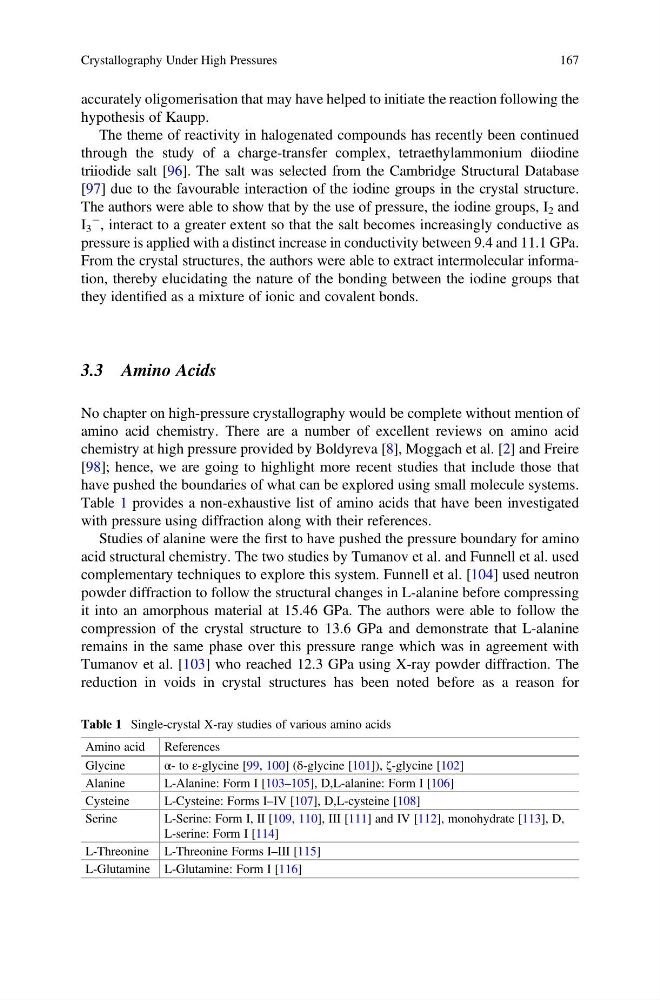
Table 1 provides a non-exhaustive list of amino acids that have been investigated
with pressure using diffraction along with their references.
Studies of alanine were the first to have pushed the pressure boundary for amino
acid structural chemistry. The two studies by Tumanov et al. and Funnell et al. used
complementary techniques to explore this system. Funnell et al. [104] used neutron
powder diffraction to follow the structural changes in L-alanine before compressing
it into an amorphous material at 15.46 GPa. The authors were able to follow the
compression of the crystal structure to 13.6 GPa and demonstrate that L-alanine
remains in the same phase over this pressure range which was in agreement with
Tumanov et al. [103] who reached 12.3 GPa using X-ray powder diffraction. The
reduction in voids in crystal structures has been noted before as a reason for
Table 1 Single-crystal X-ray studies of various amino acids
Amino acid
References
Glycine
α- to ε-glycine [99, 100] (δ-glycine [101]), ζ-glycine [102]
Alanine
L-Alanine: Form I [103–105], D,L-alanine: Form I [106]
Cysteine
L-Cysteine: Forms I–IV [107], D,L-cysteine [108]
Serine
L-Serine: Form I, II [109, 110], III [111] and IV [112], monohydrate [113], D,
L-serine: Form I [114]
L-Threonine L-Threonine Forms I–III [115]
L-Glutamine L-Glutamine: Form I [116]
Crystallography Under High Pressures
167
hypothesis of Kaupp.
The theme of reactivity in halogenated compounds has recently been continued
through the study of a charge-transfer complex, tetraethylammonium diiodine
triiodide salt [96]. The salt was selected from the Cambridge Structural Database
[97] due to the favourable interaction of the iodine groups in the crystal structure.
The authors were able to show that by the use of pressure, the iodine groups, I 2 and
I 3
À , interact to a greater extent so that the salt becomes increasingly conductive as
pressure is applied with a distinct increase in conductivity between 9.4 and 11.1 GPa.
From the crystal structures, the authors were able to extract intermolecular information, thereby elucidating the nature of the bonding between the iodine groups that
they identified as a mixture of ionic and covalent bonds.
3.3 Amino Acids
No chapter on high-pressure crystallography would be complete without mention of
amino acid chemistry. There are a number of excellent reviews on amino acid
chemistry at high pressure provided by Boldyreva [8], Moggach et al. [2] and Freire
[98]; hence, we are going to highlight more recent studies that include those that
have pushed the boundaries of what can be explored using small molecule systems.
Table 1 provides a non-exhaustive list of amino acids that have been investigated
with pressure using diffraction along with their references.
Studies of alanine were the first to have pushed the pressure boundary for amino
acid structural chemistry. The two studies by Tumanov et al. and Funnell et al. used
complementary techniques to explore this system. Funnell et al. [104] used neutron
powder diffraction to follow the structural changes in L-alanine before compressing
it into an amorphous material at 15.46 GPa. The authors were able to follow the
compression of the crystal structure to 13.6 GPa and demonstrate that L-alanine
remains in the same phase over this pressure range which was in agreement with
Tumanov et al. [103] who reached 12.3 GPa using X-ray powder diffraction. The
reduction in voids in crystal structures has been noted before as a reason for
Table 1 Single-crystal X-ray studies of various amino acids
Amino acid
References
Glycine
α- to ε-glycine [99, 100] (δ-glycine [101]), ζ-glycine [102]
Alanine
L-Alanine: Form I [103–105], D,L-alanine: Form I [106]
Cysteine
L-Cysteine: Forms I–IV [107], D,L-cysteine [108]
Serine
L-Serine: Form I, II [109, 110], III [111] and IV [112], monohydrate [113], D,
L-serine: Form I [114]
L-Threonine L-Threonine Forms I–III [115]
L-Glutamine L-Glutamine: Form I [116]
Crystallography Under High Pressures
167