

Cinnamic acids have been a great source of investigation of [2 + 2] cycloadditions
[88, 89]. Whilst these papers investigated the role of irradiation and temperature on
the reactivity of these compounds, the group of Turowska-Tyrk utilised pressure in
addition to UV irradiation to investigate a set of halogenated cinnamic acids
(2,5-difluorocinnamic
acid,
3,5-difluorocinnamic
acid
[90]
and
2,6-difluorocinnamic acid [91]). In each of these structures, the CH. . .F interaction
played a role in aligning the functional groups to enable the [2 + 2] cycloaddition to
occur. They observed that by the application of pressure, the rate of the reaction
increased over those experiments conducted at ambient pressure but in general the
reaction only went to a maximum of 50% completeness. One of the interesting
observations was that in 2,5-difluorocinnamic acid the reaction rate maximised after
0.3 GPa; reactions at 0.9 GPa proceeded at a similar rate. The reactions of
2,6-difluorocinnamic acid only went to 35% completeness at 2.1 GPa after 270 s
of irradiation. At higher pressures the molecules are not as mobile (unless undergoing a phase transition); hence, the reaction is suppressed. This would help to support
this hypothesis of Kaupp who believes the ability of a structure to move is key to
polymerisation rather than a set distance [92]. This is in contrast to the study of 2,4,6tricyano-1,3,5-triazine where shorter intermolecular contacts were identified as the
driver to reaction as opposed to the crystal structure dynamics [93].
In an excellent piece of crystal engineering, the work of Goroff and co-workers
exploited halogen bonding to form a multicomponent crystal form of
diiodobutadiyne with a selection of oxalamides to explore polymerisation using
high pressure [94, 95]. The halogen bonding was used as a tool to direct the
molecules into adopting a geometry where the dyene moieties were in close proximity which may not have been possible using a single component system. Their
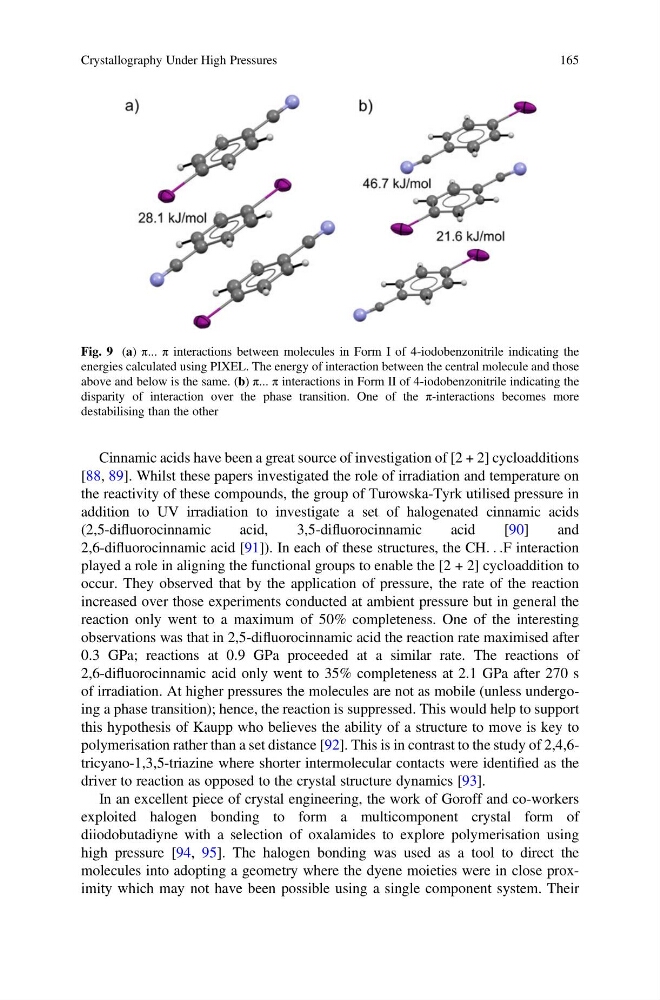
Fig. 9 (a) π... π interactions between molecules in Form I of 4-iodobenzonitrile indicating the
energies calculated using PIXEL. The energy of interaction between the central molecule and those
above and below is the same. (b) π... π interactions in Form II of 4-iodobenzonitrile indicating the
disparity of interaction over the phase transition. One of the π-interactions becomes more
destabilising than the other
Crystallography Under High Pressures
165
[88, 89]. Whilst these papers investigated the role of irradiation and temperature on
the reactivity of these compounds, the group of Turowska-Tyrk utilised pressure in
addition to UV irradiation to investigate a set of halogenated cinnamic acids
(2,5-difluorocinnamic
acid,
3,5-difluorocinnamic
acid
[90]
and
2,6-difluorocinnamic acid [91]). In each of these structures, the CH. . .F interaction
played a role in aligning the functional groups to enable the [2 + 2] cycloaddition to
occur. They observed that by the application of pressure, the rate of the reaction
increased over those experiments conducted at ambient pressure but in general the
reaction only went to a maximum of 50% completeness. One of the interesting
observations was that in 2,5-difluorocinnamic acid the reaction rate maximised after
0.3 GPa; reactions at 0.9 GPa proceeded at a similar rate. The reactions of
2,6-difluorocinnamic acid only went to 35% completeness at 2.1 GPa after 270 s
of irradiation. At higher pressures the molecules are not as mobile (unless undergoing a phase transition); hence, the reaction is suppressed. This would help to support
this hypothesis of Kaupp who believes the ability of a structure to move is key to
polymerisation rather than a set distance [92]. This is in contrast to the study of 2,4,6tricyano-1,3,5-triazine where shorter intermolecular contacts were identified as the
driver to reaction as opposed to the crystal structure dynamics [93].
In an excellent piece of crystal engineering, the work of Goroff and co-workers
exploited halogen bonding to form a multicomponent crystal form of
diiodobutadiyne with a selection of oxalamides to explore polymerisation using
high pressure [94, 95]. The halogen bonding was used as a tool to direct the
molecules into adopting a geometry where the dyene moieties were in close proximity which may not have been possible using a single component system. Their
Fig. 9 (a) π... π interactions between molecules in Form I of 4-iodobenzonitrile indicating the
energies calculated using PIXEL. The energy of interaction between the central molecule and those
above and below is the same. (b) π... π interactions in Form II of 4-iodobenzonitrile indicating the
disparity of interaction over the phase transition. One of the π-interactions becomes more
destabilising than the other
Crystallography Under High Pressures
165